Clear Sky Science · en
Two Rembrandt portraits in focus: assessing a potential relationship
Looking Closely at a Famous Painter
What can a painting reveal when we look beyond its surface? This study turns powerful cameras and scanners on two portraits long linked to Rembrandt, asking whether they once formed a matching pair. By tracing everything from the age of the wood panels to tiny changes in brushwork and later retouching, the authors show how science can help museums understand who painted what, when, and how—knowledge that shapes what we see on gallery walls today.
Two Faces, One Big Question
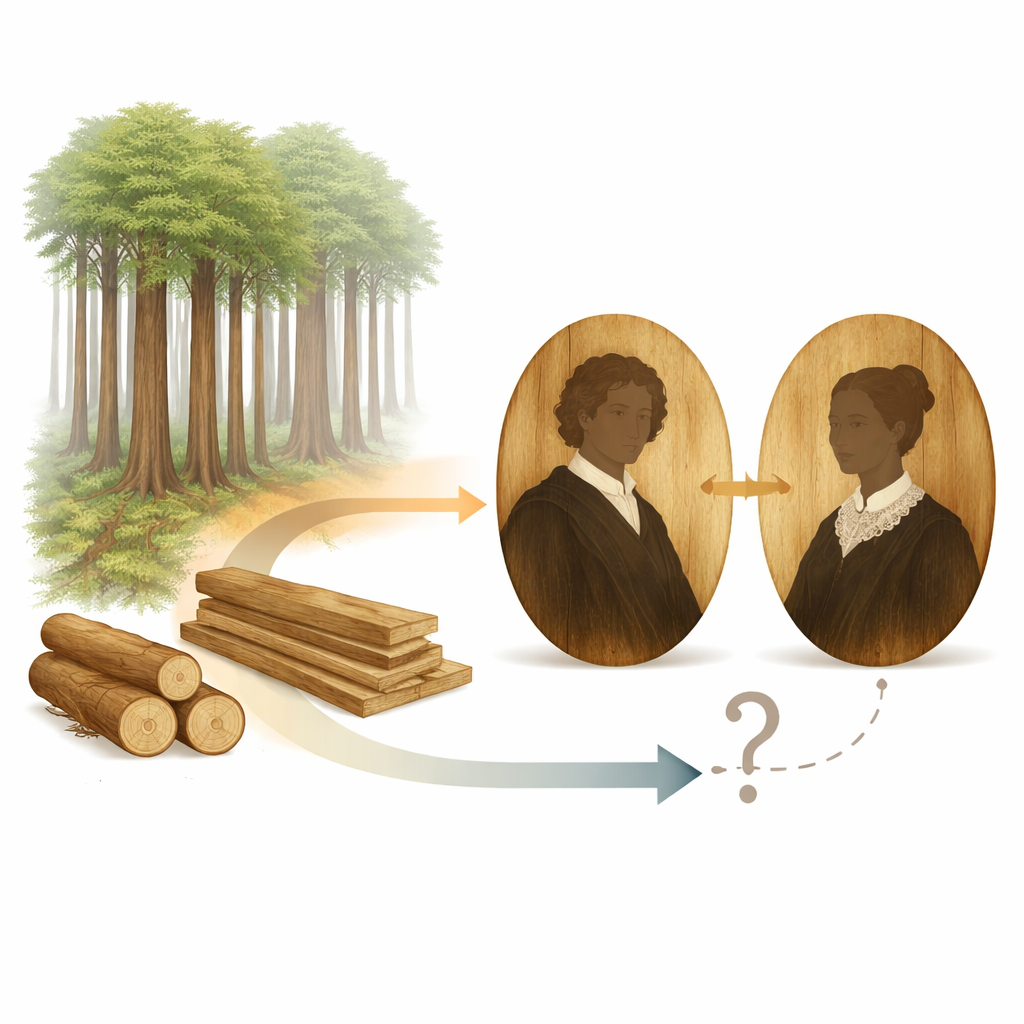
The research focuses on Portrait of a 39-Year-Old Woman in Denmark’s Nivaagaard Collection and Portrait of a Man at The Metropolitan Museum of Art in New York. Both are oval, similar in size, and attributed to Rembrandt around 1632, just after he moved to Amsterdam. The woman is shown with a modest black dress, white collar, and a small prayer book; the man sits calmly in dark clothes with a broad white ruff. Because of their matching format, dates, and early appearance together in an 1801 auction, scholars have long wondered if they were painted as “pendants”—companion portraits meant to hang side by side, most likely as a husband-and-wife pair.
Science Behind the Canvas
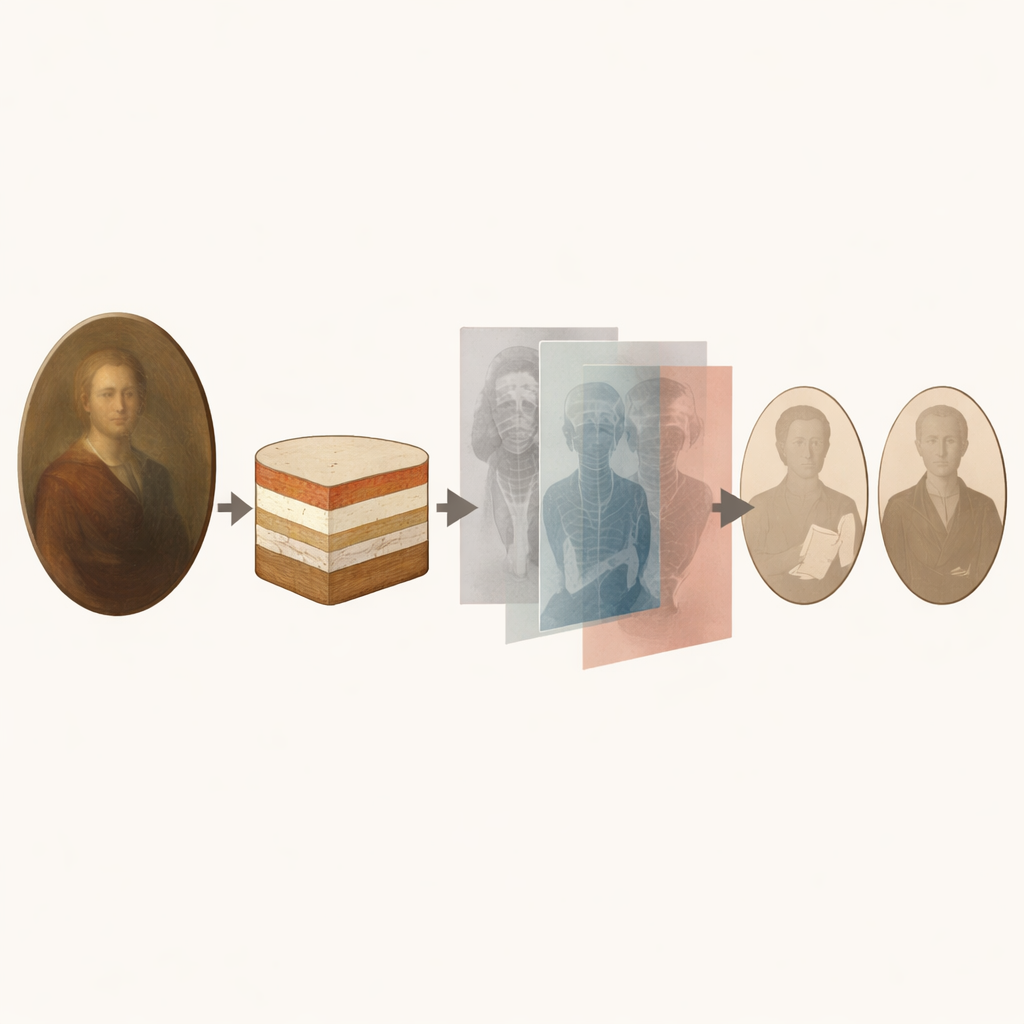
To probe that relationship, the team used a battery of noninvasive techniques, meaning the paintings were not physically sampled. They mapped the distribution of chemical elements in the paints using X-ray fluorescence (XRF), peered through surface layers with X-radiography, and captured images under ultraviolet and infrared light. These methods can reveal how a panel was built, whether the artist changed the composition midstream, which pigments were used where, and what later restorers might have added. They also compared tree-ring patterns in the oak panels, which can date when the trees were felled and hint at common origins in timber supply.
The Woman’s Portrait: A Life of Alterations
The woman’s portrait turned out to have a complicated history. Imaging shows that the original oval panel is intact but was later enlarged with an added wooden rim. Cracks, woodworm channels, and fills are visible in X-rays, along with modern restoration materials in retouched areas. Crucially, the right hand holding the prayer book does not belong to the first design. Its paint mixture, the way it covers earlier outlines, and its cracking pattern all point to a later artist who changed the position of the arm and added the book, probably between about 1650 and 1720. Scientific maps of elements like lead, copper, iron, and mercury reveal where Rembrandt’s own warm flesh tones and dark dress end and the later reworking begins, and show that the collar and the figure’s outline were also adjusted during the original painting process.
The Man’s Portrait: A Cleaner Record
In contrast, the man’s portrait has remained largely untouched. Its oak support retains its original oval shape and bevels, and the paint surface shows only minor retouching along the edges. X-rays and infrared imaging expose small adjustments to his collar and shoulder but no major rethinking of the composition. Element maps confirm a palette in line with 17th-century Dutch practice—lead white, earth colors, black, and vermilion for the flesh. One notable difference from the woman’s portrait is the presence of smalt, a blue glass pigment, in the background and jacket underlayers, likely used to tweak color, transparency, or drying. The handling of light on his translucent collar and the strategic, sparing use of vermilion in his skin give a different feel from the woman’s broader, warmer application.
Shared Roots, Diverging Stories
Some findings support a close link between the portraits. Both are painted on similar three-board oak panels whose tree rings point to felling dates in the same general period and even to wood from the same region, if not the same tree. Their overall dimensions, oval format, and Rembrandt-style signatures from 1632 fit a shared moment in his early Amsterdam career. Yet the scientific evidence also highlights differences: smalt appears only in the man’s portrait; the modeling of skin tones and the use of vermilion diverge; and the woman’s painting has undergone substantial alteration, including the added hand and book. The woman’s signature and age inscription are now so faint that they can be only partly recovered by image processing, making them much harder to compare securely with those on the man’s painting. Taken together, the study does not settle whether the two works were conceived as a pendant pair, but it shows how technical investigation can refine, and sometimes complicate, long-held art historical assumptions. For museum visitors, this means that what appears to be a simple set of matching portraits may in fact be the visible tip of a much richer story about workshop practice, later taste, and the evolving life of paintings over nearly four centuries.
Citation: Centeno, S.A., Pastorelli, G., Perondi, C. et al. Two Rembrandt portraits in focus: assessing a potential relationship. npj Herit. Sci. 14, 167 (2026). https://doi.org/10.1038/s40494-026-02423-9
Keywords: Rembrandt, pendant portraits, heritage science, art conservation, technical imaging