Clear Sky Science · en
A JianDu character restoration method based on cross-domain debiased fourier fusion and parameterized coordinate query
Bringing Faded Bamboo Texts Back to Life
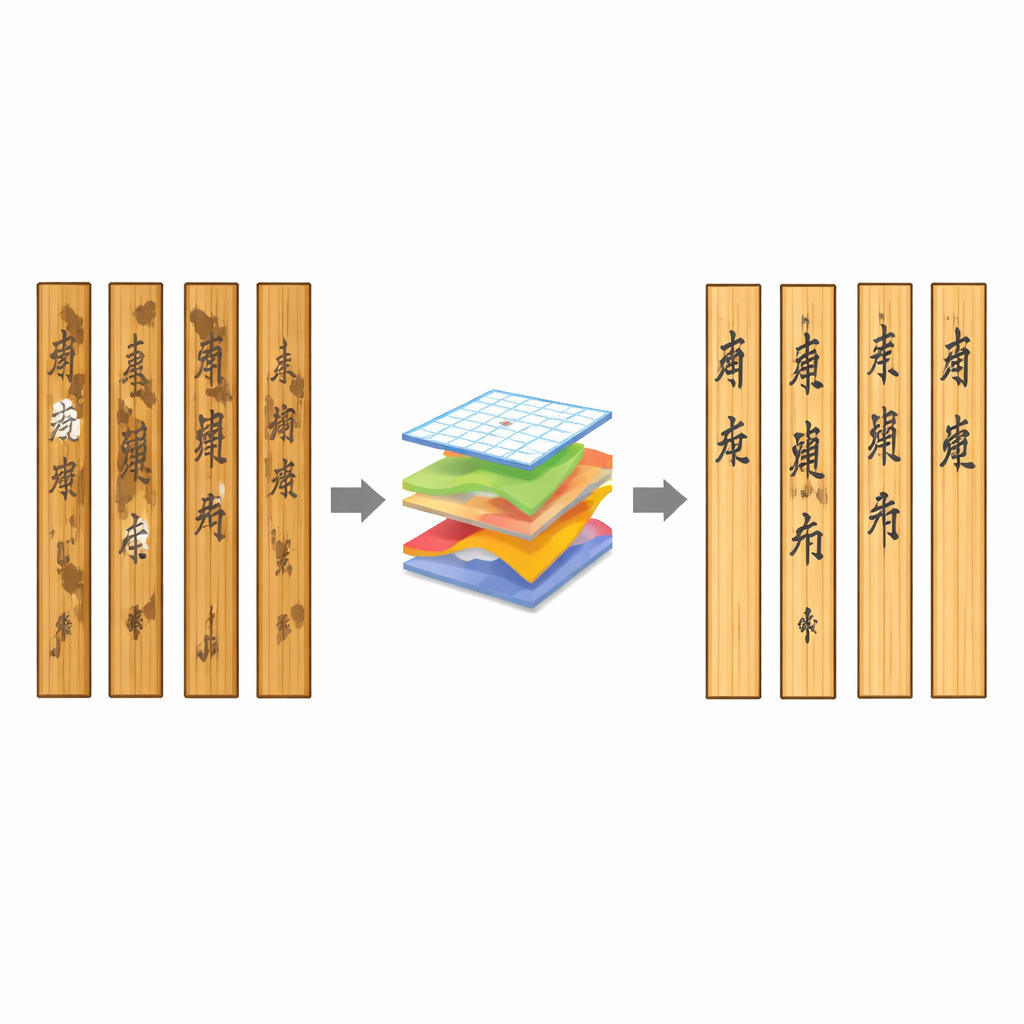
For more than two thousand years, Chinese officials, soldiers, and scholars wrote on thin strips of bamboo and wood. Today, these fragile "jiandu" slips hold priceless clues about politics, trade, and everyday life in ancient China—but the writing is often eaten away by age, mold, and damage. This paper presents a new artificial intelligence (AI) technique that can digitally restore individual characters on these slips, helping historians read texts that are otherwise close to illegible.
Why Old Bamboo Is So Hard to Read
Unlike modern printed pages, bamboo and wooden slips have strongly patterned surfaces crisscrossed by fibers and stains. The ink strokes we care about are thin and faint, while the background texture is bold and irregular. To a computer, the background can look louder than the writing itself. Mold spots smoothly darken parts of the surface, and cracks or missing fragments erase parts of characters entirely. Standard image-repair programs, which work well on ordinary photos, tend to blur these delicate strokes, invent spurious textures, or smear background noise into the areas where the characters should be.
A Focused Way to Rebuild Missing Strokes
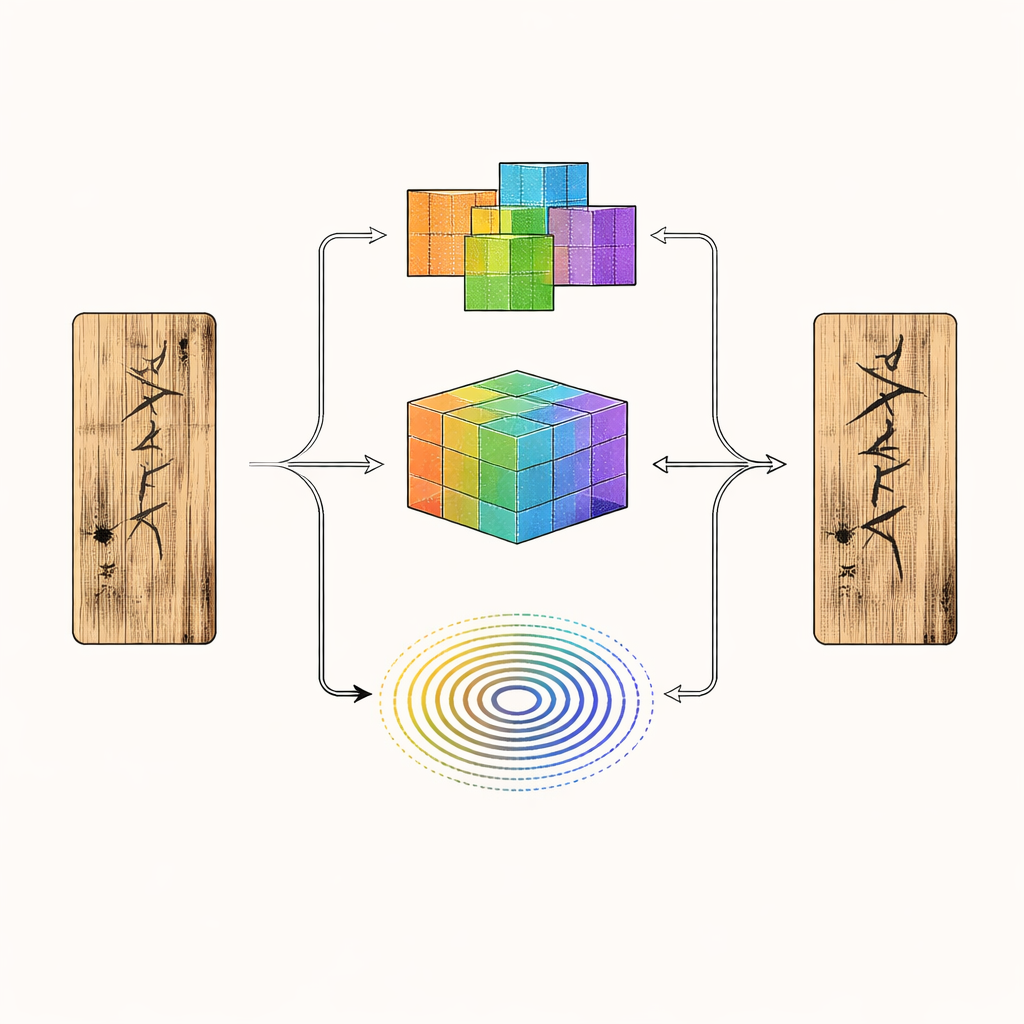
Many restoration methods try to regenerate every pixel in an image, even in regions that are perfectly intact. The authors instead design a system that concentrates its efforts on the damaged zones and their immediate surroundings. First, a "parameter generation" network scans a downsampled version of the damaged slip together with a mask showing where information is missing. It then produces a compact set of instructions—essentially a recipe—that is tailored to the holes and nearby context. A second "pixel query" network uses this recipe together with the exact coordinates of each pixel inside the damaged regions to reconstruct them one by one. Because the network always knows precisely where in the image it is working, it can better preserve fine details such as stroke edges and joins, even at high resolution.
Blending Space and Waves Without Distortion
To understand and repair complex patterns, the method does not rely only on shapes in the image plane. It also analyzes how light and dark variations are distributed across different scales, using the Fourier transform—a mathematical tool that represents the image as a mixture of waves. In jiandu images, low-frequency waves mainly describe the bamboo background, while high frequencies capture the sharp edges of the characters. However, naively applying common neural-network tricks in this wave domain can scramble the spectrum, leading to odd color blocks and background patterns bleeding into strokes. The authors therefore introduce a "debiased" Fourier module that rearranges and re-centers the spectrum, tags each frequency band with a learnable position, and gently normalizes extreme values. At the same time, a spatial–frequency fusion block lets spatial features (local shapes and textures) and frequency features (global patterns and noise statistics) guide one another through a cross-attention mechanism, creating a richer and more stable description of the damaged image.
Putting the Method to the Test
The team assembled a large dataset of over 60,000 single-character images from bamboo and wooden slips spanning several Chinese dynasties, carefully filtered for quality and split into training and test sets. They also used established collections of artificial damage masks to mimic different kinds of loss—small gaps, large missing areas, and random crack-like shapes—as well as a street-view photo dataset to see how well the method generalizes beyond heritage materials. Across a wide range of tests, the new approach more accurately reconstructed missing regions than seven leading inpainting techniques, scoring higher on measures of pixel accuracy, perceived sharpness, and structural similarity. Visual comparisons show cleaner character strokes, fewer mosaic-like artifacts, and less contamination from background textures, even when mold or fiber patterns are severe.
What This Means for Reading the Past
Ultimately, this work offers a specialized digital "conservator" for ancient bamboo and wooden texts. By learning how to separate fragile ink strokes from noisy, decayed backgrounds—and by carefully managing how spatial shapes and wave-like patterns interact—the method can fill in missing parts of characters in a way that looks plausible to human experts and supports automatic character recognition. While it still struggles with very large gaps and some complex writing styles, the approach marks a substantial step toward turning faint, broken traces on ancient slips into readable, analyzable text for historians, linguists, and the broader public.
Citation: Lu, Z., Wang, T., Hu, X. et al. A JianDu character restoration method based on cross-domain debiased fourier fusion and parameterized coordinate query. npj Herit. Sci. 14, 159 (2026). https://doi.org/10.1038/s40494-026-02414-w
Keywords: bamboo slip restoration, ancient Chinese characters, image inpainting, Fourier-based deep learning, digital cultural heritage