Clear Sky Science · en
Research on Song dynasty copper mirror pattern recognition based on MOEAD
Why ancient mirrors meet modern machines
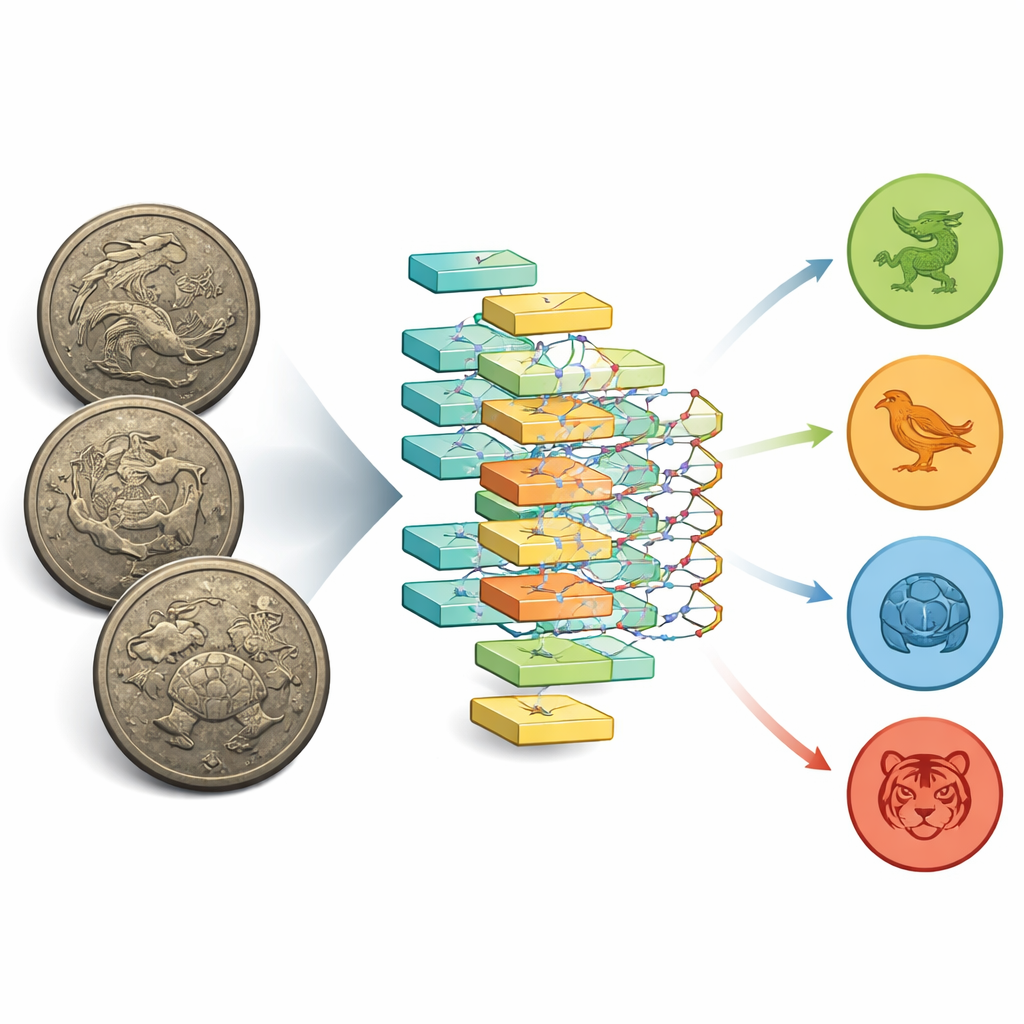
Imagine using your phone’s camera to instantly tell which mythical creatures are etched on a thousand-year-old bronze mirror. This study brings that vision closer to reality. The authors combine advanced image-recognition software with an intelligent optimization strategy to automatically identify animal designs on Song-dynasty bronze mirrors, helping curators, archaeologists, and the public explore cultural treasures more quickly and accurately.
Shining a light on Song-era bronze mirrors
Bronze mirrors were everyday objects in ancient China, but they also carried deep social and spiritual meaning. By the Song dynasty, their backs were decorated with intricate scenes: dragons and phoenixes, cranes and turtles, lions and deer, each charged with symbolism about power, luck, and belief. Large numbers of these mirrors have been excavated, yet identifying their detailed patterns has long depended on expert eyes—an approach that is slow, subjective, and hard to scale. The authors argue that if computers could reliably recognize these motifs, it would support more consistent cataloging, digital preservation, and new kinds of cultural analysis.
Turning motifs into data a computer can read
To teach a computer to “see” these designs, the team first assembled a dedicated image collection of 140 Song-dynasty bronze mirrors featuring 14 types of animals, from dragons and phoenixes to fish, tigers, and mandarin ducks. Each image was carefully labeled by motif and then split into training, validation, and test sets. Because the dataset is small and some animals are rare, the researchers expanded the training material using systematic transformations—cropping, flipping, rotating, changing color and brightness, and even erasing small patches. These variations mimic the way real artifacts might look under different lighting, camera angles, or wear, helping the model learn the essence of each motif rather than memorizing a few pristine examples.
How the smart recognition system works
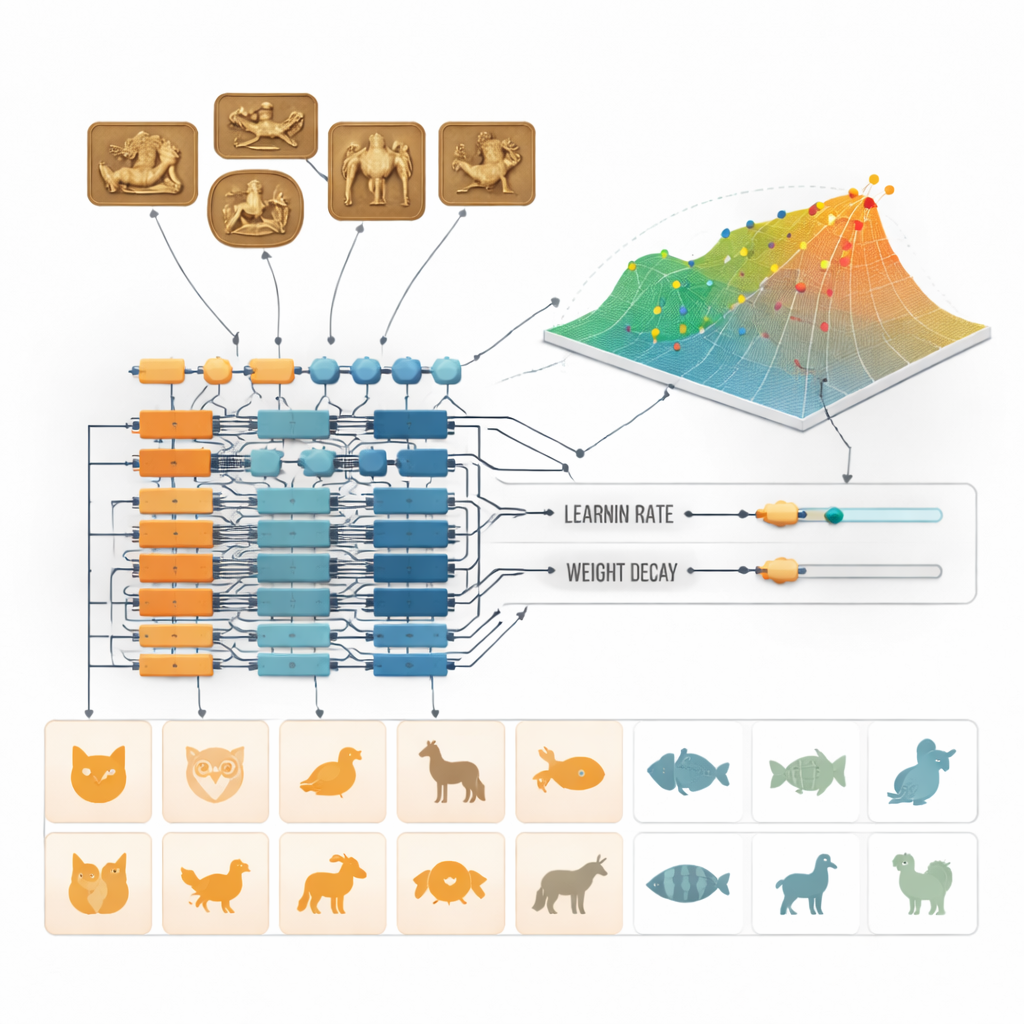
At the heart of the system is a deep-learning model called ResNet50, a kind of digital eye that learns to extract visual patterns from images. Its design includes “shortcut” connections that help information flow through many layers without getting lost, allowing it to capture both fine surface details and higher-level shapes. On top of this, the authors introduce a strategy from evolutionary computing known as MOEA/D. Instead of guessing training settings by hand, they let a virtual population of candidate settings “evolve” over many rounds. Each candidate is judged on several goals at once: keeping prediction errors low, maximizing accuracy across labels, and maintaining stable behavior. Over time, the algorithm converges on combinations of learning speed and regularization strength that give the best trade-off between accuracy and reliability.
Putting the system to the test
The researchers then compared their optimized model with three popular alternatives: VGG16, EfficientNet-B0, and an unoptimized version of ResNet50. All models were trained on the same mirror images and tested on unseen examples. The optimized system stood out. It achieved a Hamming accuracy—a measure of how consistently each label is predicted—of more than 94% on the validation set and over 91% on the test set, outperforming the other networks. It also showed smoother performance across categories, avoiding the pattern where some animals are recognized almost perfectly while others are missed entirely. Additional experiments, including statistical tests and occlusion studies that hide parts of the image, indicated that the gains are not just luck: the model is genuinely focusing on the motif regions and doing so in a repeatable way, even for some of the rarer animals.
What this means for cultural heritage
For non-specialists, the takeaway is straightforward: the study shows that carefully tuned artificial intelligence can reliably spot animals on centuries-old bronze mirrors, with minimal extra computing cost and less dependence on expert judgment alone. While the model still struggles with very rare or visually similar motifs, it already offers a practical tool for museums and researchers to speed up cataloging and support digital archives. As larger image collections become available and the method is refined—possibly with more powerful data generation and explainable visualizations—similar approaches could be extended to other artifacts, from carved stone to painted textiles, making the invisible structure of our material past newly visible to both scholars and the wider public.
Citation: Feng, Q., Yu, K., Li, Y. et al. Research on Song dynasty copper mirror pattern recognition based on MOEAD. npj Herit. Sci. 14, 158 (2026). https://doi.org/10.1038/s40494-026-02413-x
Keywords: Song dynasty bronze mirrors, cultural heritage AI, image pattern recognition, deep learning optimization, artifact motif classification