Clear Sky Science · en
Earliest iron blooms discovered off the Carmel coast revise Mediterranean trade in raw metal ca. 600 BCE
Hidden Iron Treasure Beneath the Waves
Along the coast of today’s Israel, archaeologists have stumbled on a kind of time capsule for one of humanity’s most important technologies: ironmaking. On the seafloor of the Dor Lagoon, they found a cargo of raw iron blocks from around 600 BCE, astonishingly well preserved. These lumps, called blooms, were the first solid product of ancient smelting. Because they were found untouched and still wrapped in their original waste material, they offer a rare, almost laboratory-like glimpse into how iron was made, traded, and controlled across the eastern Mediterranean at the dawn of the Iron Age economy.
From Rock to Working Metal
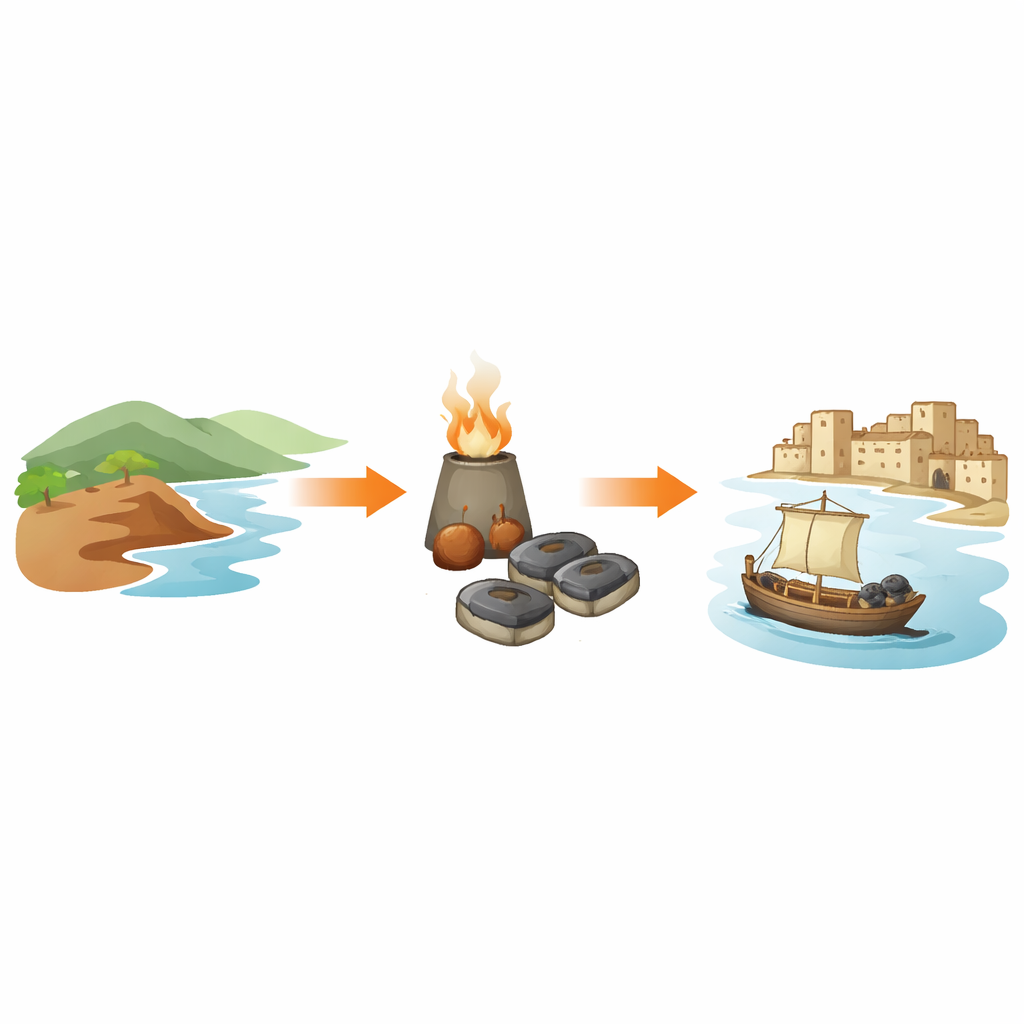
Iron is everywhere in Earth’s crust, but turning rock into useful metal was anything but straightforward for ancient craftspeople. Unlike copper or gold, iron ore does not simply melt and separate when heated. Instead, Iron Age smelters heated ore with charcoal in special furnaces to about 1200 °C. At these temperatures, the ore never became a liquid; it slowly reduced to a spongy, solid mass of iron packed with trapped slag and charcoal. This first lump was the bloom. To turn a bloom into bars and tools, smiths normally hammered it while it was still hot, squeezing out slag and compacting the metal in stages until it became the blades, nails, and fittings that powered ancient farming, warfare, and shipbuilding.
A Shipwreck Full of Raw Iron
Storms and underwater surveys in the Dor Lagoon revealed nine heavy, sub-rectangular iron masses lying with pottery jars, a composite lead-and-wood anchor, and ballast stones at just a few meters’ depth. Each bloom weighed between 5 and 10 kilograms, about the size of a small loaf of bread but much denser. Pottery styles and earlier radiocarbon dates already suggested the cargo was from the late 7th to early 6th centuries BCE, a time of shifting power between Assyria, Egypt, and Babylonia. To be sure, the team sampled a tiny charred twig trapped inside one bloom—likely a piece of fuel from the furnace—and dated it along with grape seeds and wine resin from the jars. Using advanced statistical modeling, they showed the ship’s final voyage most likely occurred before 540 BCE, firmly in the Iron Age rather than the later Persian period.
Peering Inside an Ancient Iron Block
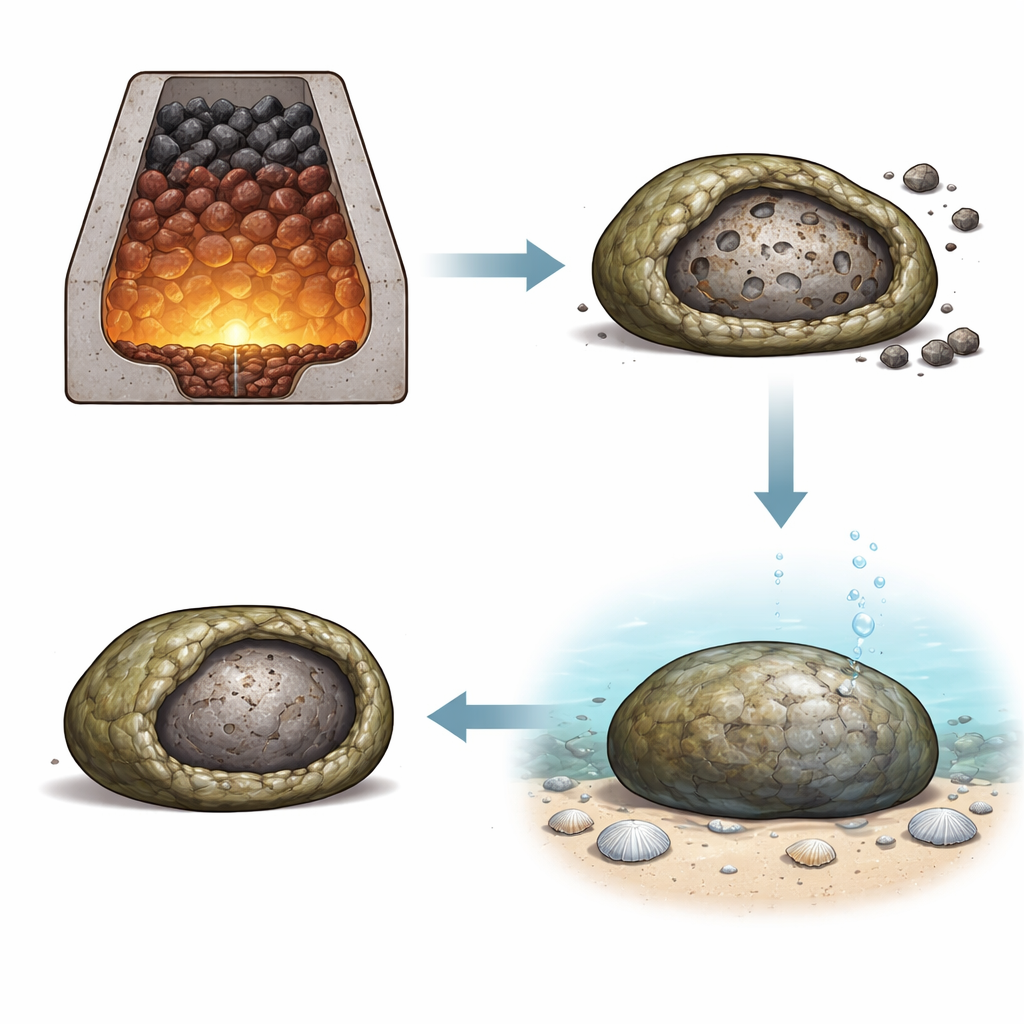
To understand what these masses really were, researchers cut one bloom and examined it with microscopes and high-precision chemical tools. Under the encrusted outer surface they found a continuous glassy slag shell, still clinging to the metal after more than 2600 years underwater. Inside lay relatively pure, low‑carbon iron with a characteristic ferrite–pearlite texture, dotted with pores and slag inclusions. Crucially, the pores and inclusions showed no sign of being squeezed or deformed—evidence that the bloom had never been forged after smelting. The slag layer on the surface closely matched slag trapped inside, confirming it formed in the furnace, not on the seafloor. This slag “jacket” acted like a natural rust shield, explaining why so much original metal survived despite long immersion in seawater.
Rethinking Where the Work Was Done
These untouched blooms overturn long‑held assumptions about Iron Age metalworking. Scholars had believed ancient smiths always rushed to hammer blooms while they were still hot, turning them into bars or tools near the smelting sites. That practice would leave almost no complete blooms in the archaeological record—and until now, early examples were indeed vanishingly rare. The Dor finds show another strategy: smelt iron in rural or remote areas, leave the blooms wrapped in their protective slag, and ship them by sea as raw industrial feedstock to busy ports like Dor. There, urban workshops specialized in the next steps—refining, adding carbon to create steel, and shaping tools—leaving behind only light waste such as thin hammer scales and modest slag heaps. This pattern helps explain why many cities show evidence of ironworking debris but not the heavy waste typical of full-scale smelting.
Iron, Empires, and Sea Routes
Viewed in their wider setting, the Dor blooms illuminate a changing Mediterranean world. The cargo probably traveled within Phoenician-run trade networks that linked the Levant with Cyprus, the Aegean, and Egypt during a period of intense maritime exchange. Instead of shipping only finished implements or neatly forged bars, merchants were moving raw iron itself, keeping the most skilled work—and the know-how to make high-quality steel—concentrated in select urban workshops. Control over these raw materials and specialized crafts would have given coastal cities and their elites economic and political leverage. In short, a pile of rough, slag-covered blocks from a modest shipwreck reveals the earliest clear evidence that raw iron was a traded commodity in its own right, reshaping our picture of how technology, trade, and power were intertwined at the close of the Iron Age.
What This Means Today
For non-specialists, the Dor Lagoon discovery shows how a single cargo can rewrite a chapter of technological history. These blooms confirm that ancient people were not only skilled metalworkers but also savvy logisticians, using slag as a built-in protective jacket to ship half-finished iron safely across the sea. They demonstrate that the heavy, dirty work of smelting could be separated from the more controlled craft of smithing in cities, where tools and weapons were finally made. In doing so, the study transforms unremarkable-looking lumps of metal into key witnesses of how early societies organized industry, managed resources, and built far-reaching economic networks long before modern factories and container ships existed.
Citation: Eshel, T., Ioffe, A., Langgut, D. et al. Earliest iron blooms discovered off the Carmel coast revise Mediterranean trade in raw metal ca. 600 BCE. npj Herit. Sci. 14, 155 (2026). https://doi.org/10.1038/s40494-026-02409-7
Keywords: Iron Age metallurgy, Mediterranean trade, iron blooms, Dor Lagoon, ancient shipwrecks