Clear Sky Science · en
Damage risk prediction of wall paintings with clay and earthen plaster substrates during drying
Why old temple paintings care about indoor air
In museums and historic temples, even small changes in indoor humidity can slowly crack treasured wall paintings. This study focuses on famous Buddhist murals from Horyu-ji Temple in Japan and asks a practical question: how quickly, and by how much, can the air around these fragile works be dried without causing new damage? By building a detailed computer model of the paintings’ layered clay and plaster backing, the authors explore safer ways to control humidity while avoiding unnecessary energy use.
Ancient art made of breathing earth
The Horyu-ji wall paintings are mounted on panels made of several stacked layers: a middle and upper coat of earthen plaster, a white clay layer that helps the paint adhere, and the thin pigment layer itself. These materials are porous and behave a bit like a sponge—they swell as they take up moisture and shrink as they dry. Because each layer responds differently, changes in air humidity can create internal strains and stresses that may eventually crack the surface. Some of the original panels already show vertical cracks, especially near their centers, raising concern that future humidity shifts could worsen the damage.
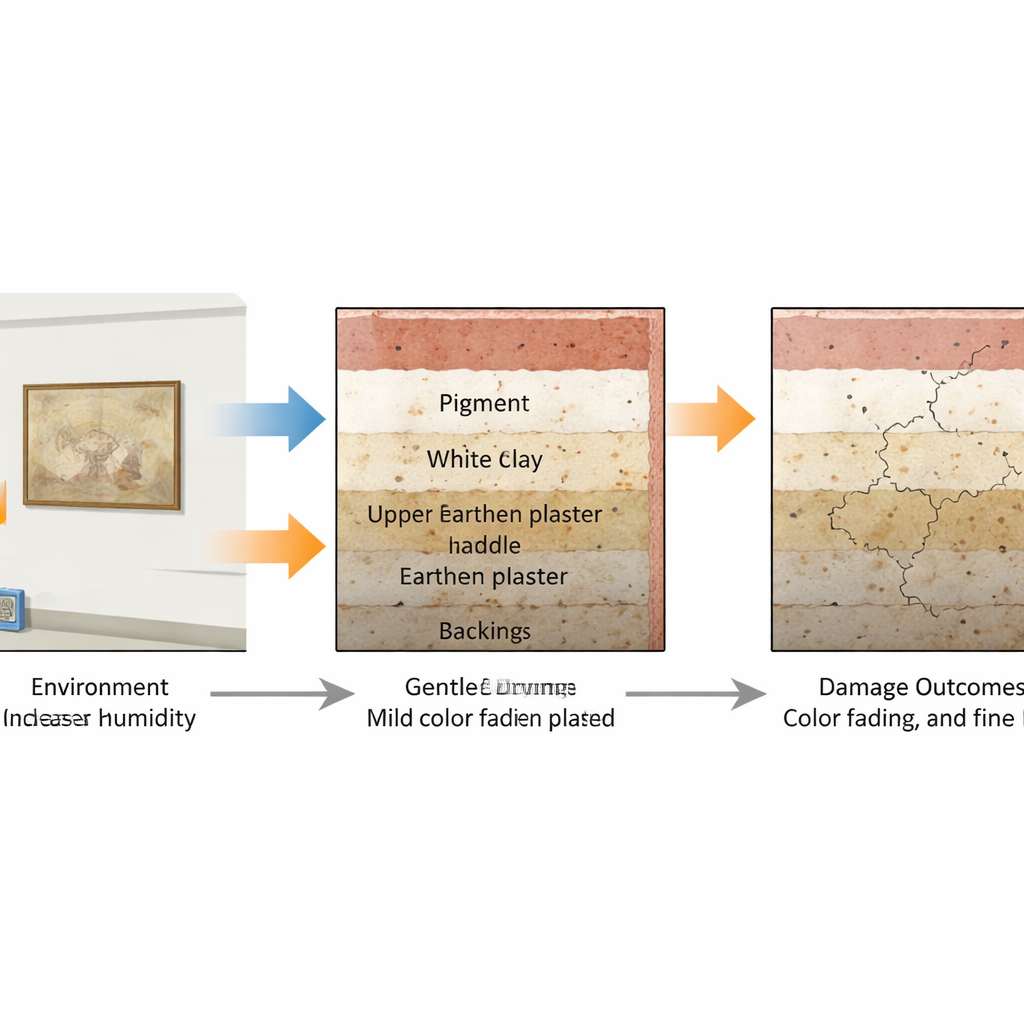
A virtual twin of a fragile painting
To probe this problem without experimenting on the originals, the researchers built a numerical “virtual twin” of a typical panel. They represented the wall painting in cross-section and combined two advanced types of models: one that tracks how heat and moisture move through porous materials over time, and another that links changes in moisture to mechanical stress and strain inside those materials. Using data from carefully prepared mock-up samples of the white clay and plaster, they fed the model with realistic material properties, such as stiffness, strength, porosity, and how these properties change with humidity and composition. The model outputs a damage risk degree, a number between zero and one that compares the predicted tensile stress to the material’s tensile strength.
Where and when cracks are most likely
Simulations showed that during drying, the highest tensile stresses develop near the front surface of the white clay layer, especially around the center of the painting. As the air around the painting dries, the near-surface region loses moisture and starts to shrink first, while the still-moist interior resists this movement. That restraint concentrates tension close to the surface. The team also explored how the exact recipe of the white clay—its mix of pottery clay, plant fibers, and rice flour—affects vulnerability. Across many combinations, they identified a specific mixture with relatively high fiber and rice content that produced the greatest damage risk, and they used this “worst-case” composition to avoid underestimating possible harm to the real paintings.
How much drying is too much, and how fast?
The authors then tested different humidity scenarios. They compared abrupt drops in relative humidity over one second with slower, gradual changes lasting up to six hours. Even a very large sudden change—from 90 percent to 10 percent relative humidity—did not push the simulated damage risk above the crack-starting threshold in their non‑aged materials. However, the model likely underestimates the true risk for the centuries-old originals, which may already be weakened by past damage and long-term aging. More reliably, the model serves as a tool for comparing conditions. It showed that for a moderate humidity drop from 70 to 50 percent, spreading the change over six hours produced a lower damage risk than a small, rapid drop from 70 to 65 percent that current museum guidelines consider harmless for most objects.
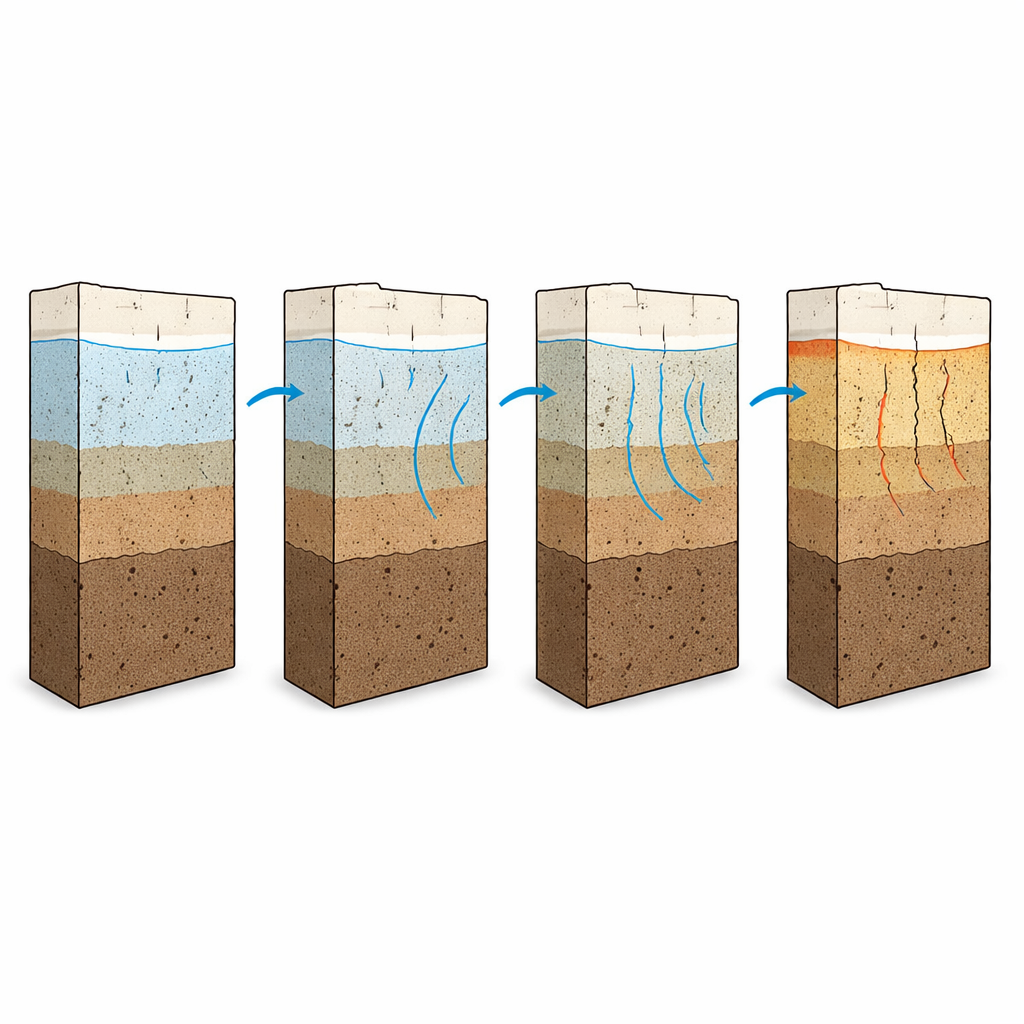
Gentle changes keep history safer
For non-specialists, the main message is simple: wall paintings made of layered clay and earthen plaster are especially sensitive to how quickly the surrounding air dries, not just to the final humidity level. Slow, controlled drying lets moisture and stress even out within the layers, reducing the chance of new cracks. While more work is needed to account for aging and existing damage in the real Horyu-ji paintings, this modeling approach gives conservators a science-based way to compare environmental strategies and choose humidity settings that both protect priceless art and limit energy-hungry climate control.
Citation: Ishikawa, K., Ogura, D., Iba, C. et al. Damage risk prediction of wall paintings with clay and earthen plaster substrates during drying. npj Herit. Sci. 14, 156 (2026). https://doi.org/10.1038/s40494-026-02408-8
Keywords: wall painting conservation, humidity control, cultural heritage, earthen plaster, numerical modeling