Clear Sky Science · en
Physically interpretable unsupervised thermographic clustering for structural alteration diagnostics in ancient jade artifacts
Why Hidden Changes in Jade Matter
Ancient Chinese jade objects are celebrated for their beauty and symbolism, but beneath their glossy surfaces they can be quietly falling apart. Centuries of burial and exposure to moisture and minerals leave behind subtle layers of damage that the human eye cannot see. This study introduces a new, non-invasive way to "X-ray" these treasured artifacts with heat instead of harmful radiation, helping conservators spot weak spots, understand how the objects have aged, and even glimpse traces of how they were once used or handled.
Seeing Below the Surface with Gentle Heat
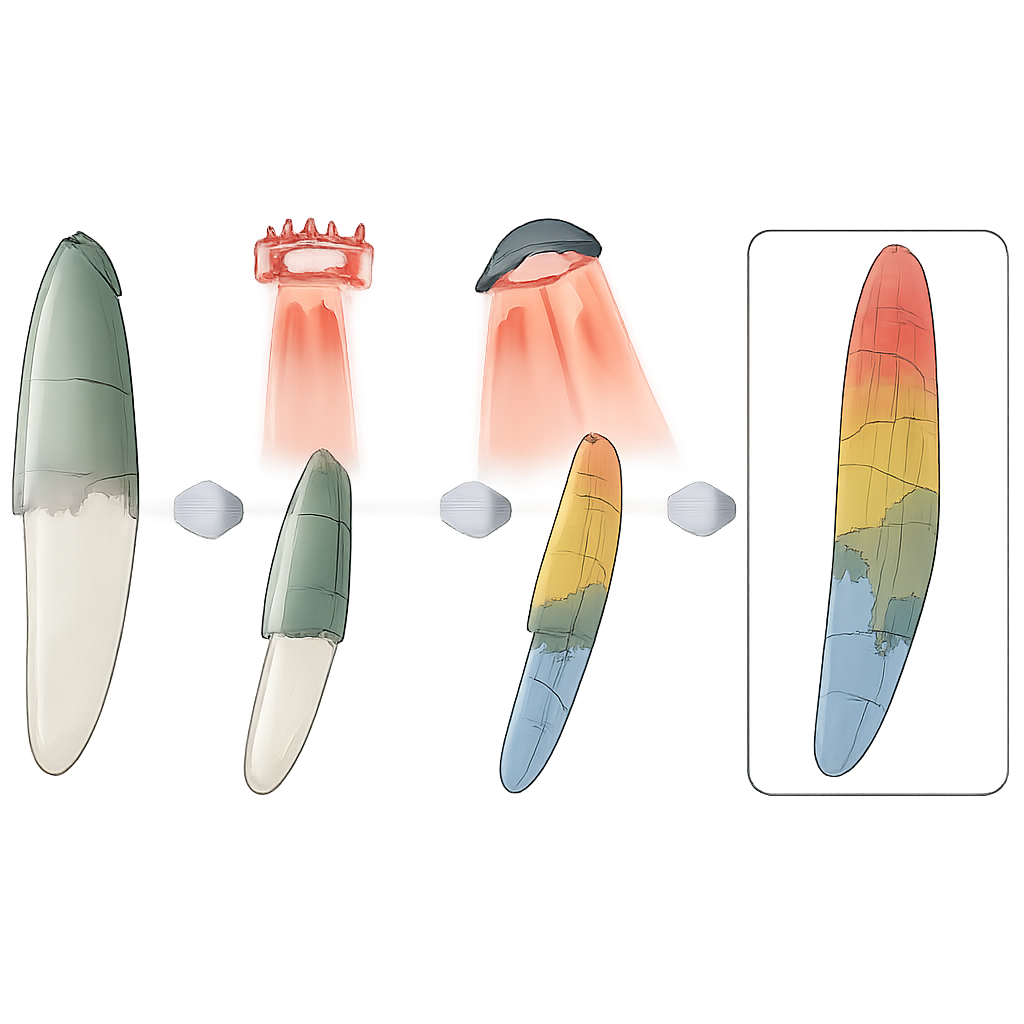
The researchers focus on a Shang-dynasty jade dagger that shows flaking, chalky white patches, and dark streaks, all signs of long-term weathering. Traditional tools—like optical microscopes, X-ray scans, and laser-based chemical tests—each reveal only part of the story, often missing thin altered layers just beneath the surface. The team instead turns to infrared thermography, which looks at how an object warms up and cools down when gently heated. Because heat moves differently through dense, intact jade than through porous, weathered material, the dagger’s internal structure can be read from its changing temperature patterns.
Two Ways of Heating, One Smarter Way of Grouping
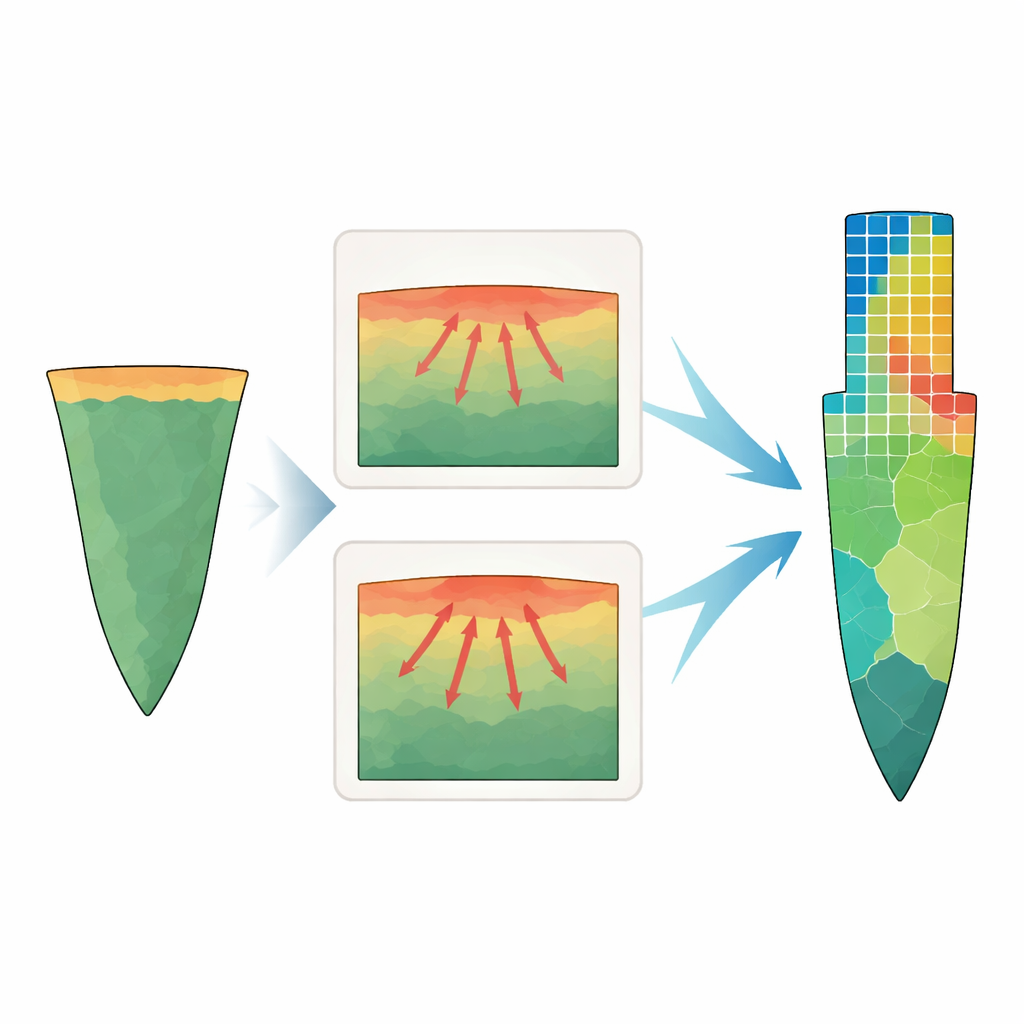
To tease out surface and deeper changes, the authors combine two heating methods. In pulsed thermography, the dagger is hit with a quick burst of light, making it ideal for sensing very shallow layers. Long-pulsed thermography shines light for several seconds, allowing heat to travel further inside and highlight deeper defects. The resulting temperature movies are then converted into simplified curves that describe how heat spreads over time. Crucially, instead of squeezing these curves into a few summary numbers—which can erase important detail—the team feeds the full, rich curves for every image pixel into a type of artificial neural network called a Self-Organizing Map. This network groups pixels with similar thermal behavior into clusters, in effect drawing a map of different internal conditions across the dagger.
Testing the Method Before Touching History
Before applying their approach to the real artifact, the researchers build a reference sample: a metal plate with layers of tape on one side and holes of different depths on the other. This mock-up mimics a layered object with hidden flaws. They compare three common unsupervised analysis methods: a standard combination of principal component analysis with K-means clustering, a more advanced pairing of an autoencoder with a Gaussian mixture model, and the Self-Organizing Map. Only the Self-Organizing Map consistently recovers the known layered structure on the front and correctly picks out the deepest holes on the back. The other methods either blur together different layers or overreact to minor experimental noise, suggesting they are less trustworthy for delicate heritage work where no destructive check is allowed.
Revealing Weathering and Hidden Traces on the Jade Dagger
When the new workflow is turned on the Shang jade dagger, it uncovers a rich patchwork of hidden variation. On one side, the pulsed data split the surface into a more translucent half and a heavily whitened half, matching what can be seen by eye. But the long-pulse data show that part of this contrast is only skin-deep, shrinking the area that appears truly altered at depth. A crack-like feature that appears sharply in the pulsed results fades in the long-pulse view, marking it as a shallow flaw. On the other side, both heating methods agree on a distinct region near one corner that has no visible mark, pointing to a buried zone of different composition. Another striking pattern is a vertical band near the handle end that appears on both sides in the thermal maps but not in visible light—likely the faint imprint of an ancient binding or handle, preserved as subtle surface or near-surface alteration.
What This Means for Protecting the Past
In plain terms, the study shows how carefully controlled heating and smart pattern-finding can turn a jade blade into a kind of thermal landscape, where regions of different strength and history stand out in color-coded patches. The method separates superficial discoloration from deeper structural decay, highlights the most fragile areas, and even hints at how the dagger was once mounted or used, all without removing material or causing damage. Because the approach is based on basic heat flow and works with limited data, it can be adapted to many mineral-based artifacts beyond jade. This gives museums and conservators a new, physically grounded tool for diagnosing hidden damage and making more informed decisions about how to preserve irreplaceable objects.
Citation: Tang, H., Yang, X., Lian, J. et al. Physically interpretable unsupervised thermographic clustering for structural alteration diagnostics in ancient jade artifacts. npj Herit. Sci. 14, 148 (2026). https://doi.org/10.1038/s40494-026-02406-w
Keywords: jade artifacts, infrared thermography, cultural heritage conservation, unsupervised clustering, self-organizing maps