Clear Sky Science · en
A computational framework for evaluating an edge-integrated, multi-ramp construction model of the Great Pyramid of Giza
A Fresh Look at How the Great Pyramid Was Built
For more than 4500 years, people have wondered how ancient Egyptians raised millions of stone blocks to create the Great Pyramid of Giza within a single king’s lifetime. This study uses modern computer simulations, engineering, and structural analysis to test one specific idea: that the builders carved a temporary spiral ramp into the pyramid’s outer edges, then later filled it in so that hardly any trace remains today. The work aims to see whether such a method could really move blocks fast enough, stay structurally safe, and match what we now know from modern scans of the monument.
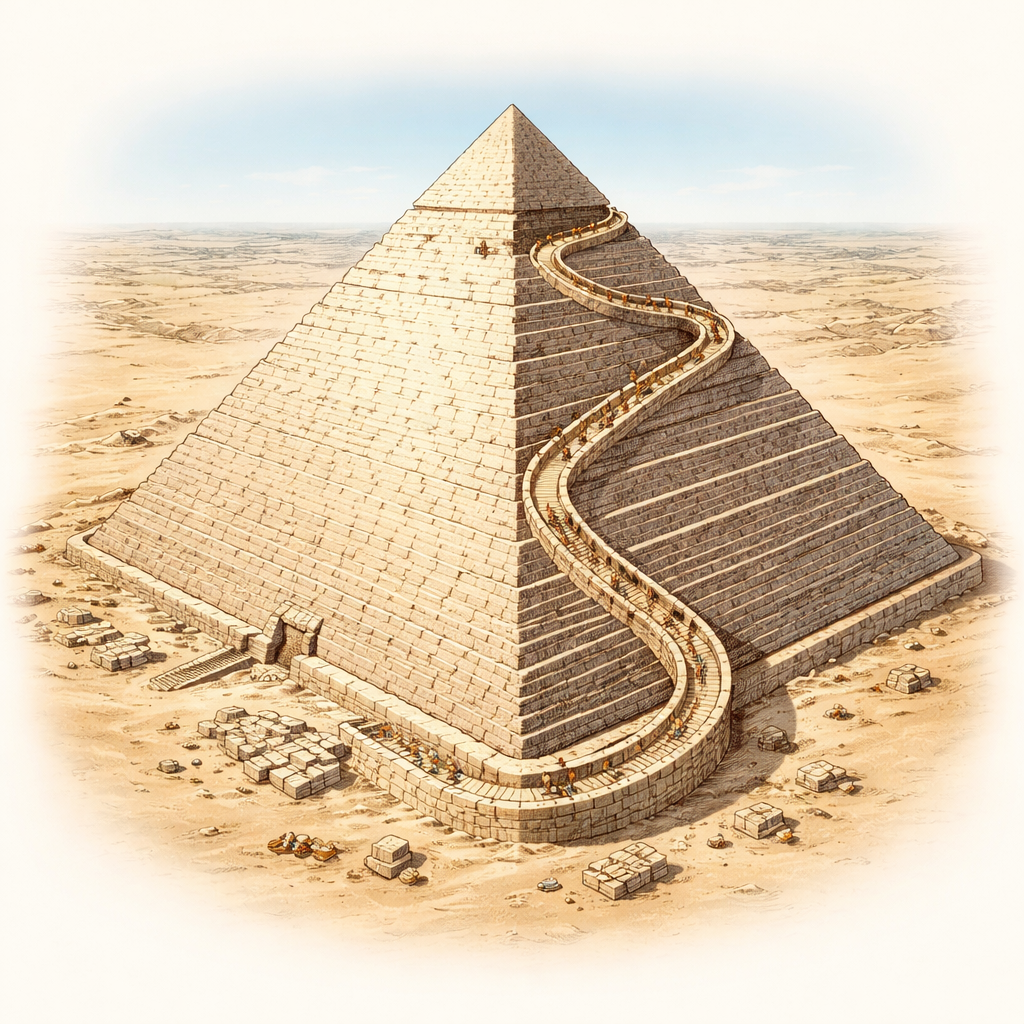
A Hidden Spiral Roadway in the Pyramid’s Skin
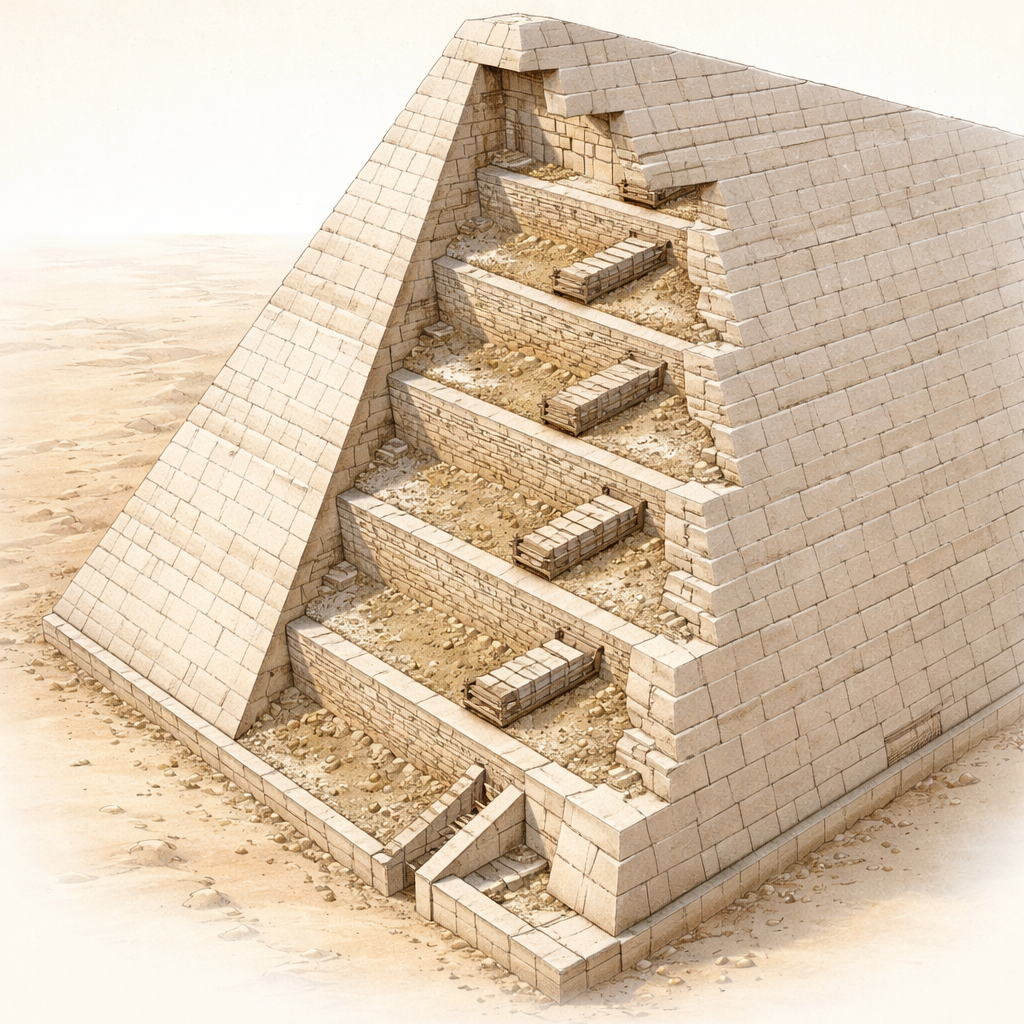
The paper focuses on an “Integrated Edge-Ramp” model. Instead of building a huge earth ramp outside the pyramid, workers would leave out narrow bands of blocks along the edges, creating open-air corridors that spiral gently upward. These lanes, about four meters wide and sloped at roughly seven degrees, would allow teams pulling sledges to haul limestone blocks up from the base to the working levels. As construction climbed higher, the ramp would climb with it. When the pyramid was nearly complete, the empty edge lanes would be backfilled from the top down with normal masonry, restoring the smooth exterior and leaving almost no visible footprint on the surrounding plateau.
Building Fast Enough for Khufu’s Reign
A key question is speed. Historical records suggest the pyramid had to be finished within about 20–27 years, roughly the reign of Pharaoh Khufu. That implies placing a block every few minutes, day after day, for decades. The author builds a detailed computer pipeline that generates the 3D geometry of each construction stage, calculates how far each block must travel on ramps and terraces, and then runs a queuing-style logistics simulation to model traffic on the ramps. By letting multiple edge ramps operate at once—up to 16 short straight ramps near the base, then four spiraling ramps, later tapering to two and finally one—the model can keep blocks moving every 4–6 minutes per lane. The simulations suggest on-site construction could reasonably take about 14–21 working years, and when time for quarrying, river transport and seasonal pauses is added, the total fits the 20–27‑year window.
Safe Stone, Heavy Loads, and Modern Scans
Any construction path carved into the edges of the pyramid raises another issue: would it weaken the structure? To check this, the study runs three-dimensional finite element analyses, a standard engineering tool for calculating stresses and deformations inside large structures. Using conservative properties for Old Kingdom limestone and a step-by-step build sequence, the results show that the temporary edge corridors keep stresses far below the rock’s crushing strength, with only small, localized stress increases near the ramp zones. The model also separates routine limestone hauling from the rare task of moving 50–80 ton granite beams for the King’s Chamber, suggesting these megaliths could be inched upward on short, shallow internal slips with ropes wrapped around anchored wooden posts—challenging but not rate‑limiting for the overall schedule.
Matching Subtle Clues Inside the Pyramid
The edge-ramp idea is also compared with recent high-tech surveys. Muon imaging and electrical scans have revealed hidden cavities, notches, and a “North Face Corridor” inside Khufu’s pyramid. Without adjusting its parameters to chase the data, the model’s predicted ramp path happens to pass near several of these anomalies at the right heights and depths, especially along the north face. It also lines up statistically with certain bands where the thickness of the stone courses suddenly changes, as if builders stiffened or re-levelled the structure after turning the ramp around corners. These overlaps are not proof, but they show that an edge‑integrated ramp is geometrically compatible with modern measurements and suggest specific places where further scans and endoscopic probes could look for tell‑tale backfilled channels or corner wear.
Why This Matters for Understanding Ancient Engineering
In the end, the study does not claim to have the final word on how the Great Pyramid was built. Instead, it demonstrates that a carefully designed edge‑integrated ramp system is both mechanically and logistically plausible within Khufu’s lifetime and Old Kingdom technology. It avoids the enormous earthworks that should have left obvious archaeological traces, keeps the pyramid’s corners visible for precise surveying, and offers clear, testable predictions about subtle internal density patterns and stone damage. Perhaps most importantly, the research showcases a reusable computational framework that can test other construction ideas for Khufu’s pyramid and for ancient mega‑structures worldwide, turning age‑old architectural mysteries into quantitative, falsifiable scientific questions.
Citation: Rosell Roig, V.L. A computational framework for evaluating an edge-integrated, multi-ramp construction model of the Great Pyramid of Giza. npj Herit. Sci. 14, 142 (2026). https://doi.org/10.1038/s40494-026-02405-x
Keywords: Great Pyramid construction, edge-integrated ramp, ancient Egyptian engineering, construction logistics, muon imaging