Clear Sky Science · en
Research on batik image pattern detection based on improved YOLOv11
Ancient Cloth Meets Modern Code
Batik cloth from China’s Miao communities is more than decoration: its butterflies, dragons, birds, and flowers quietly record history, beliefs, and daily life in the absence of a written script. Yet as these textiles age and younger generations move away from traditional crafts, vital cultural information risks being lost in piles of unlabelled photos and fading fabrics. This study shows how advanced image-recognition software can automatically find and identify tiny, overlapping motifs in complex batik images, offering a new way to preserve and explore this living art form at scale.

Why These Patterns Matter
Chinese batik is a hand-dyeing technique that has flourished for more than two millennia, especially among the Miao people in Guizhou Province. Because this community historically lacked a written language, batik motifs became a visual archive of myths, rituals, aesthetics, and social customs. Scholars have begun to digitize and analyze these patterns using tools from mathematics, design, and artificial intelligence. Previous work could classify isolated motifs fairly well, but it typically required cutting them out of their original cloth, severing the ties between each symbol and the larger composition. This made it difficult to understand how motifs interact on a garment or textile to convey layered meanings.
From Simple Labels to Smart Detection
The authors argue that what is needed is not just classification but full object detection: locating every motif in a complete photograph and naming its type. That is a tough problem in real batik images, where designs are crowded together, vary greatly in size, and are often faded, cracked, or partially hidden. Standard detection systems, including earlier versions of the popular YOLO (“You Only Look Once”) family of algorithms, struggled with these conditions. They tended to miss very small symbols, become confused by intricate backgrounds, or falter when lighting and image quality were uneven—exactly the kind of images curators and field researchers most often collect.
Teaching a Neural Network to Read Cloth
To tackle these challenges, the team first created what is now the largest Chinese batik detection dataset: 861 high-resolution images annotated with 9933 bounding boxes across seven motif categories (butterfly, fish, dragon, bird, drum, flower, and fruit). They carefully balanced image size and quality, and expanded the limited data by applying controlled blurring, color changes, flips, mosaics, and other transformations so the model would not simply memorize the training samples. On top of this dataset, they built an enhanced version of YOLOv11, a cutting-edge object detection framework chosen for its speed and compact size—important traits if the tool is to run on everyday computers in museums and cultural centers.
Looking Farther and Seeing More Clearly
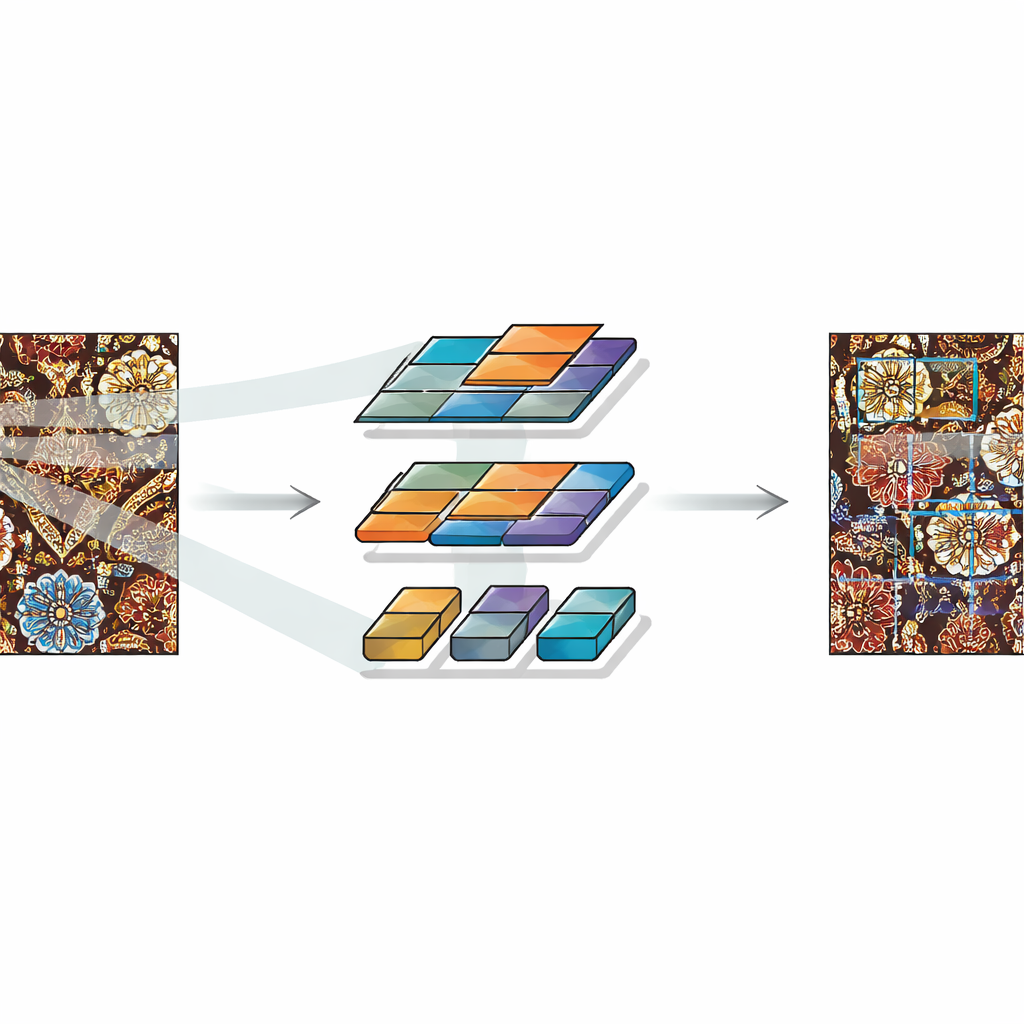
The improved model adds two key ideas. First, a component inspired by the VOLO “vision outlooker” mechanism lets the network look across distant parts of the image at once, rather than only in small local neighborhoods. This helps it recognize that two tiny shapes far apart may belong to the same meaningful pattern, and that a motif’s role depends on its neighbors. Second, the team reworked the way the network processes image features using a structure called Fused-MBConv. This redesign keeps computations efficient while sharpening the model’s ability to tease out subtle details from noisy, aged fabrics. In tests and careful ablation studies, their final design achieved higher average detection accuracy than the baseline YOLOv11 and several other lightweight detectors, while still running fast enough for real-time or near-real-time use.
From Automatic Tags to Cultural Stories
Beyond raw detection scores, the researchers connected their model to a batik knowledge graph that links each motif type to stories about its origins, symbolic meanings, and related examples. In a prototype software system, a user can upload a photo of a cloth, see the detected motifs highlighted, and then click through to explore their cultural background. For archivists, this means faster, more consistent cataloguing of large collections. For educators and visitors, it turns pattern recognition into an entry point for learning about Miao beliefs, rituals, and aesthetics. Although the current system is trained only on Chinese batik, the authors see it as a blueprint for cross-cultural tools that could one day help safeguard textile traditions from Indonesia to India, ensuring that the designs on cloth continue to speak, even as the fabrics themselves age and fade.
Citation: Li, Y., Quan, H., Li, Q. et al. Research on batik image pattern detection based on improved YOLOv11. npj Herit. Sci. 14, 143 (2026). https://doi.org/10.1038/s40494-026-02404-y
Keywords: batik pattern detection, intangible cultural heritage, computer vision, YOLO object detection, Miao textile art