Clear Sky Science · en
Study on the pre-consolidation mechanism of barium phosphotungstate before mounting-repairing of degraded paper historical relics
Why Saving Old Paper Matters
From family letters to centuries‑old books, much of human memory is written on paper. Yet the paper itself slowly crumbles: it turns yellow, becomes brittle, and can fall apart at the slightest touch, especially when it gets wet during repair. This study explores a new way to gently strengthen badly decayed paper before restoration, using a special inorganic compound called barium phosphotungstate. The goal is to help conservators save fragile documents and artworks without causing further harm.
The Problem with Fragile, Water‑Sensitive Paper
Old paper weakens over time as its main ingredient, cellulose, breaks down under the combined assault of moisture, heat, light, acids, microbes, and insects. For severely damaged paper, routine conservation steps—such as washing, deacidification, or lining with a new backing sheet—often require water‑based pastes or baths. Ironically, this water can cause the already fragile fibers to swell, separate, and disintegrate, turning pages into pulp. Traditional dry repair avoids water but is technically demanding and does not remove acidity. Conservators therefore need a way to give decayed paper enough temporary strength to withstand wet treatments safely.
A Two‑Step Chemical Helping Hand
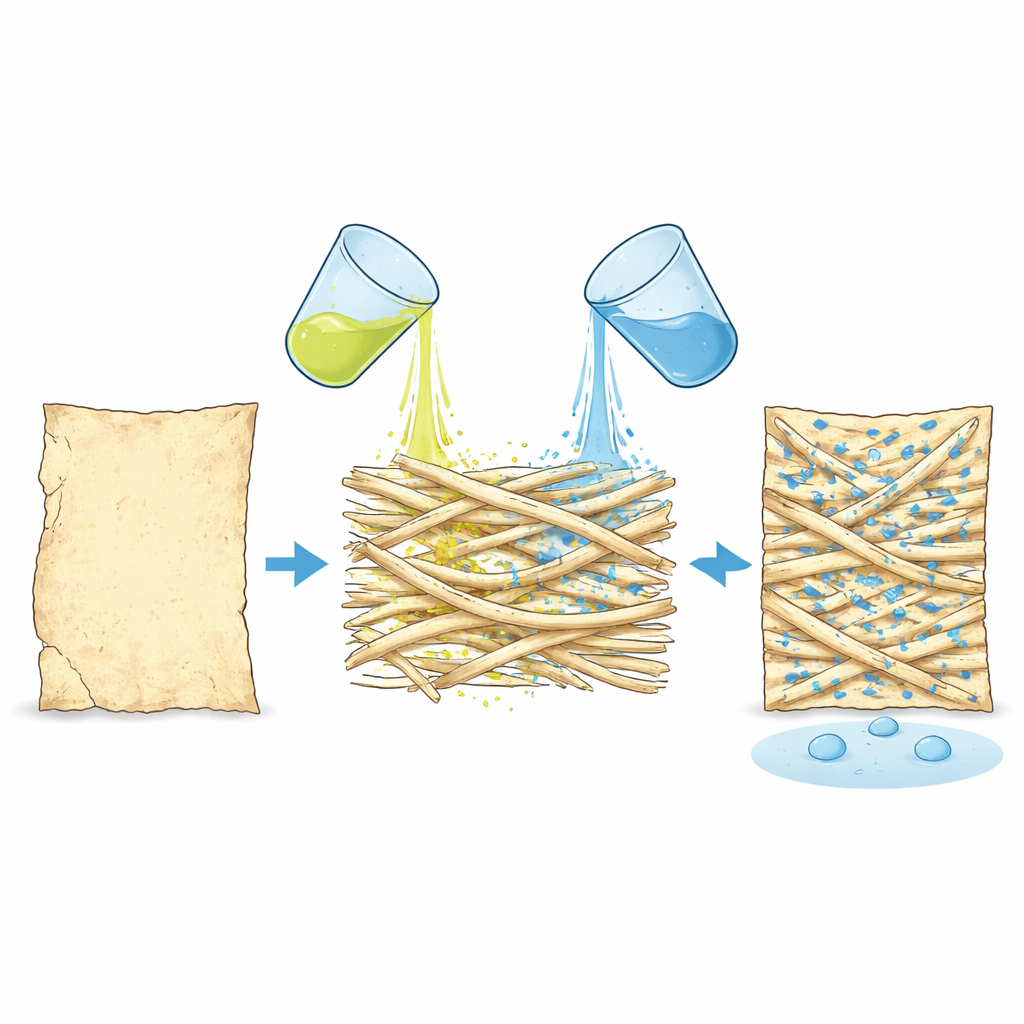
The method studied here is a "pre‑consolidation" treatment carried out not in water but in alcohols, which are much less swelling to paper. First, the paper is brushed with a solution of phosphotungstic acid in ethanol, which seeps into the network of cellulose fibers. After drying, a second solution of barium hydroxide in methanol is applied. Where the two meet inside the paper, they react in place to form tiny, insoluble particles of barium phosphotungstate. Earlier practical work had shown that this in‑situ deposit can keep rotten paper sheets from falling apart and stop water‑soluble inks from bleeding, but the underlying mechanism was not well understood.
Looking Close: How the Fibers and Particles Interact
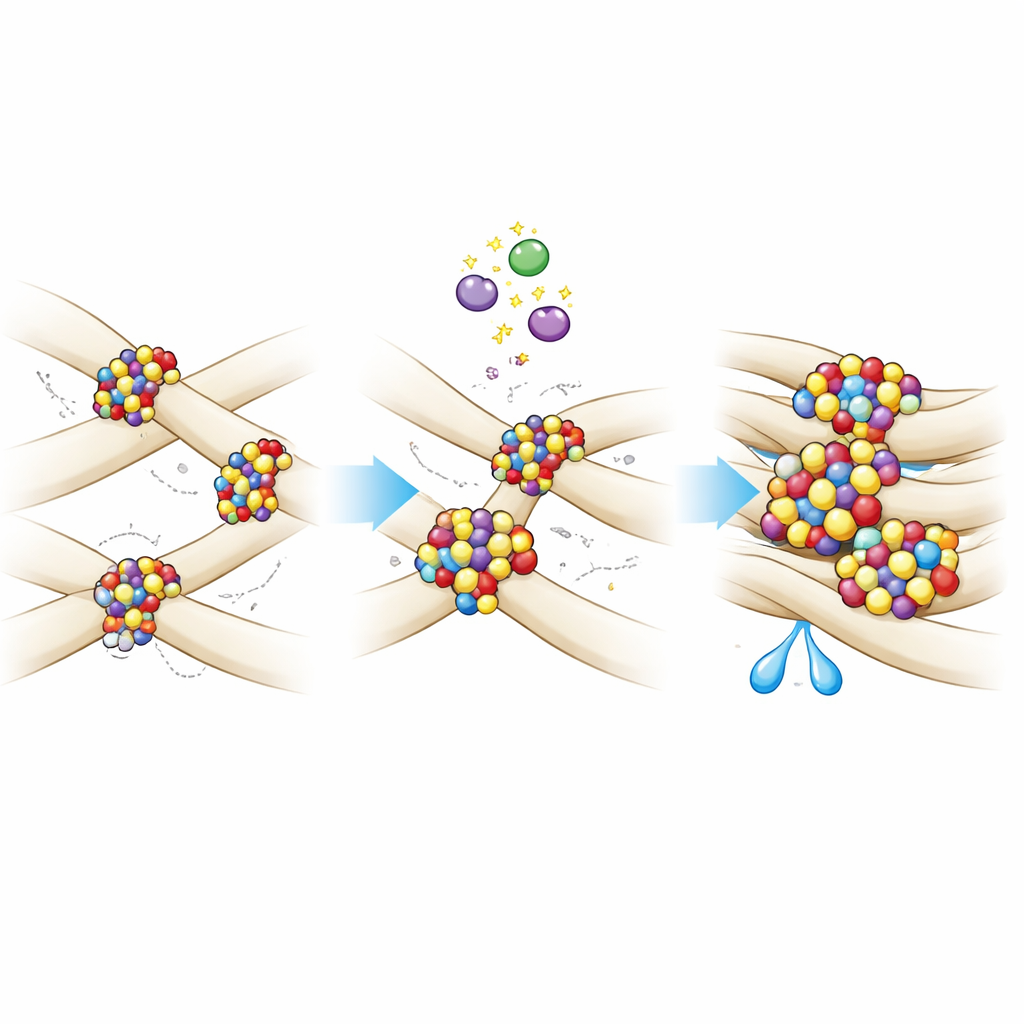
To probe what happens at the microscopic level, the researchers used model systems made from carboxylated cellulose nanofibers—very fine, chemically modified cellulose strands suspended in water. They mixed these nanofibers with phosphotungstic acid and observed that the acid molecules stick strongly to the cellulose, forming multiple hydrogen bonds with the fibers’ hydroxyl and carboxyl groups. Spectroscopic techniques and electron microscopy showed that this interaction pulls separate nanofibers together into denser, sheet‑like structures: the acid acts as a multi‑point connector that rearranges and aggregates the cellulose network. When barium hydroxide is then added, it reacts with the bound phosphotungstic acid to form barium phosphotungstate particles exactly where the acid was attached, replacing directional hydrogen bonds with more isotropic ionic links.
From Loose Web to Dense Shield Against Water
When the same chemistry is applied to real paper, the newly formed barium phosphotungstate precipitates lodge between and onto the degraded fibers. Microscopy images reveal that untreated or simply water‑soaked decayed paper develops a loose, fluffy texture with enlarged pores, while treated paper maintains a compact, interlocked fiber structure even after immersion. Measurements of water contact angles and penetration show that as more barium phosphotungstate is deposited, the paper absorbs water more slowly and to a lesser degree. Mechanical tests confirm that the wet tensile strength of aged Xuan paper jumps significantly after treatment, in both main directions of the sheet, and the acidity of the paper is partly neutralized as well.
Implications for Protecting Our Written Heritage
Put simply, this work shows that forming barium phosphotungstate inside decayed paper turns a fragile, water‑loving fiber mat into a denser, more water‑resistant network. The chemical acts like a microscopic scaffold and pore filler: it pulls weakened cellulose strands together, occupies the tiny capillaries that would otherwise suck up water, and helps the paper stay intact during wet restoration steps. While the results so far apply mainly to cellulose‑rich papers and do not yet answer questions of long‑term reversibility, they provide a clear, experimentally grounded explanation for a technique that is already helping conservators rescue severely degraded documents. The study offers a roadmap for adapting similar strategies to other cellulose‑based heritage materials in the future.
Citation: Zhu, Y., Luo, Y., Li, Y. et al. Study on the pre-consolidation mechanism of barium phosphotungstate before mounting-repairing of degraded paper historical relics. npj Herit. Sci. 14, 145 (2026). https://doi.org/10.1038/s40494-026-02402-0
Keywords: paper conservation, cultural heritage, cellulose fibers, pre-consolidation, barium phosphotungstate