Clear Sky Science · en
Mapping semantic bias in UNESCO intangible heritage metadata through community detection in South America
Why this matters for how culture is seen
When we think about world heritage, we often picture famous monuments or spectacular festivals. But behind every item on UNESCO’s cultural lists sits an invisible layer of labels and keywords that decide what becomes visible—and what fades into the background. This article peels back that digital curtain for South America, showing how the language used in UNESCO’s online records can subtly tilt global attention toward certain images of a region—such as colorful rituals and pilgrimages—while pushing other forms of knowledge into the margins.
How a global list shapes local stories
UNESCO’s Intangible Cultural Heritage Lists catalogue living practices such as dances, pilgrimages, farming rituals, and oral traditions. Each practice is described with a set of standardized keywords, like “dance,” “festival,” “mountains,” or “religious syncretism.” These descriptors are organized into two layers: primary concepts, which define how a practice is officially categorized, and secondary concepts, which add background context. The authors argue that these labels do not simply describe culture; they help construct it, because they frame how communities appear in the global imagination. For instance, a complex Andean pilgrimage may be reduced to a mix of “dance,” “procession,” and “religious syncretism,” terms that fit UNESCO’s global vocabulary more easily than local understandings of sacred landscape or reciprocity.
Turning words into a map of meaning
To study this hidden layer, the researchers collected all the descriptors that UNESCO assigns to heritage practices worldwide, then focused on how South American entries fit into the bigger picture. They treated each descriptor as a dot in a network and drew a line between two dots whenever the corresponding terms appeared together in the same heritage item. Using community-detection algorithms, they identified clusters of terms that often travel together—such as those related to dance and music, or to agriculture and ecology. They also measured how widely each South American country’s heritage is spread across these clusters, using an information measure known as entropy to capture how varied, or narrow, each national profile is. 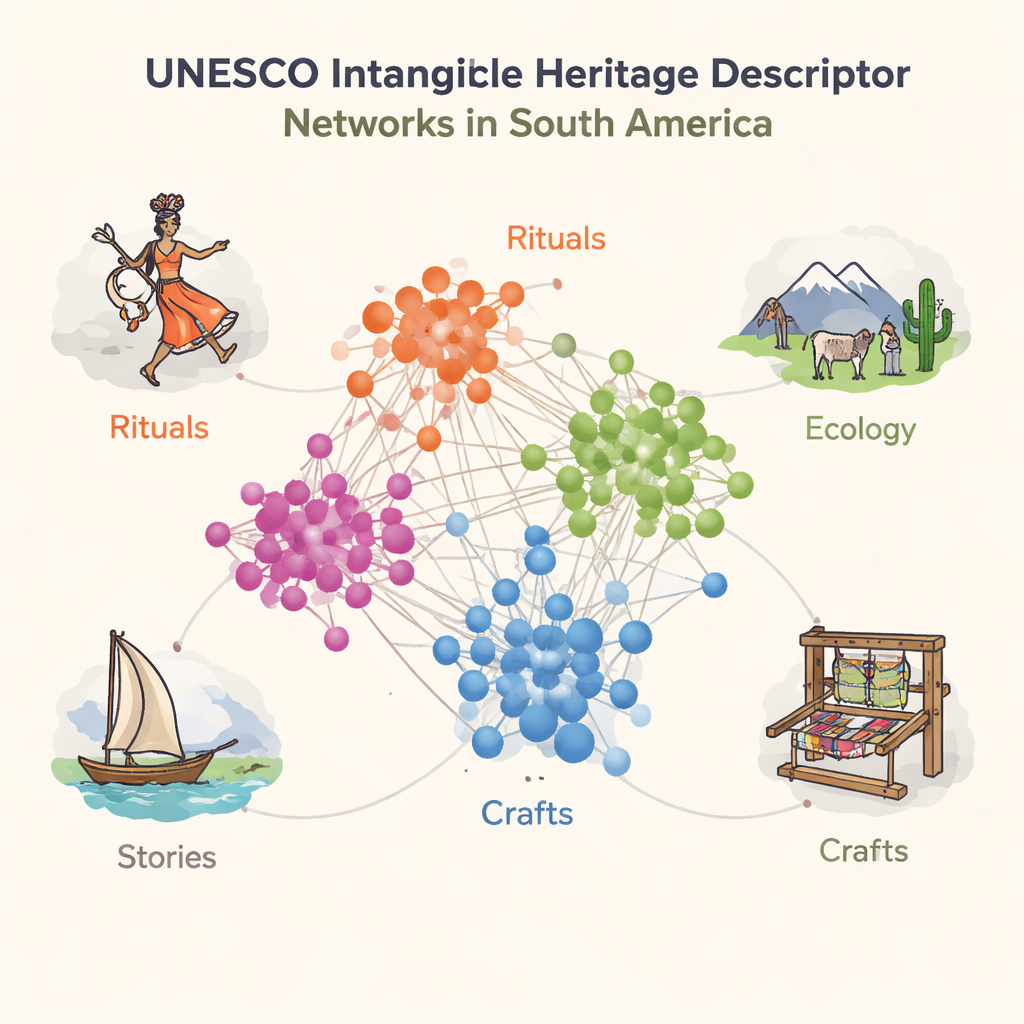
Rituals in the spotlight, other know-how in the wings
The resulting map shows that UNESCO’s primary concepts form clear thematic islands across the globe: performative rituals, oral and ecological knowledge, poetic and theatrical arts, craft practices, and agricultural rituals. South American countries, especially Andean ones like Peru and Bolivia, are heavily concentrated in the clusters tied to processions, dances, and urban religious practices. Brazil and Colombia, by contrast, appear across a broader range of themes, including crafts and oral traditions, giving them more diverse profiles in the global system. When the authors look at the secondary, contextual layer of descriptors, a different pattern emerges. Here, South American entries are strongly linked to ecological knowledge, colonial history, and questions of identity and ethics. Terms such as “agro-ecosystems,” “pastoralism,” “colonial history,” or “intolerance” help explain these practices—but they are placed in the background, not in the main categories that define the items.
Tracing hidden pairings and subtle biases
By connecting the primary and secondary layers, the study uncovers systematic pairings that reveal how local realities are translated into institutional language. Strong links appear between “procession” and “religious syncretism,” “pilgrimage” and “animism,” or “festival” and “colonial history.” These repeated combinations suggest that indigenous cosmologies and postcolonial experiences are consistently framed through a limited set of global concepts. The entropy analysis reinforces this picture: countries like Brazil and Colombia show high thematic diversity, while others, such as Uruguay and Argentina, are represented through a much narrower band of categories. In effect, some nations are allowed to appear as culturally multi-dimensional, while others are repeatedly cast in a few familiar roles. 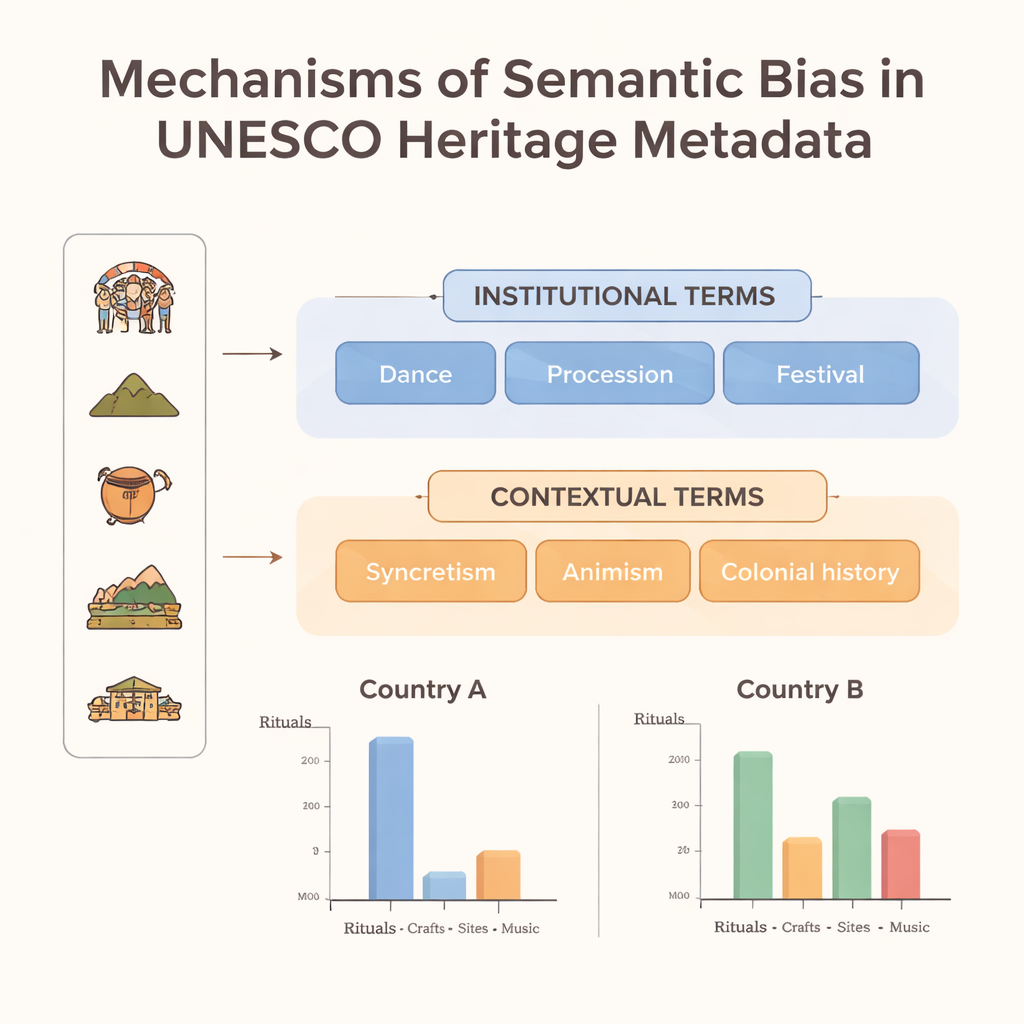
What this means for cultural fairness
For a general reader, the key message is that even seemingly dry metadata—the keywords that sit behind UNESCO’s website—carry real consequences. They influence which aspects of South American cultures are most visible, and which remain peripheral. The study shows that network analysis can turn long-standing concerns about Eurocentric or folklorizing biases into measurable patterns: who is described mainly through ritual labels, who is linked to ecological wisdom, and how often deeper histories or cosmologies are pushed into secondary slots. The authors suggest that making these patterns visible is a first step toward fairer heritage governance, where descriptor vocabularies are diversified, communities have more say in how they are labeled, and global heritage lists better reflect the full complexity of the living cultures they aim to safeguard.
Citation: Vera Zúñiga, J., Urbina Parada, F. & Cornejo Meza, D. Mapping semantic bias in UNESCO intangible heritage metadata through community detection in South America. npj Herit. Sci. 14, 133 (2026). https://doi.org/10.1038/s40494-026-02400-2
Keywords: UNESCO intangible heritage, South America, cultural bias, digital metadata, network analysis