Clear Sky Science · en
Rediscovered megalithic engravings in Slovakia: 3D reconstruction and comparative analysis of a forgotten Neolithic site
Ancient stones beneath a modern town
Beneath a quiet housing estate in western Slovakia, builders once uncovered something extraordinary: giant carved stones, a human skeleton and mysterious symbols that had been hidden for thousands of years. This study revisits that little-known discovery at Holíč and uses modern 3D technology to show that the stones may belong to the same great tradition of prehistoric monuments as Stonehenge and other famous sites, pushing the known reach of this culture farther east into Central Europe.
Forgotten giants in the heart of Europe
When construction workers dug foundations in Holíč in 1988, they hit more than forty large stones about three metres below ground. One stone stretched almost seven metres and lay above a human burial; others formed a rough line pointing toward the nearby Morava River. At first the blocks were dismissed as natural, but closer inspection revealed engravings: a human figure carrying a tool, what looks like an animal, and sets of neatly carved concentric circles. Despite early documentation by a Slovak ethnologist and a French megalithic specialist, most stones were moved to a park and rearranged as a decorative sundial, their original setting largely erased.
Reading weathered carvings with lasers and paper
By the time the authors returned to Holíč in 2022, decades of weather and pollution had blurred all but one of the engravings. To recover what was lost, they combined three lines of evidence. First, they performed high‑resolution laser scanning of the surviving stones, capturing tiny variations in the rock surface as 3D point clouds. Second, they revisited archival photographs taken soon after the discovery, when the carvings were still sharp. Third, during a 2025 visit they laid large sheets of paper over key stones and traced faint ridges and depressions by hand. All of these layers—scans, photos and tracings—were overlaid and aligned in computer software to reconstruct the original images at full scale.
People, animals and circles of meaning
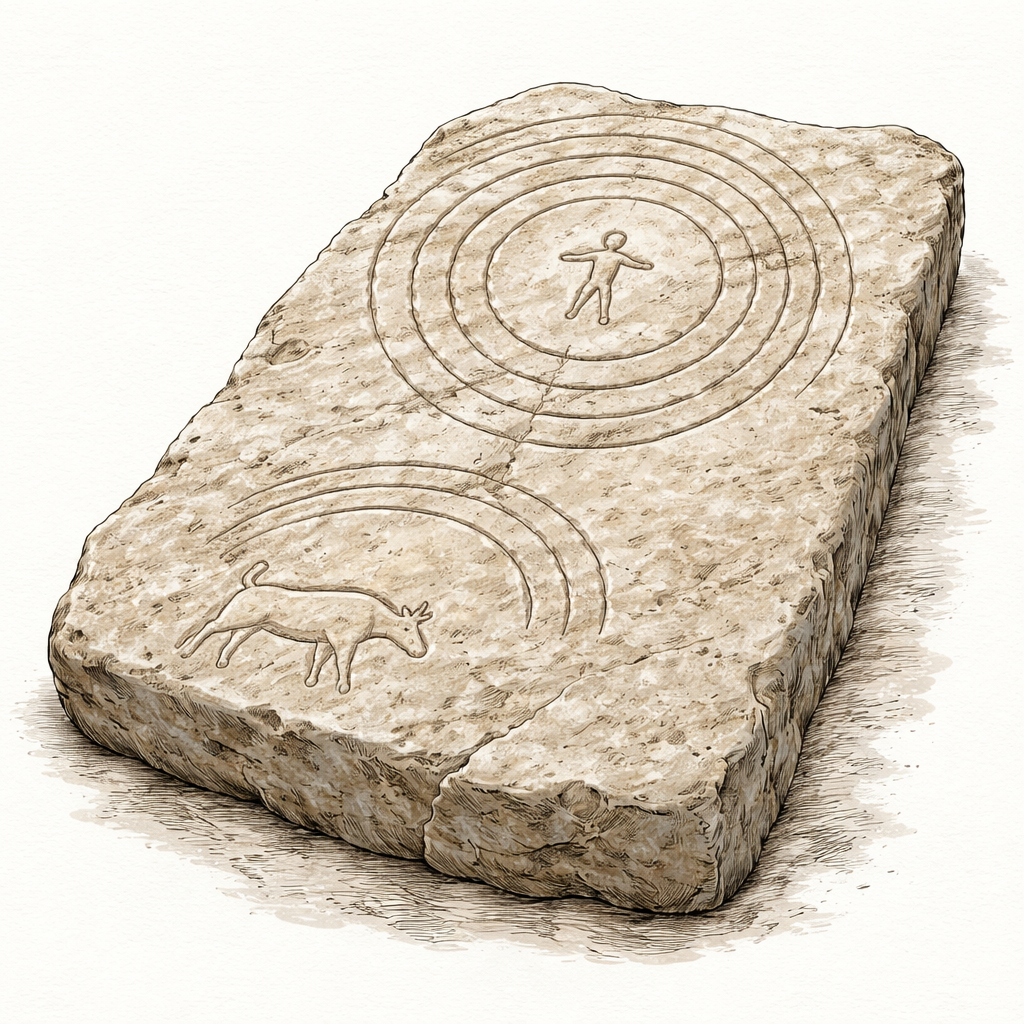
The reconstructions reveal three especially striking engravings. On one stone, a small human figure, about 25 centimetres tall, appears to hold a tool while standing amid sweeping circular grooves nearly a metre across. On another, an animal roughly the size of a sheep is carved beneath a fan of partial circles. A third stone bears broader, deeply cut lines forming a bold abstract motif. Careful geometric analysis showed that the centres of the circles sit at symbolically charged points: the back of the human’s head and the area of the animal’s heart. Similar circles—without such clear figures—are common at famous Neolithic sites in France, Italy and Scotland, suggesting that the Holíč artists were part of a shared visual language that stretched across Europe.
Stones aligned with the summer sunset
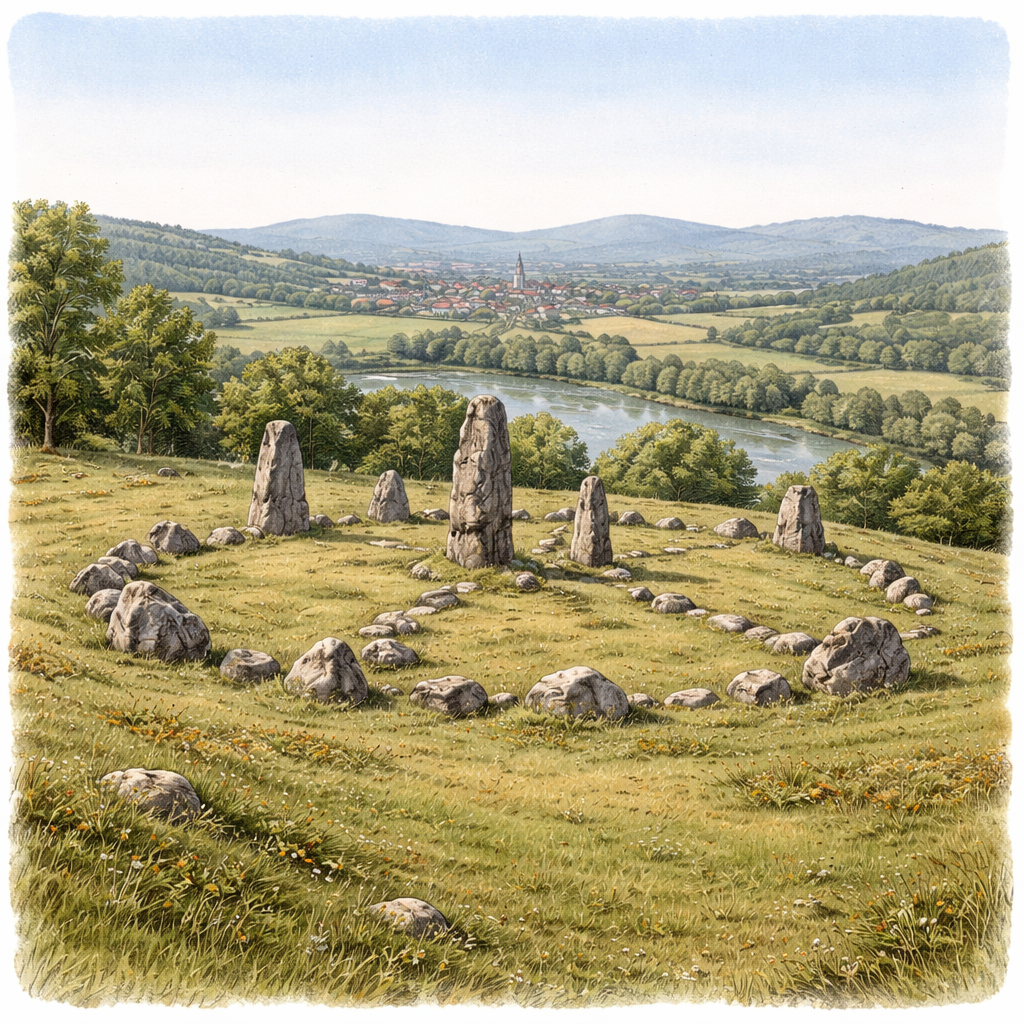
The original excavation notes and old site photographs hint that eight stones once lay in a westward line, roughly matching the direction of the sun setting at the summer solstice. The largest stone lay across this line, and traces of low earth mounds suggest that the stones may have formed part of a circular structure on a hill overlooking the broad Morava valley. This pattern echoes other prehistoric monuments whose entrances frame sun or moon events, turning the landscape itself into a kind of calendar. Although no precise dating material survives—the human remains and many artefacts were lost—nearby finds from Neolithic farming cultures and the lack of metal tools in the deep layers strengthen the case for a Stone Age origin.
Why these stones matter today
Together, the engravings, their careful geometry and the likely solar alignment point to Holíč as more than a pile of random rocks. They suggest a planned monument in which people, animals, the sky and the surrounding river valley were woven into a single symbolic scene. Because Slovakia and its neighbours were long thought to lack such large stone constructions, the Holíč site may fill an important gap in the story of Europe’s earliest monumental builders. The authors argue that these vulnerable, unprotected stones deserve legal protection and further scientific study, so that a housing project’s forgotten discovery can help rewrite our picture of how far—and how thoughtfully—prehistoric people shaped their world.
Citation: Dlábiková, I., Pospíšil, P. & Illingworth, S. Rediscovered megalithic engravings in Slovakia: 3D reconstruction and comparative analysis of a forgotten Neolithic site. npj Herit. Sci. 14, 138 (2026). https://doi.org/10.1038/s40494-026-02399-6
Keywords: megaliths, Neolithic art, Slovakia archaeology, stone engravings, archaeoastronomy