Clear Sky Science · en
A lightweight integrated diagnostic approach for Macao Architectural Heritage using 3D laser scanning and NDT
Why this temple story matters
Across the world, historic buildings are crumbling under modern pressures, from pollution to climate change. In the bustling, humid city of Macao, small neighborhood temples still serve worshippers every day, even as their centuries‑old walls quietly weaken. This study follows one such temple and shows how a backpack‑sized toolkit of digital devices can reveal hidden damage inside its walls without drilling, sampling, or closing the site to visitors. The work points to a new way of caring for fragile landmarks in crowded cities: gather precise, three‑dimensional information first, then intervene as gently as possible.
A living shrine in a tough environment
The Kuan Tai and Tin Hau Temple on Taipa Island was founded in 1717 and is still an active place of worship. Architecturally, it is a rare hybrid: thick earthen walls and timber framing from Chinese building traditions combined with lime mortars and tiles linked to Portuguese influence. This mix of materials gives the temple great character but also makes its behavior over time harder to predict. The building sits in Macao’s warm, sea‑air climate, where high humidity and salt‑laden winds promote decay. Inside, incense burns for long hours each day. Together, moisture and smoke leave visible traces: flaking plaster, powdery surfaces, and salt crusts on the walls. Because the monolithic earthen walls are both very thick and structurally vital, conventional tests that require drilling or removing samples are unacceptable; the challenge is to see inside the walls without harming them.
Light tools for a heavy task
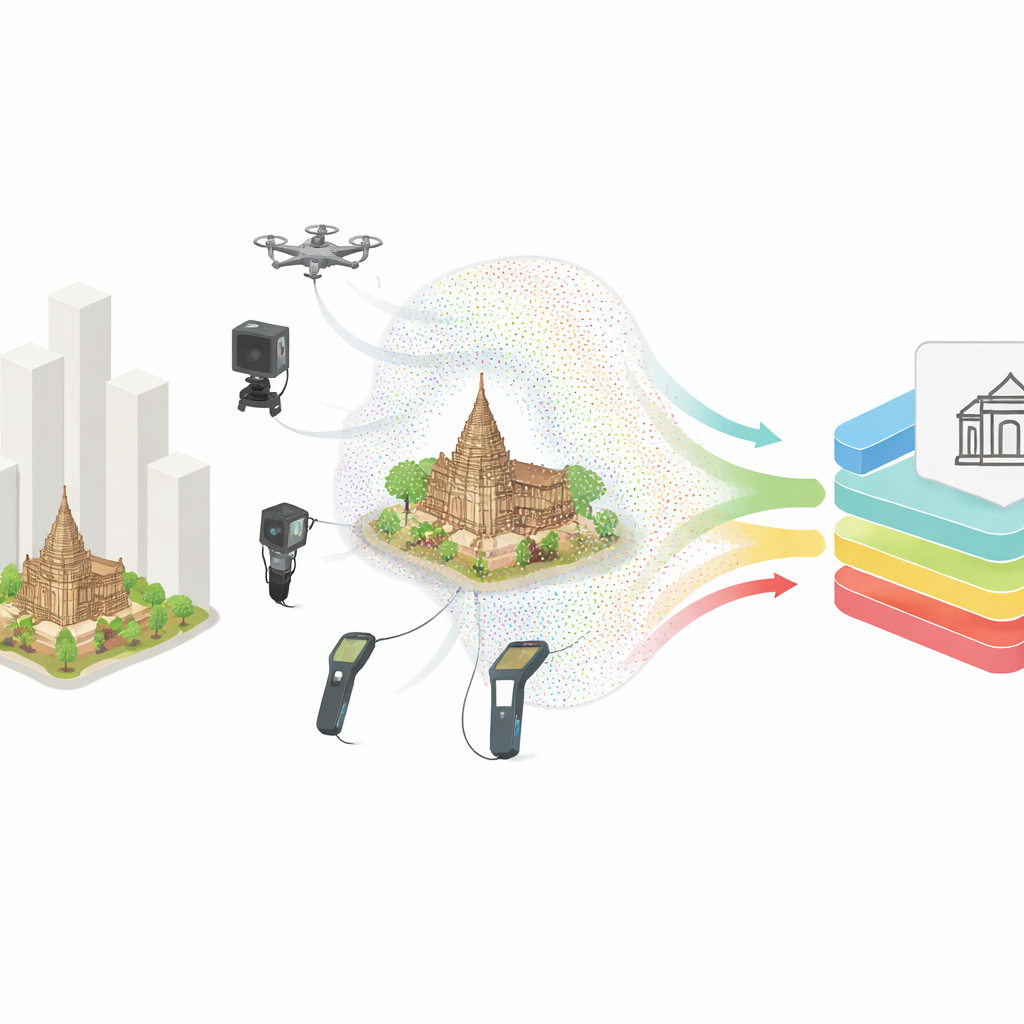
To meet this challenge, the researchers assembled a lightweight set of instruments, collectively weighing under four kilograms. A portable 3D laser scanner captured the full shape of the temple, inside and out, as a dense “point cloud” with millimeter accuracy. A tiny drone photographed the roof and surroundings. Handheld devices then examined the wall materials more closely: an infrared camera spotted cold patches linked to damp areas; an X‑ray fluorescence probe measured the chemical elements present at the surface; and a rebound hardness tester gauged how resistant the walls remained to impact. Crucially, every reading was tied back to the laser‑scanned 3D model, so geometry, chemistry, moisture, and strength all shared the same spatial frame. The team refers to this combined framework as a “spatial‑composition‑physical‑mechanical” model.
Making sense of invisible damage
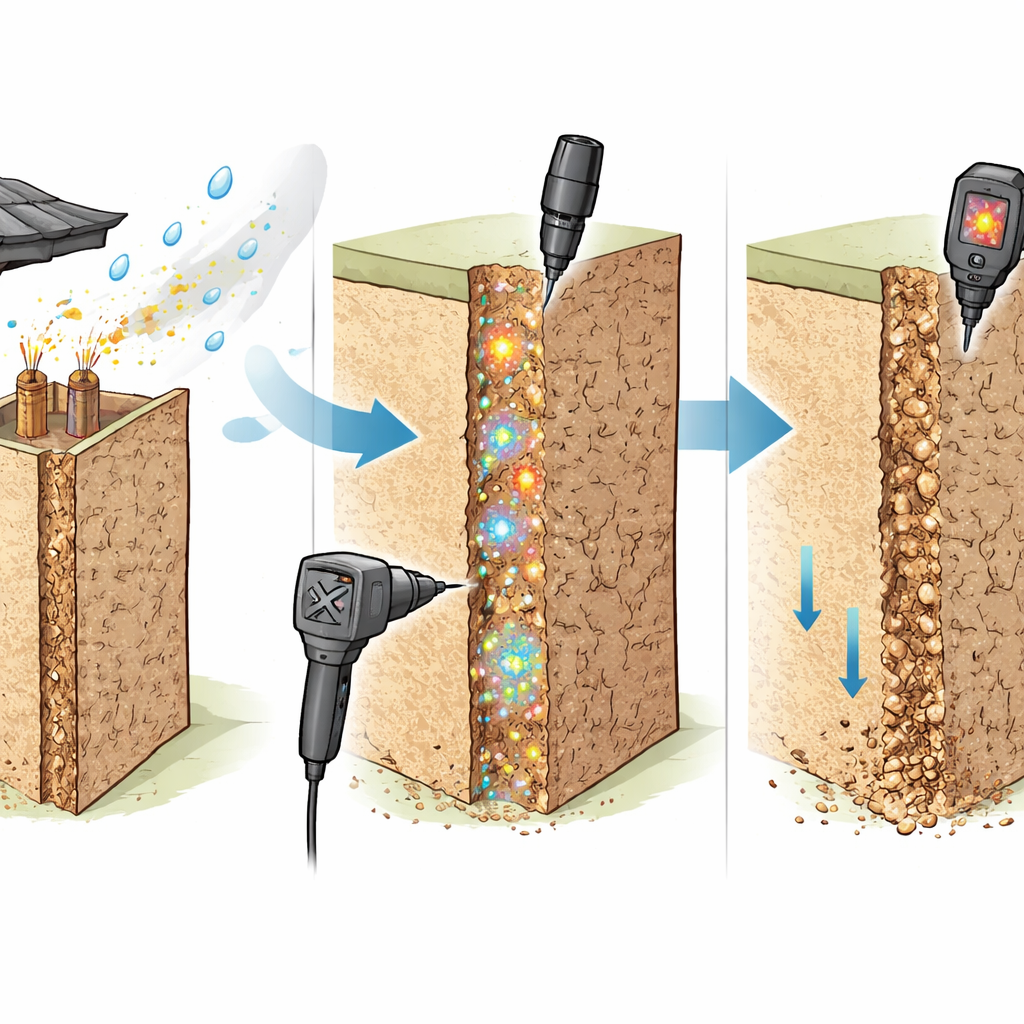
With all measurements anchored in 3D space, the team could move beyond simply mapping cracks and stains. They used statistical tools to explore how pollutants, moisture, and strength interact. Infrared images highlighted zones where the walls stayed cooler, pointing to trapped moisture. At forty points on a heavily smoked interior wall, the researchers measured both chemical makeup and hardness. They found that sulfur‑rich areas—linked to incense smoke—were consistently softer, while zones richer in calcium, a key ingredient in lime binders, tended to be harder. A power‑law relationship showed that as sulfur compounds (recorded as SO₃) increased, hardness dropped in a clear, predictable way. By interpolating between measurement points, they produced continuous wall‑sized maps showing where sulfur had built up and where the material had lost strength, revealing a hidden pattern of weakening behind what might look like minor surface blemishes.
From scanning to smarter care
These findings point to a specific decay mechanism: in the temple’s humid air, sulfur from incense smoke migrates into the rammed‑earth walls, forms sulfate salts, and gradually undermines the material’s mechanical strength. Because the entire workflow is non‑invasive, portable, and relatively quick, it suits “living” heritage sites that cannot be closed or scarred by testing. The integrated 3D approach also complies with international and Chinese accuracy standards for documenting historic buildings, giving conservation teams a sound basis for long‑term monitoring and digital archiving. In plain terms, the study shows that a small, smart toolkit can reveal how daily religious practices and local climate combine to erode sacred architecture, and can do so early enough to guide gentle, well‑targeted repairs. The same method could help protect many other historic buildings that must survive in today’s dense, polluted, and ever‑humid cities.
Citation: Zheng, Y., Huang, G., Wang, M. et al. A lightweight integrated diagnostic approach for Macao Architectural Heritage using 3D laser scanning and NDT. npj Herit. Sci. 14, 170 (2026). https://doi.org/10.1038/s40494-026-02393-y
Keywords: architectural heritage, 3D laser scanning, non-destructive testing, temple conservation, sulfate corrosion