Clear Sky Science · en
A critical Artificial Intelligence-generated content approach for the reconstruction of Qing Palace interiors: the case of Juanqinzhai
Why this matters beyond palace walls
Artificial intelligence is getting remarkably good at inventing pictures of places that never existed. But can it be trusted to faithfully recreate places that really did exist, especially when they carry deep cultural meaning? This article looks at a famous building inside Beijing’s Forbidden City and asks whether today’s image-generating AI tools can help us digitally rebuild such interiors without quietly distorting history.
A hidden jewel of the Forbidden City
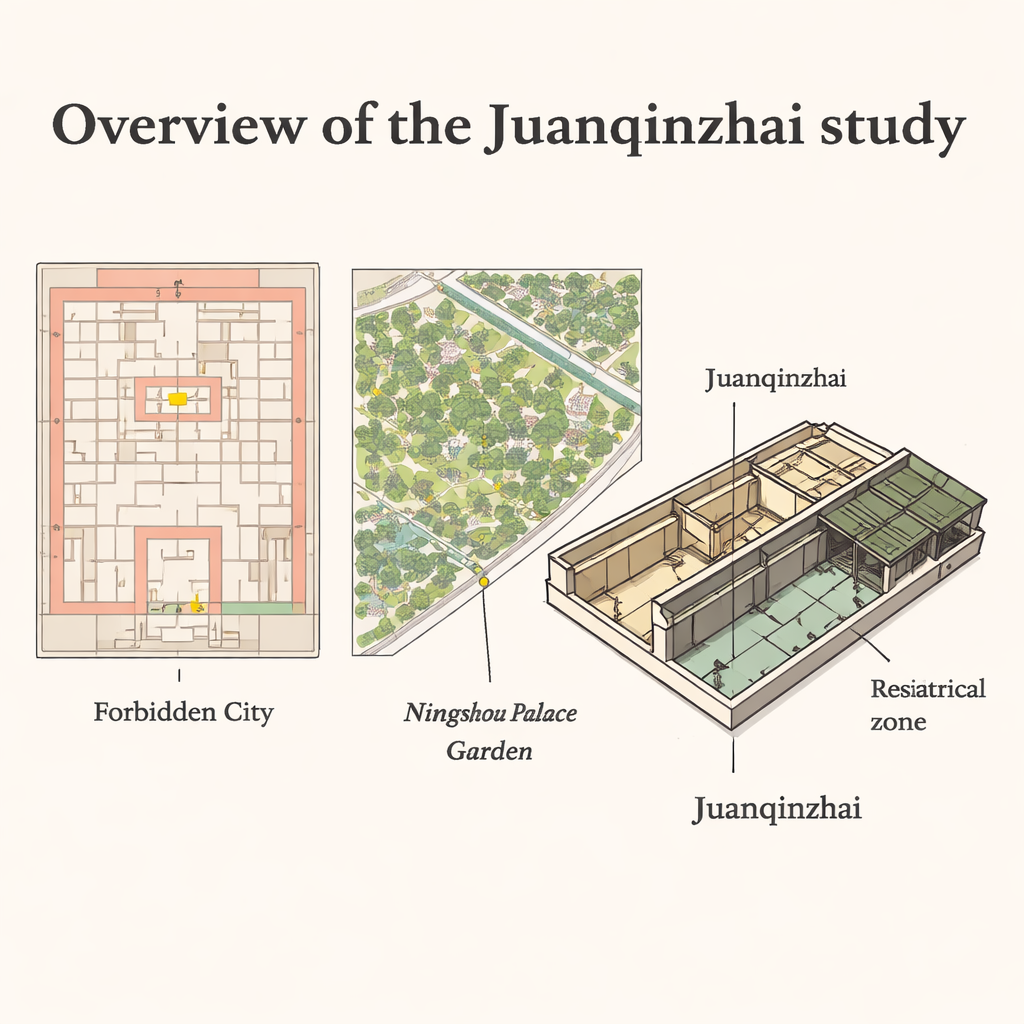
Juanqinzhai, the “Studio of Exhaustion from Diligent Service,” is a jewel-like retreat tucked inside the Ningshou (Tranquil Longevity) Palace Garden of the Forbidden City. Built for the Qianlong Emperor in the Qing dynasty, its rooms are packed with exquisite craft: carved rosewood, bamboo-thread inlay, jade set into furniture, shimmering embroidered screens, and illusionistic wall paintings that turn flat surfaces into deep landscapes. Because Juanqinzhai has been carefully preserved and richly documented in historic manuals, drawings, and repair records, it offers an ideal testbed: we know its layout, proportions, and decorative logic in detail, so any digital reconstruction can be checked against a reliable record.
Putting AI’s imagination to the test
The researchers built a very precise three-dimensional computer model of Juanqinzhai using laser scanning and archival drawings. This SketchUp model acts like a tape measure and blueprint combined, capturing exact room sizes, column grids, ceiling details, and even the pattern of window lattices. They also assembled a “semantic” framework that explains what each space is for—quiet rest or theatrical performance—what components belong there, and how decoration, color, and symbolism support those functions. With this as a benchmark, they used two popular image generators, Midjourney and Stable Diffusion, to create more than 200 images of Juanqinzhai’s two main zones: the eastern residential bays and the western theatrical bays.
Where AI goes wrong inside the palace
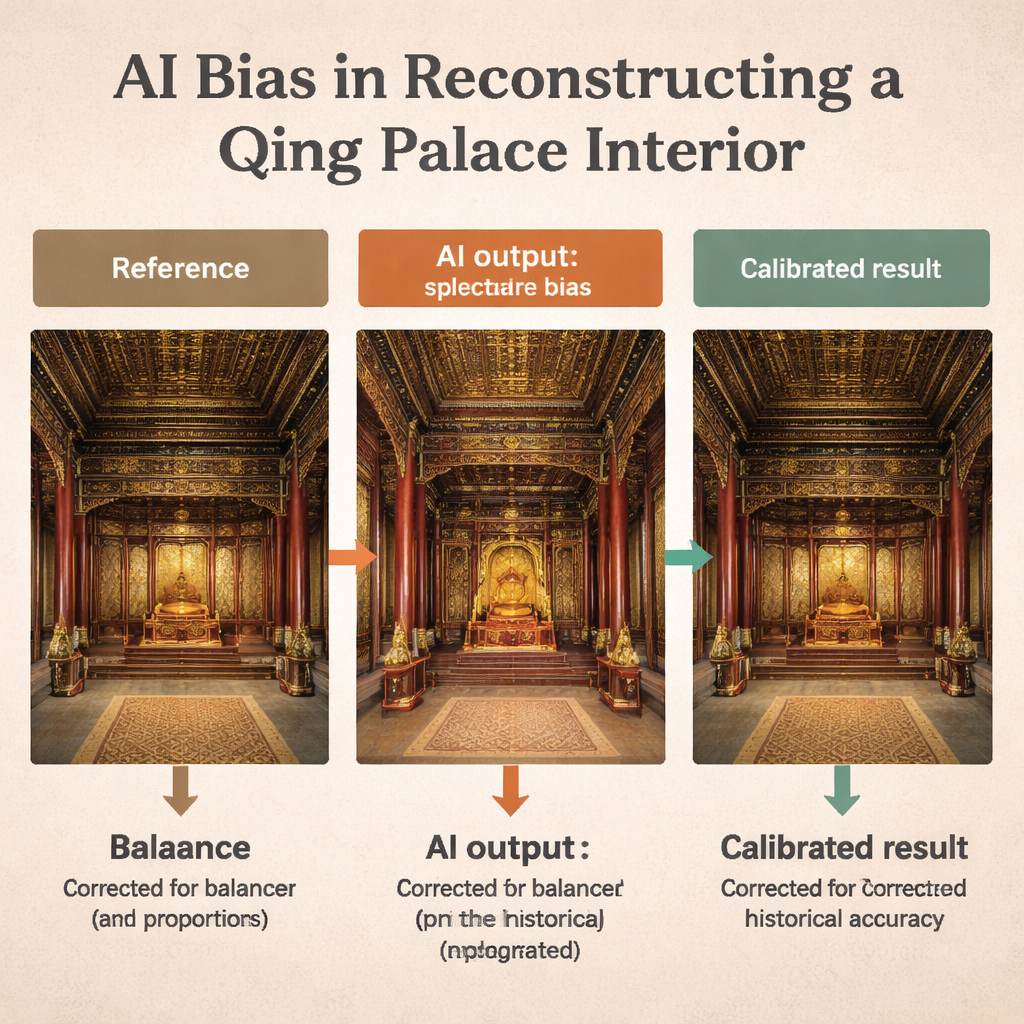
On first glance, many AI-generated interiors look stunning and “authentically Chinese,” rich with carved wood, glowing colors, and ornate ceilings. But when the team measured them against the reference model, consistent distortions emerged. Depths were exaggerated by up to about 40%, horizontal dimensions were squeezed, upper stories were slightly flattened, and decorative elements—such as caisson ceilings and corridor screens—were blown up beyond their real size. In other words, the AI favored dramatic vistas and visual spectacle over the quiet discipline of actual structure. A second layer of analysis looked at cultural meaning. Here the models tended to crowd in too many patterns, turn up color saturation, or blur distinctions between different periods and regional styles, producing a kind of generalized “Oriental palace” rather than a specific Qing interior with clear rules about where certain motifs, colors, and furnishings belong.
Uncovering hidden cultural bias
These patterned errors are not simply technical glitches. They mirror long-standing habits in global visual culture, where East Asian spaces are often portrayed as exotic, theatrical backdrops rather than carefully proportioned buildings governed by strict regulations. Because image generators learn from vast online collections—movies, games, tourist photos, fantasy art—they inherit this bias. The study suggests that, for Juanqinzhai at least, the AI is recreating a worldwide “Oriental palace” fantasy more than it is reconstructing a documented imperial room. That makes such systems risky if their images are treated as historically accurate by museums, designers, or the public.
A new way to work with, not for, AI
Instead of abandoning AI, the authors propose a three-stage “critical generation” workflow. First, AI is used freely to explore atmospheric possibilities and variations, guided by carefully structured prompts that include function, key components, and historical period. Second, experts “calibrate” the best of these images against measured models and archival sources, correcting proportions, filtering out anachronistic details, and rebalancing decoration and structure. Third, the corrected results are brought into specialized heritage-building information systems that embed metadata about materials, craft traditions, and symbolism. In this setup, AI becomes a fast, creative sketching partner whose ideas are always checked and reshaped by human knowledge and evidence.
What this means for digital heritage
The article concludes that current image-generating AI is powerful for quickly producing evocative views of historic interiors, but unreliable as a stand-alone reconstruction tool. Left unchecked, it tends to enlarge the spectacular, shrink the structural, and mix cultural signals in ways that can mislead viewers about the past. Used critically, however—anchored to precise measurements and expert interpretation—it can speed up early design and visualization work and help explore different restoration options. For non-specialists, the key takeaway is that convincing images are not the same as truthful ones, and preserving cultural heritage in the digital age will depend on thoughtful collaboration between human historians, architects, and the machines that now help picture the past.
Citation: Wei, C., Liu, J., Jia, J. et al. A critical Artificial Intelligence-generated content approach for the reconstruction of Qing Palace interiors: the case of Juanqinzhai. npj Herit. Sci. 14, 124 (2026). https://doi.org/10.1038/s40494-026-02390-1
Keywords: digital heritage, Forbidden City, AI image generation, Qing dynasty interiors, architectural reconstruction