Clear Sky Science · en
Plant selection in ancient Tibetan palm-leaf manuscripts: a novel approach to rapid species identification
Ancient books made from palm leaves
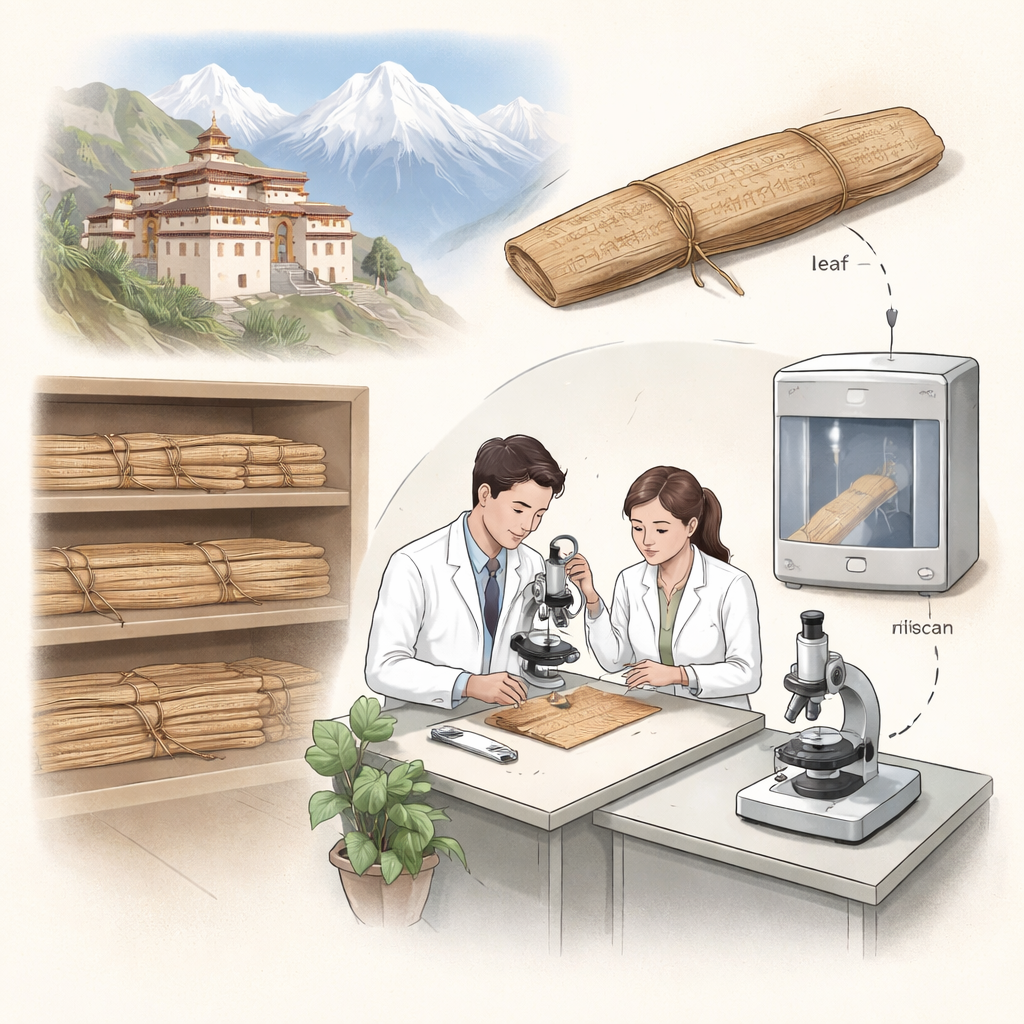
Long before paper was common, people across South and Southeast Asia wrote sacred texts, calendars, and scientific records on strips of dried palm leaves. Many of these fragile “books” have survived for centuries in Tibetan monasteries. Yet scholars often do not know exactly which palm species the leaves came from—a clue that can reveal when and where a manuscript was made, and how ideas and religions moved across Asia.
Why the kind of palm tree matters
Different regions traditionally favored different palm species for making writing material. In South and Southeast Asia, scribes mainly used leaves from three fan palms in the palm family: the talipot palm (Corypha umbraculifera), the gebang palm (Corypha utan), and the palmyra palm (Borassus flabellifer). Historical records hint that certain palms were linked to particular areas—so if experts can match a manuscript to a species, they gain a powerful hint about its geographic origin and trade routes. The challenge is that centuries-old leaves are fragile, and closely related palms can look almost identical on the surface, making traditional, cutting-based identification risky and uncertain.
Looking inside leaves without cutting them apart
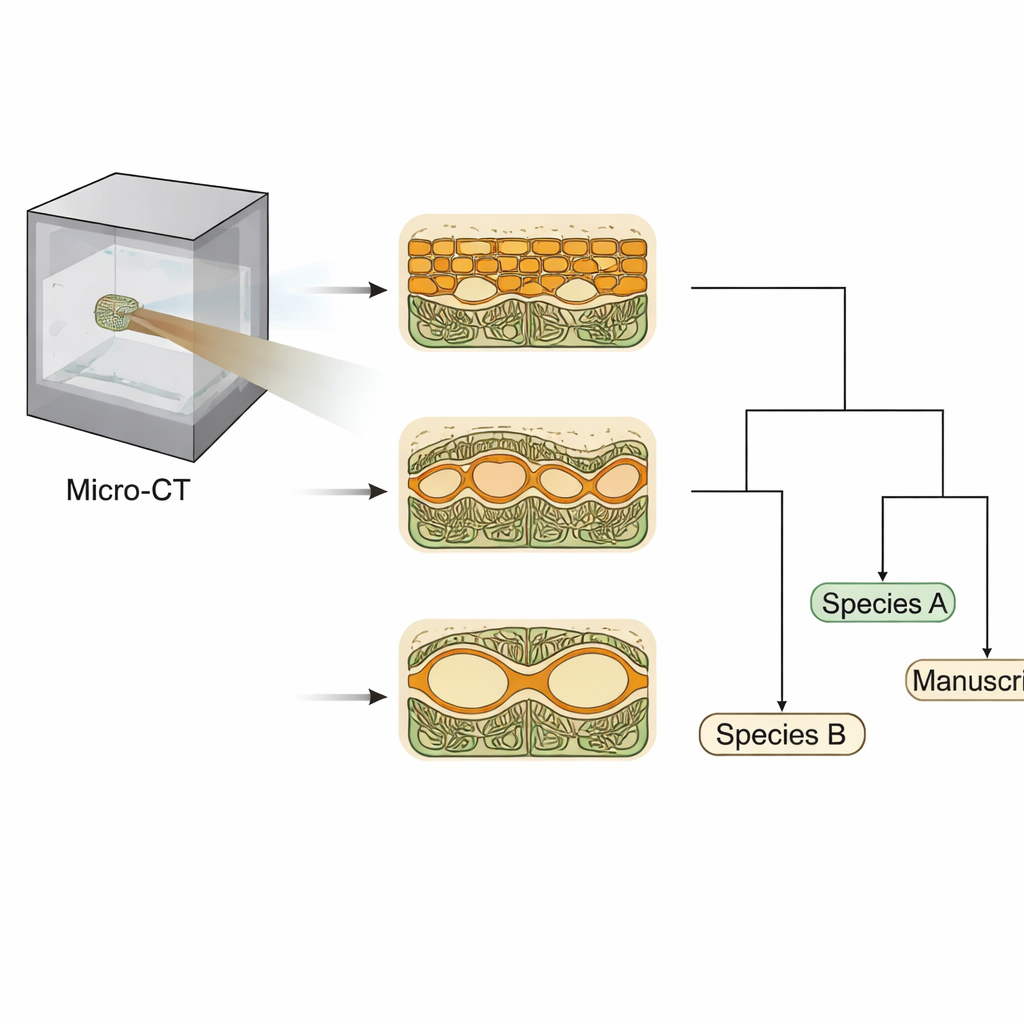
The researchers behind this study turned to a medical-style imaging tool called micro–computed tomography, or micro-CT. Much like a hospital CT scanner, but on a microscopic scale, it uses X‑rays to build a three-dimensional picture of a tiny object’s internal structure. The team collected fresh leaves from the three key palm species at a botanical garden in southern China. They then scanned thin strips of these leaves in three directions, creating high‑resolution images that reveal the veins, support fibers, and other tissues inside the leaf. At the same time, they used gentle chemical treatment and light microscopy to peel off and inspect the outer skin of the leaf, where the breathing pores (stomata) and surface cells form distinct patterns.
Spotting species by their microscopic patterns
Under the microscope, each palm showed its own “fingerprint.” The palmyra palm had unusually large stomata and similar leaf surfaces on both sides. The two Corypha palms shared a different stomatal type but differed subtly in the width and variability of their stomatal bands and in the shape of their surface cell walls. Micro‑CT images added a second layer of evidence: palmyra leaves displayed a thick, almost brick‑like network of cross veins, while Corypha leaves had more loosely arranged, slightly curved cross veins and characteristic support sheaths. One Corypha species had a clearly visible soft sheath around both long and cross veins, while the other lacked this feature and placed some veins at different depths in the leaf. By measuring eleven traits—from leaf thickness and vein spacing to pore size—the team built a numerical profile for each modern species.
Tracing the roots of Tibetan manuscripts
Next, the researchers examined two damaged fragments from ancient Sanskrit palm‑leaf manuscripts preserved in a Tibetan monastery. These pieces were ideal for study because using them would not harm complete texts. Even after centuries, the surface patterns were clear enough to show the same style of stomata and cell walls seen in Corypha palms, not palmyra. Micro‑CT scans of the fragments revealed vein networks and fiber arrangements that closely matched those of modern talipot palm. To test this resemblance objectively, the team fed their eleven measured traits into a clustering algorithm—a statistical method that groups samples by similarity. The two ancient fragments grouped tightly with talipot palm and clearly apart from the other Corypha species, pointing to Corypha umbraculifera as their source.
What this means for history and conservation
By combining non‑destructive micro‑CT imaging with careful surface microscopy and statistics, the study shows that it is now possible to identify the palm species used for priceless manuscripts without cutting or visibly damaging them. For the Tibetan fragments, the method reveals that they were made from talipot palm leaves, supporting the idea that many Tibetan palm‑leaf manuscripts were imported from South Asia, where this species was widely used. More broadly, the approach gives historians, conservators, and librarians a new toolkit for tracing the journeys of texts, planning better preservation strategies tailored to each plant material, and piecing together how knowledge traveled across mountains and continents using something as humble as a palm leaf.
Citation: Chen, Q., Bai, Y., Tang, J. et al. Plant selection in ancient Tibetan palm-leaf manuscripts: a novel approach to rapid species identification. npj Herit. Sci. 14, 116 (2026). https://doi.org/10.1038/s40494-026-02389-8
Keywords: palm-leaf manuscripts, micro-CT imaging, Tibetan heritage, plant species identification, Corypha umbraculifera