Clear Sky Science · en
An integrated framework to quantify tour-view experience in classical gardens using computer vision and spatial analysis
A Walk That Feels Like a Story
Imagine strolling through a garden where each step reveals a new scene, like turning the pages of a picture book. Classical Chinese gardens are famous for this “tour-view” experience, but until now it has been hard to explain, in measurable terms, why these spaces feel so rich, calm, or mysterious. This study takes Ji Xing Garden in New York—a carefully crafted Suzhou-style garden—as a living laboratory, using digital tools and human surveys to decode how paths, walls, water, rocks, and plants work together to shape what visitors see and feel.
A Small Garden with Big Ambitions
Ji Xing Garden sits inside the Staten Island Botanical Garden, occupying less than 1,500 square meters—about the size of a small city block. Yet it aims to embody a core idea of classical Chinese design: “seeing the vast in the small.” Around a central pond, pavilions, zigzag bridges, moon gates, and rockeries are tightly woven together. Visitors enter through a plain wall, move along covered corridors, pause at waterside pavilions, and slip through circular openings into quieter side courts. The garden was built on-site by Suzhou craftsmen in 1999 using traditional Ming dynasty techniques, making it a rare, highly authentic example of Chinese garden art outside China.
Turning Space and Views into Data
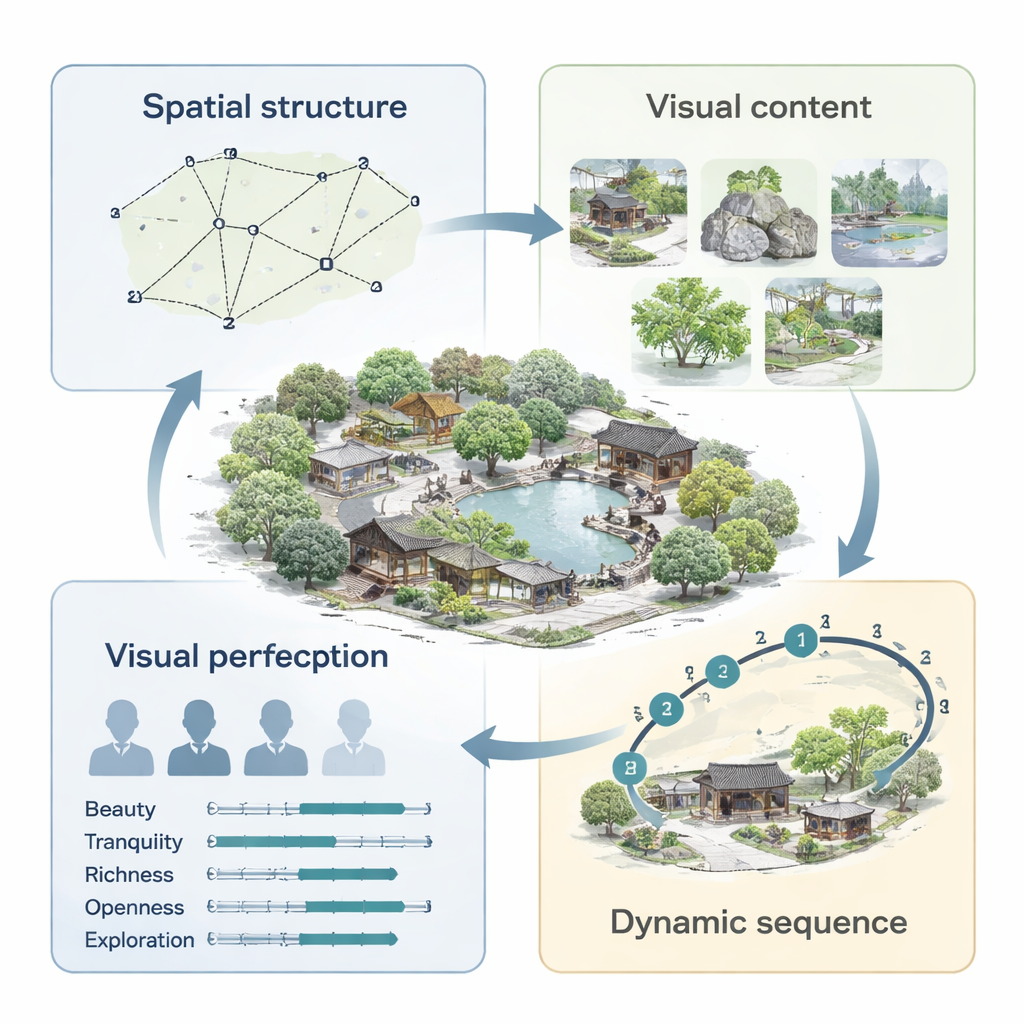
To understand how this garden "works" on visitors, the researchers built a four-part framework that follows the journey from physical layout to human feelings. First, they analyzed the plan using a method called space syntax, which maps where people are most likely to walk and what they can see from each spot. This revealed that the open pond and a few key forecourts act as visual and movement hubs, while long, narrow corridors create a sense of winding seclusion. Second, they photographed a representative walking route and used computer vision to break each image into four main elements—buildings, rocks, plants, and water—then calculated how varied, complex, or tightly clustered these elements were.
Linking Numbers to Human Feelings
The team then invited graduate students in landscape architecture to rate 83 views along the route for beauty, tranquility, richness, openness, and desire to explore. By comparing these scores with their image metrics, they found clear patterns. Views that mixed several elements in intricate ways tended to feel richer and more beautiful, especially when water and plants were prominent and buildings did not dominate the scene. Large, continuous surfaces of a single element—such as solid walls or blocky buildings—reduced the sense of richness and openness. Water played a special role: scenes where ponds or streams were visually continuous and easy to follow were rated calmer, more open, and more inviting to explore, suggesting that water lines quietly tell visitors “there is more to see ahead.”
Why the Garden Feels Like It Moves
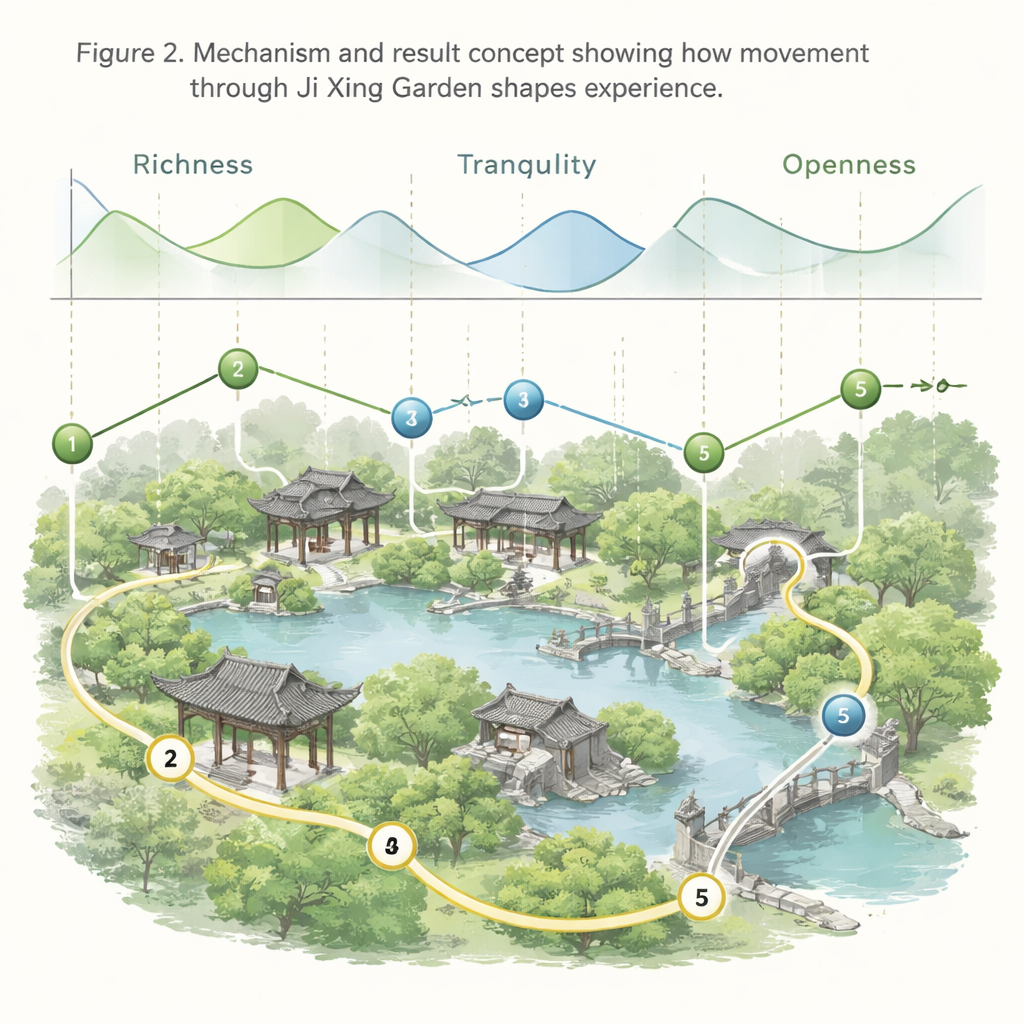
Finally, the researchers stitched all these viewpoints into a time line that matches the walking route. They showed that the garden’s famous “scenes changing as steps move” is not just poetic language: measures of visual richness and complexity rise and fall in a clear rhythm. At the entrance, the view suddenly opens from a blank wall to a layered pond scene, creating a strong visual “reveal.” Corridors then narrow the view, calming things down before another expansion at a pavilion or forecourt. Moon gates and zigzag bridges act as turning points where the mix of rocks, plants, and water changes abruptly, creating small climaxes. Quieter back courts, with white walls, bamboo, and rocks, offer visual and emotional rest before the route bends back toward the main pond for a final panoramic high point.
What This Means for Garden Lovers and Designers
For a lay visitor, the message is simple: the emotional power of Ji Xing Garden does not come from any single feature, but from how paths, walls, plants, rocks, and water are choreographed in time. Careful alternation between tight and open spaces, between simple and intricate views, helps the garden feel deeper, larger, and more engaging than its modest size suggests. For designers, the study offers a practical recipe: combine traditional garden ideas with modern analysis to plan where people will walk, what they will see, and how their feelings will rise and fall along the way. In doing so, even small urban sites—whether in China or overseas—can be shaped into places that tell a quiet, walkable story.
Citation: Zhou, L., Li, R., Liu, D. et al. An integrated framework to quantify tour-view experience in classical gardens using computer vision and spatial analysis. npj Herit. Sci. 14, 119 (2026). https://doi.org/10.1038/s40494-026-02387-w
Keywords: Chinese classical gardens, spatial experience, visual perception, landscape design, heritage interpretation