Clear Sky Science · en
The mechanisms of color, opacifying, and cracks in celadon glazes from the Southern Song Guan Kiln
Why old blue-green bowls still fascinate us
Centuries-old Chinese celadon bowls from the Southern Song dynasty are prized not just as antiques, but as objects with an almost living surface: a soft blue-green color, a milky, jade-like glow, and a fine web of cracks that collectors adore. This study looks under the surface of these celebrated "Guan" wares to explain, in modern scientific terms, how potters long ago managed to create such a distinctive look—and how we might reliably recreate it today.
The story behind a royal kiln
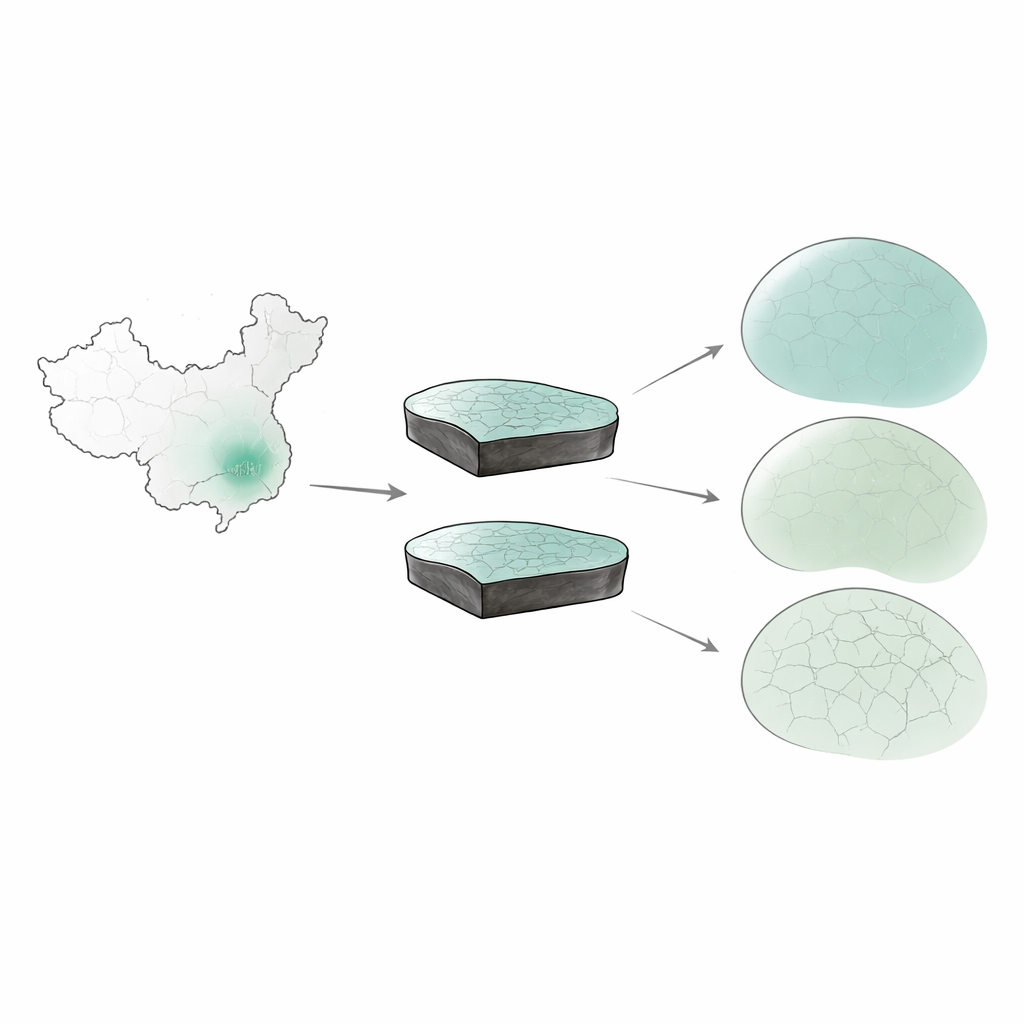
Guan ware was made for the imperial court after the Song rulers moved their capital south to Hangzhou in the 12th century. Archaeological digs at the Guan kiln sites have turned up only small fragments, but even these shards show remarkable variety in body color, glaze thickness, and crack patterns. The researchers selected six representative pieces and treated them almost like space rocks: carefully cleaned, then probed with instruments that measure color, chemical makeup, crystal structure, and even how the material expands when heated. Their goal was to connect what we see with the naked eye—the shade of blue or yellow, the creamy opacity, the network of cracks—to what is happening at the microscopic and atomic level in the glaze.
How the glaze gets its gentle color
The famous blue‑green of Guan celadon comes from a tiny amount of iron dissolved in the glassy glaze. Whether the glaze looks more blue, green, or yellow depends on two main factors: how much of the iron sits in a reduced form and which companion elements surround it. The team found that most of the iron is in a reduced state, which fits with firing in a low‑oxygen, wood‑burning kiln. Samples fired in stronger reducing conditions contained more of this form of iron and tended toward greener or bluer tones, while samples with relatively more oxidized iron leaned yellow. On top of this, the balance of common glaze ingredients such as calcium and potassium subtly shifts the energy levels around the iron atoms, nudging the color toward either cooler sky‑blue or warmer yellow‑green, much as a slight twist of a camera filter alters a photograph’s mood.
Why the glaze looks like carved jade
Guan glazes are valued for their soft, cloudy depth rather than glass‑clear transparency. The study shows that this jade‑like effect does not come from pigment particles, but from how light struggles to pass through an apparently simple layer of glass. Within the glaze, the researchers observed many tiny bubbles, a small number of crystals, and even much smaller droplets of slightly different glass composition. Together, these features scatter light over and over, lengthening its path and making the glaze appear milky yet luminous. Thick, high‑viscosity glazes—encouraged by recipes rich in calcium and fired at high temperatures—trap more bubbles and maintain these internal structures, which is why Guan pieces with thicker glazes often look especially rich and soft.
How beautiful cracks are born
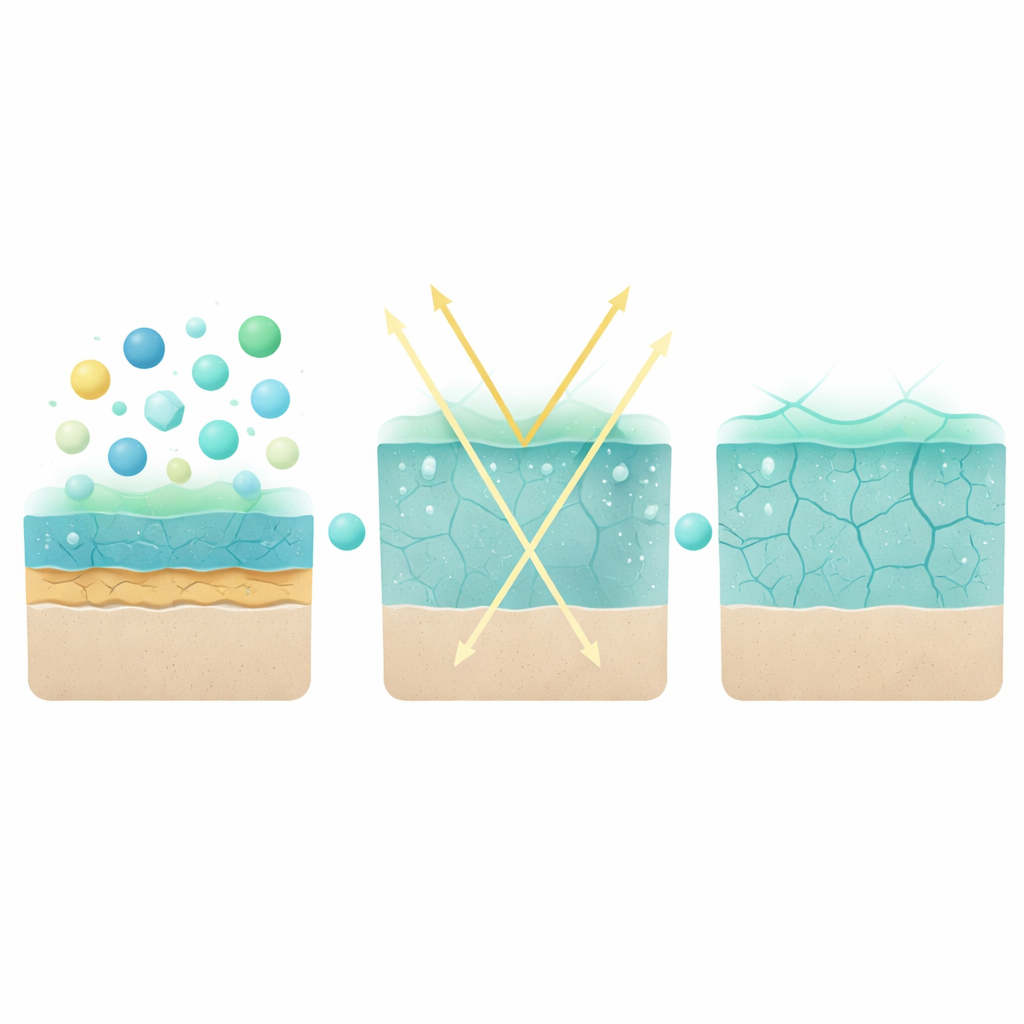
The fine network of lines on Guan celadon is not accidental damage but a built‑in effect created as the bowl cools. The glaze and the clay body beneath it expand and contract at slightly different rates with temperature. Because the glaze on these wares contains more calcium and less aluminum than the body, it tends to shrink more as it cools. Once this shrinking glass layer is held back by the comparatively rigid body, it is pulled into tension and finally fractures, releasing the stress as a web of cracks. Thicker glazes, and thinner bodies, amplify this stress difference and produce more numerous or coarser crack patterns, helping to explain why crackle is such a signature of Guan ware.
What this means for art, history, and making new ware
By tying color, glow, and crackle directly to chemistry, firing atmosphere, and microscopic structures, the study shows that the beauty of Southern Song Guan celadon is not a mystery or a lucky accident, but the outcome of carefully tuned material choices and kiln practice. For museum curators and conservators, these insights help distinguish true Guan ware from later imitations and guide gentle restoration. For modern potters and materials scientists, they offer a practical roadmap for recreating similar blue‑green tones, jade‑like depth, and controlled crackle patterns—bridging traditional craft and contemporary science while keeping the spirit of these imperial ceramics alive.
Citation: Ren, Z., Wang, H., Liu, Z. et al. The mechanisms of color, opacifying, and cracks in celadon glazes from the Southern Song Guan Kiln. npj Herit. Sci. 14, 187 (2026). https://doi.org/10.1038/s40494-026-02383-0
Keywords: celadon glaze, Song dynasty ceramics, Guan kiln, crackle glaze, cultural heritage science