Clear Sky Science · en
Dolomite properties, microenvironment, and water-rock interactions in the Temple of the Inscriptions, Palenque, Mexico
A Hidden Tomb and the Story Written in Stone
Deep inside a Mayan pyramid at Palenque, Mexico, lies the spectacular tomb of the ruler K’inich Janaab’ Pakal. His massive carved stone sarcophagus has survived for more than 1,300 years in a humid, underground chamber fed by nearby springs and streams. This study asks a deceptively simple question: how has this stone reacted to centuries of dripping water, trapped air, and a changing climate—and what does that mean for preserving one of the most famous burials in the ancient Americas?
Where the Temple Meets the Mountains and the Rain
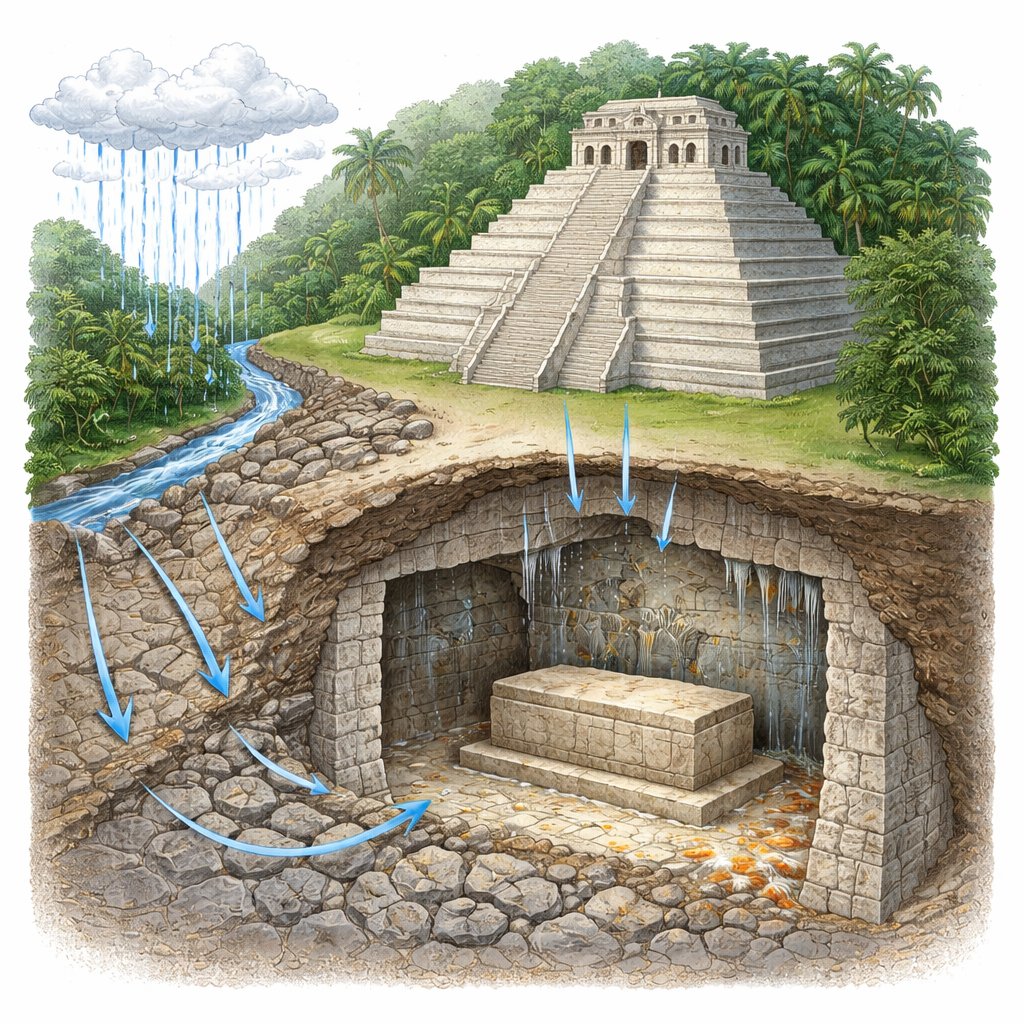
The Temple of the Inscriptions rises on a forested slope at the edge of the Chiapas mountains, in one of Mexico’s wettest regions. Beneath its grand staircase, engineers of the ancient city channeled spring water through hidden conduits, while the burial chamber itself sits just below plaza level at the heart of the pyramid. The sarcophagus, floor slabs, walls, and stairs are all cut from a pale, dense stone known as dolomite, quarried locally when the builders leveled the hillside to create the temple platform. This tight link between geology, architecture, and abundant water created a semi-enclosed cave-like environment where rock, air, and water have been interacting ever since the tomb was sealed.
Reading the Stone’s Chemical Fingerprint
To understand this environment, the researchers treated the temple’s stone as both an artifact and a rock sample. Using tiny cores and chips from the sarcophagus, walls, floors, nearby outcrops, and construction fill, they analyzed the stone’s chemistry and crystal structure with modern lab tools. These tests show that the material is “pure” dolomite—rich in magnesium and poor in impurities such as sodium and strontium—matching specific rock layers in the surrounding fold-and-thrust belt. Under microscopes and 3D X‑ray scans, the stone reveals a dense mosaic of crystals with very little connected pore space, especially in the chamber walls. The sarcophagus and some masonry elements are slightly more porous, with tiny passages where water can creep in and out.
Ancient Seas, Microbes, and Microscopic Caves
On the scale of sand grains and smaller, the dolomite still carries traces of its origin in a warm, shallow sea tens of millions of years before the Maya. The authors found relicts of algae, sponges, and tiny shelled organisms, now replaced by magnesium-rich crystals. Their shapes and the way crystals overgrow one another suggest that microbes helped transform earlier lime muds into dolomite, slowly dissolving old mineral coatings and re-precipitating new ones. This long history matters today because it controls how the stone breaks, how easily water can diffuse through it, and how resistant it is to being dissolved again in the damp tomb.
Water, Heat, and the Slow Sculpting of a Sarcophagus
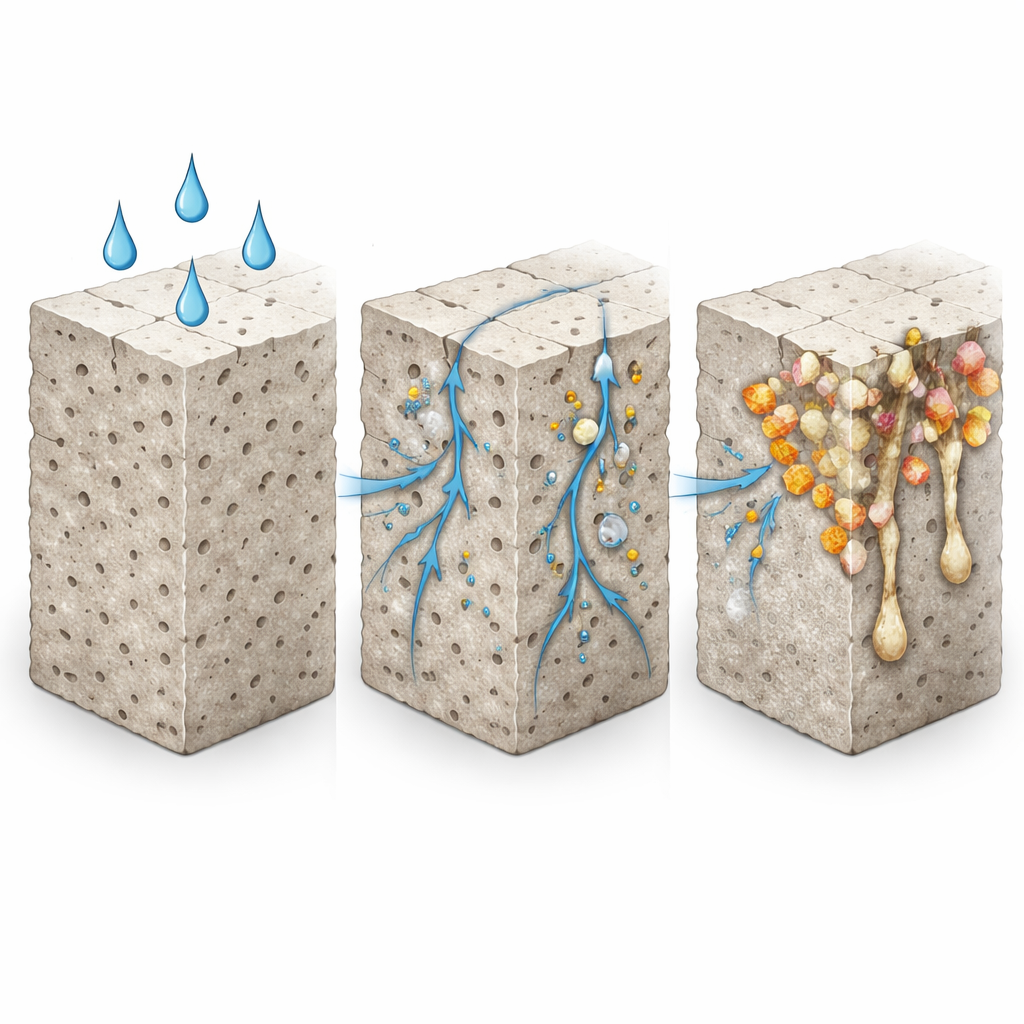
Inside the chamber, conditions are remarkably stable but relentlessly wet: temperatures hover around 23–24 °C, and relative humidity stays near saturation most of the year. Sensors show that groundwater seeps through fractures and joints above, feeding slow drips that form stalactites on the vault and speleothems on the sarcophagus lid. At the same time, thin films of moisture condense on the cooler stone whenever the air warms slightly. Chemically, rainwater enriched in carbon dioxide dissolves minerals from the overlying rocks, then re-deposits them as delicate calcite and other carbonates on the crypt walls, stucco figures, and the carved lid. Over centuries, this has etched fine details, stained surfaces with organic films, and built up crusts that partly mask tool marks, plaster traces, and pigments.
Climate Change and Caring for a Fragile Masterpiece
Recent decades have brought slightly higher temperatures and more uneven rainfall to the region, trends expected to continue. In this confined chamber, even small shifts can tip the balance between dissolution and re-crystallization, drying and wetting, and dilute and concentrated solutions. The study concludes that two intertwined processes dominate: direct water flow that dissolves and re-precipitates carbonates, and vapor-driven moisture cycles that cause condensation and salt concentration in micro-pores. To keep Pakal’s sarcophagus from slowly dissolving or crumbling, the authors recommend ongoing monitoring and gentle interventions: diverting runoff and drips, removing harmful surface deposits, buffering extreme acidity or alkalinity, and, if needed, regulating moisture and temperature. By combining cutting-edge rock science with heritage conservation, their work turns a royal tomb into a natural laboratory for understanding how tropical monuments can be protected in a warming, changing world.
Citation: Mora Navarro, G., López Doncel, R.A., Castillo-Rivera, F. et al. Dolomite properties, microenvironment, and water-rock interactions in the Temple of the Inscriptions, Palenque, Mexico. npj Herit. Sci. 14, 140 (2026). https://doi.org/10.1038/s40494-026-02382-1
Keywords: Palenque, dolomite, water-rock interaction, Maya archaeology, heritage conservation