Clear Sky Science · en
Element mining, network associations and scene reconstruction of qiantang river poetry road literary allusion landscapes
Poems That Shape Real Places
Along China’s Qiantang River, poems have done more than describe the scenery—they have helped create it. For more than a thousand years, writers have woven stories, legends, and historical figures into their depictions of this river, turning coves, fishing platforms, and tidal flats into places people still seek out today. This study asks a simple but powerful question: can modern data tools help us see, protect, and revive this living bridge between literature and landscape?
A River of Stories, Not Just Water
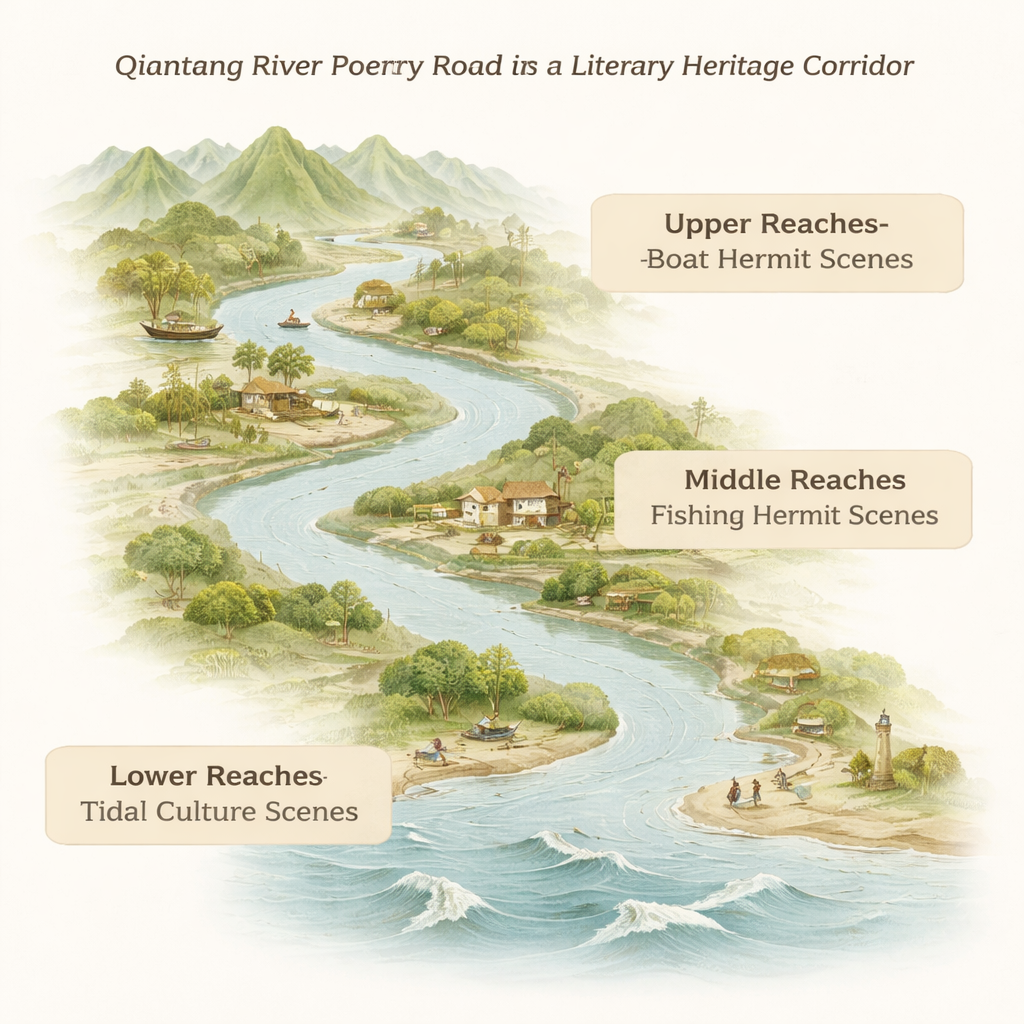
The Qiantang River Poetry Road is a 400-kilometer cultural corridor stretching from mountain headwaters to the sea. Since the Song Dynasty, poets have written about its cliffs, villages, tides, and temples. In their verses, they constantly引用 literary allusions—short references to famous people, myths, and earlier works. These allusions act like cultural “genes,” carrying shared memories and values across centuries. Yet many such traditions around the world are fading as their original contexts disappear. The authors argue that to keep this heritage alive, we must move beyond treating each allusion as an isolated curiosity and instead uncover how they cluster together into rich, repeating scenes that link text, place, and experience.
From Ancient Verses to Data-Rich Maps
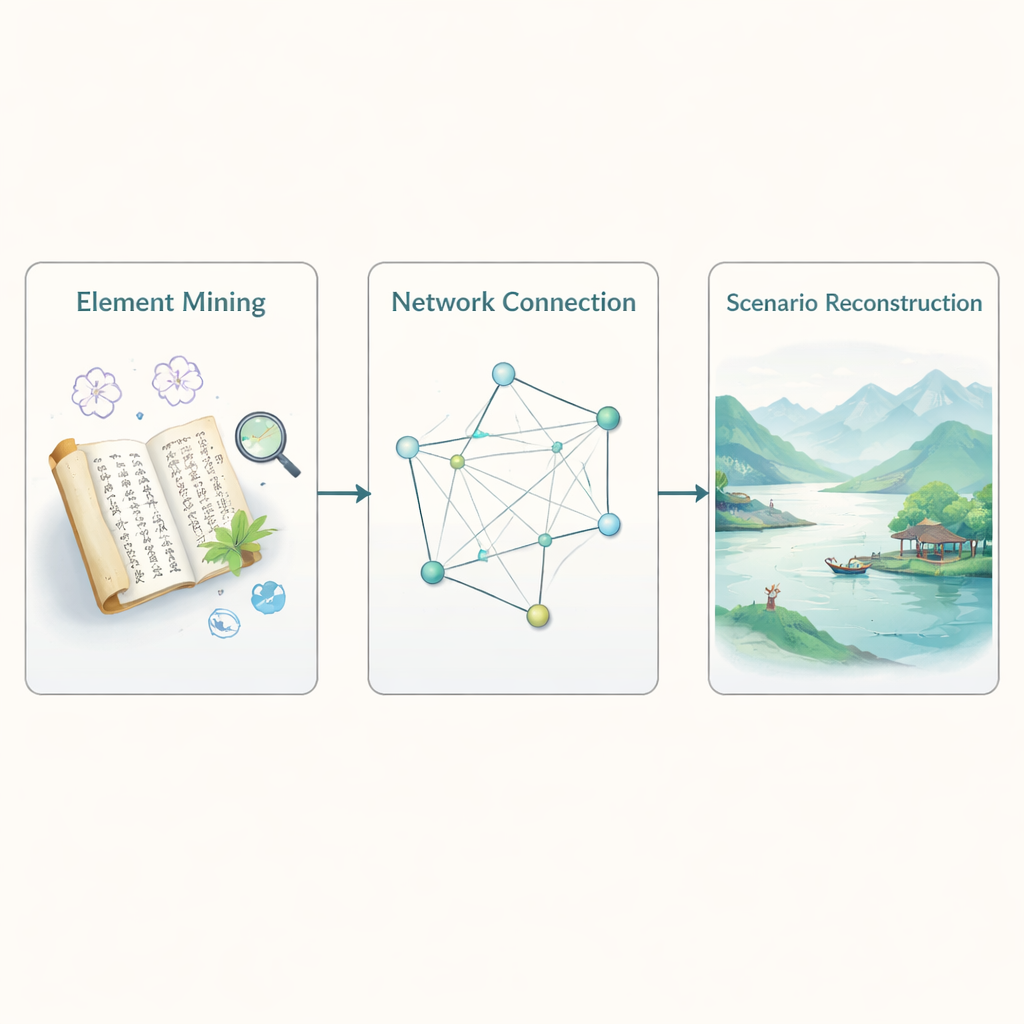
To do this, the team assembled a digital corpus of 683 Song Dynasty poems about the Qiantang basin—tens of thousands of characters of classical Chinese. They then used a modern language model (ALBERT with a CRF layer) to automatically spot 9,000-plus known allusion terms and extract those that actually appear in the poems. After careful testing, the model proved both accurate and thorough, allowing the authors to build a structured “gene map” of 228 standard allusions and 533 allusion mentions. Next, they broke the poems down to their most basic building blocks: single-character words for natural features (like river, cloud, tide) and cultural elements (like boat, shrine, tower). By seeing which allusions and landscape words co-occurred in the same poem, they could draw a network showing which stories, images, and places most strongly travel together.
Three Distinct Worlds Along One River
The network analysis revealed that the Qiantang is not a single uniform story world but three linked ones. In the upper reaches, where the river winds through mountains, allusions cluster into “boat hermit” scenes such as “Autumn Waters Canoeing”: recluse-scholars like Yan Guang and Jiang Ziya on small leaf boats, under blazing suns and high winds, moving between withdrawal and public duty. In the middle reaches, where shoals and mist are common, “fishing hermit” scenes dominate, especially “Misty Rain Solitary Angling” around Yan Ziling’s Fishing Platform—fur-clad sages, coir raincoats, cormorants, and maple forests veiled in drizzle. Near the estuary, the focus shifts dramatically to “tidal culture.” Here scenes like “Tidal Thunder Resonance” center on roaring bores, drums, passenger sails, and water deities linked to the statesman Wu Zixu, blending natural spectacle, folk belief, and political memory.
Turning Data Networks into Lived Scenes
Crucially, the authors did not stop at abstract graphs. They fed the strongest allusion–landscape clusters into an image-generation model to create historically grounded visual scenes: boats on autumn rivers framed by reed beds and wild geese; misty fishing platforms with red maples and cormorant nets; crowded riverfronts where thousands gather to watch the tide crash like thunder. They then cross-checked these drafts against old paintings, local gazetteers, and historical maps to refine details such as house materials, river widths, and festival customs. From this, they proposed concrete plans: hermit-themed boat and fishing routes in the upper and middle reaches, complete with role-playing and seasonal drama festivals; and, downstream, tidal markets, deity-themed interpretive trails, and science-meets-myth education camps that connect hydrology with legend.
Why It Matters for Visitors and Communities
For non-specialists—travelers, local residents, and planners—the takeaway is that heritage is not just old stones or isolated scenic spots. It is a living network where stories, feelings, and environments reinforce one another. This study shows that by mining classical poetry with modern algorithms, we can see recurring “scene archetypes” that survive across many poems and places. Protecting and activating these clusters—rather than only single monuments—helps avoid generic, copy-paste tourism. Instead, each river reach can highlight its own flavor: quiet hermit retreats upstream, reflective fishing worlds midstream, and thunderous ritual tides downstream. In doing so, the Qiantang River Poetry Road offers a model for other regions worldwide seeking to turn fragile literary memory into vivid, sharable experiences without losing depth or authenticity.
Citation: Han, D., Xu, T., Li, J. et al. Element mining, network associations and scene reconstruction of qiantang river poetry road literary allusion landscapes. npj Herit. Sci. 14, 127 (2026). https://doi.org/10.1038/s40494-026-02381-2
Keywords: literary landscapes, Qiantang River, Chinese poetry, cultural heritage, digital humanities