Clear Sky Science · en
Ecosystem services in UNESCO World Heritage sites: a review of research trends and future directions
Why special places matter to everyday life
UNESCO World Heritage sites are often seen as postcard-perfect destinations or treasured ruins from the past. But this review argues that they are also quiet workhorses of the planet, supplying clean water, stable climates, fertile soils, food, and inspiration for millions of people. By examining 201 scientific studies published between 2005 and 2025, the authors explore how these globally important places support human well‑being through “ecosystem services” and how those benefits are being strained by climate change, tourism, and uneven protection.
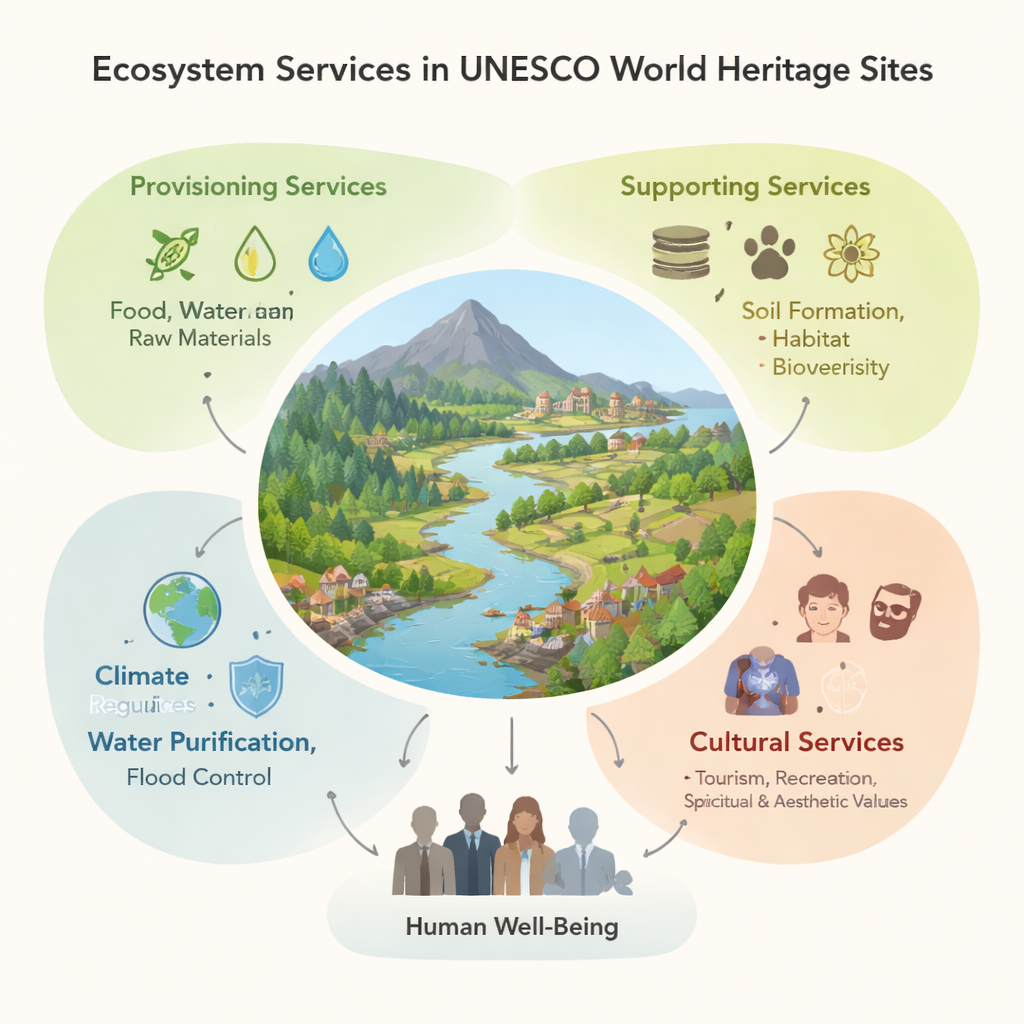
What nature gives us at heritage sites
The paper uses the idea of ecosystem services to unpack what World Heritage sites actually do for people. These services include material goods like crops, timber, and freshwater; background functions like soil formation and habitats for wildlife; regulatory roles such as storing carbon, buffering floods, and purifying water; and cultural benefits like recreation, beauty, spiritual meaning, and a sense of identity. The authors show that these services underlie the “Outstanding Universal Value” that earns a site its World Heritage badge. If forests thin, soils erode, or coastlines crumble, the very qualities that justified inscription can be lost. In this sense, the health of ecosystem services is the hidden foundation of each site’s global significance.
Rising attention and uneven focus
Research on World Heritage ecosystem services has grown rapidly, especially after global milestones such as the Millennium Ecosystem Assessment, the Paris climate agreement, and the Sustainable Development Goals. The review divides this growth into three phases: a slow start up to 2010, steady expansion through the 2010s, and a surge after 2020 as climate impacts and post‑pandemic tourism pressures intensified. Yet the attention is lopsided. Studies cluster around famous natural sites—like the Great Barrier Reef, Jiuzhaigou, and Hani rice terraces—while cultural and “mixed” sites that weave together nature and culture remain underexplored. Most work stays within national boundaries, mirroring the way governments manage World Heritage, and there is almost no true international research collaboration even though many threats, such as climate shifts and invasive species, cross borders.
How scientists study these living treasures
The authors find that researchers use a mix of methods to measure and interpret services. On the quantitative side, computer models and satellite data estimate carbon storage, water regulation, soil conservation, and economic value. These numbers are powerful in debates over land use and funding because they translate nature’s work into physical or monetary terms. On the qualitative side, interviews, surveys, and participatory mapping capture how residents, tourists, and managers perceive beauty, heritage, and well‑being. However, cultural benefits are still often treated as an afterthought or even as a problem—tourism crowds and visitor impacts—rather than as a positive force that can support conservation and local livelihoods. The review argues that combining hard data with local stories and values is essential for realistic management.
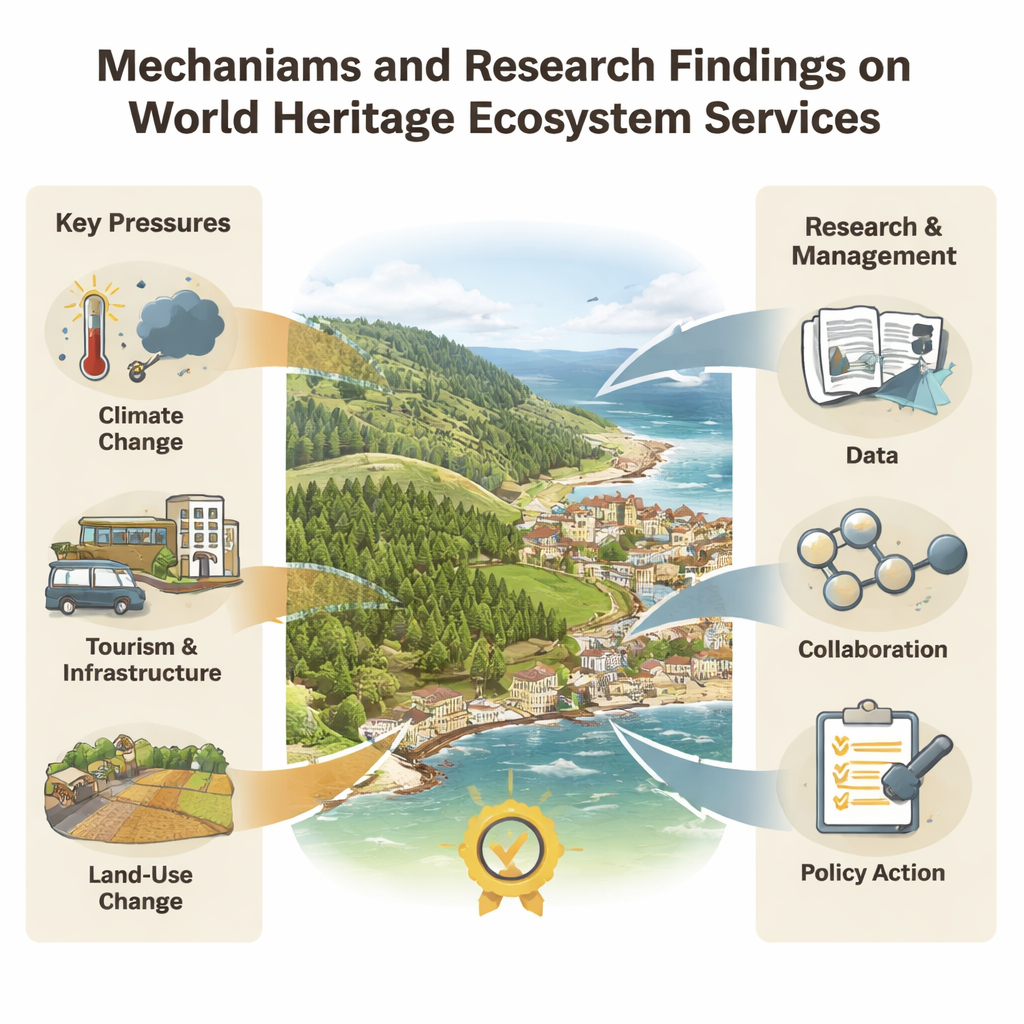
Climate strain, tough trade‑offs, and management gaps
Climate change emerges as a central pressure on World Heritage ecosystem services. Rising seas threaten coastal sites; heatwaves and droughts kill trees and reduce carbon storage; storms and fires damage both wildlife and historic structures. At the same time, protected forests, wetlands, and mangroves inside many World Heritage areas store vast amounts of carbon and shield communities from floods and storms, making them natural allies in climate adaptation and mitigation. The review also highlights difficult trade‑offs: expanding tourism or agriculture may bring short‑term income but can erode habitats, water quality, and the very scenery that draws visitors. Because decisions are often driven by national authorities and experts, local communities—who live with the consequences—may be sidelined, fueling conflict and undermining long‑term stewardship.
Where we go from here
To a lay reader, the message is clear: World Heritage sites are not museum pieces frozen in time. They are living landscapes and cityscapes that quietly support climate stability, food production, biodiversity, and cultural identity. The article concludes that protecting these services is the only way to safeguard the famous views and monuments people recognize. Doing so will require better long‑term monitoring, smarter use of big data and artificial intelligence, stronger international cooperation, and governance that genuinely shares power with local residents. If we treat World Heritage sites as connected social‑ecological systems rather than isolated tourist brands, they can continue to sustain both nature and people for generations to come.
Citation: Gui, Y., Ma, Y., Chen, Y. et al. Ecosystem services in UNESCO World Heritage sites: a review of research trends and future directions. npj Herit. Sci. 14, 115 (2026). https://doi.org/10.1038/s40494-026-02380-3
Keywords: World Heritage, ecosystem services, climate change, cultural landscapes, conservation policy