Clear Sky Science · en
Coupling coordination and obstacles in industrial historical spaces: the environment-value-memory framework in Shenyang
Why old factories still matter
Across many cities, old factories, rail yards, and workers’ housing blocks are being torn down or turned into coffee shops and museums. These places are more than shells of past industry: they hold memories of how people lived and worked, and they shape today’s neighborhoods. This study looks at 64 such industrial sites in Shenyang, a major industrial city in northeastern China, to ask a simple but powerful question: how can we protect their environment, cultural value, and collective memory at the same time, instead of treating each in isolation?
A three-part way to read the city
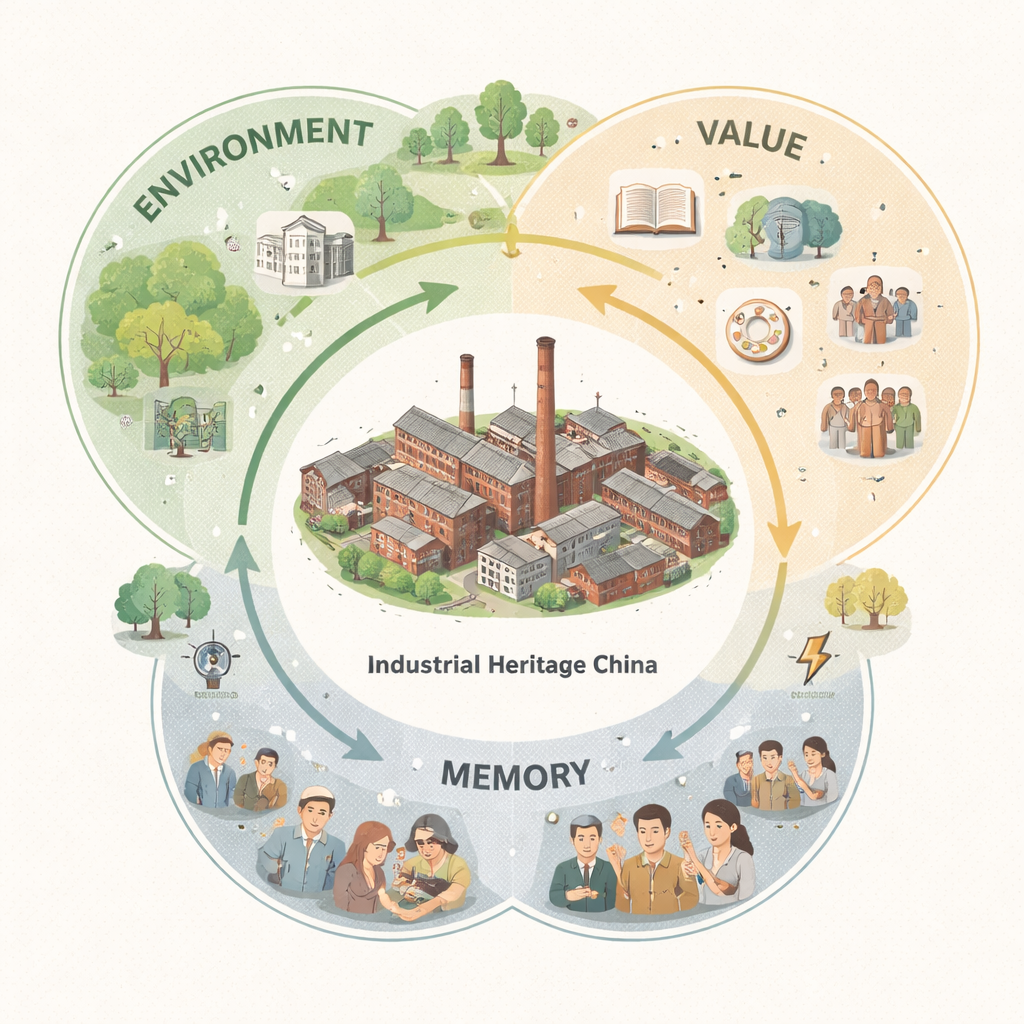
The researchers propose a new way to understand industrial areas, which they call the “Environment–Value–Memory” framework. Environment covers both nature (like trees and air quality) and the built setting (street layout, nearby buildings, and public facilities). Value refers to why a site matters, including its history, technology, architecture, art, and role in community life. Memory focuses on how people remember and feel about a place, through stories, emotions, and traditions. Rather than looking at these pieces separately, the study treats them as a linked system: a good environment can support heritage value, clear stories can strengthen memory, and strong memories can, in turn, demand better care for the environment.
Measuring balance and conflict
To see how well this three-part system works in real neighborhoods, the team combined maps, field visits, interviews, and more than 1,200 questionnaires from former workers, residents, and visitors. They used mathematical models to measure how tightly the three systems are linked (the “coupling” degree) and how well they are actually working together (the “coordination” level). This distinction matters. In some places, environment, value, and memory are strongly connected but poorly balanced, like gears that are firmly meshed yet grinding. In others, the links are looser but the overall functioning is smoother, suggesting that careful management can partly make up for weaker natural connections.
Different stories for different types of sites
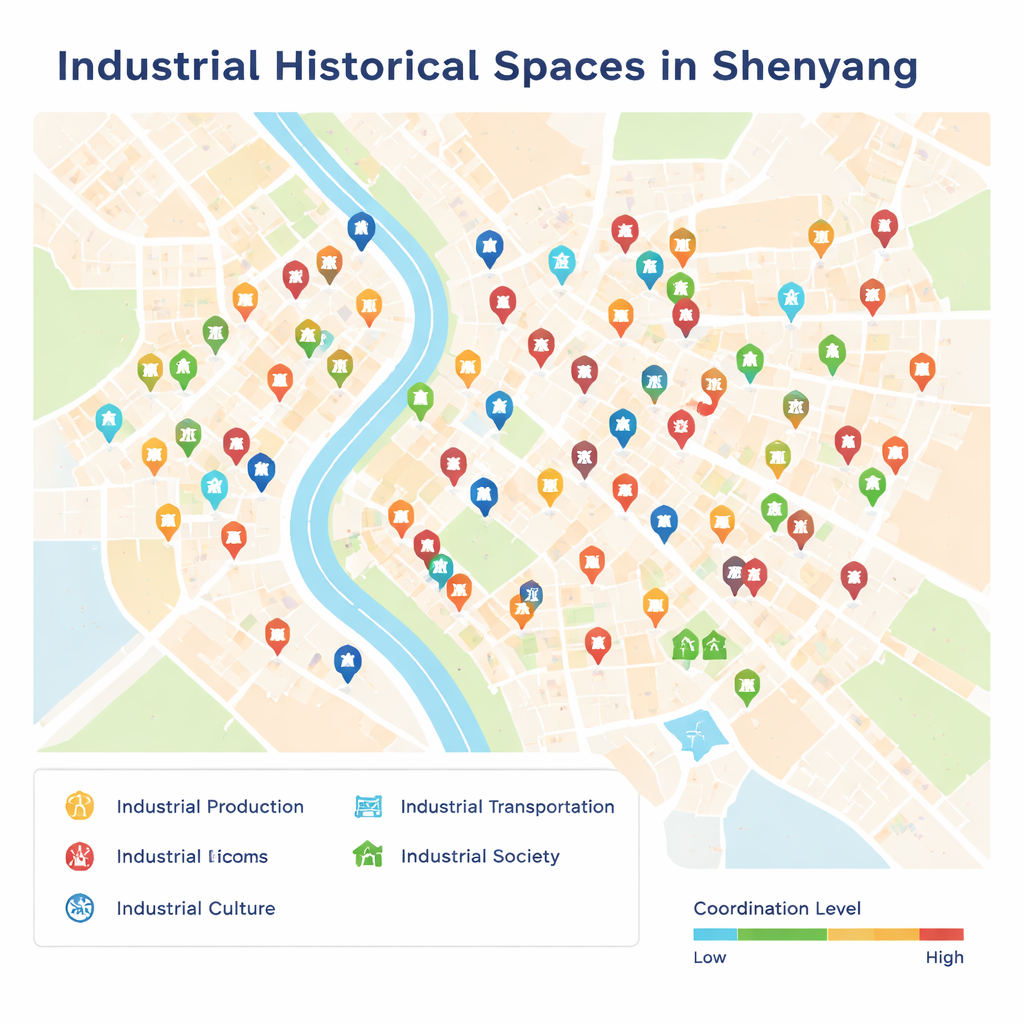
The 64 sites were grouped into four types: production (factories and workshops), transportation (rail lines and freight yards), society (workers’ housing and services), and culture (museums and heritage parks). The results show clear contrasts. Cultural and some production sites generally score highest, especially in how well value and memory reinforce each other; museums and well-preserved factories, for example, make it easier for visitors to understand history and feel attached to it. Transportation sites, by contrast, often suffer from broken surroundings: old rail corridors have been cut up by roads or redevelopment, so their environment does not support memory or value very well. Social sites sit in the middle; their everyday life stories are rich, but green space, noise, and design quality can be weak, which drags down overall coordination.
Places that lift up their neighbors
Location also matters. Central districts of Shenyang, where different industrial periods overlap and public investment has been stronger, tend to show better balance between environment, value, and memory. These “high-coordination” areas appear to have a spillover effect: they pull nearby spaces upward by setting standards for restoration, attracting visitors, and keeping stories alive. Still, the study finds that the main obstacles differ by system. Built surroundings, such as street networks and facility quality, are the biggest environmental problems. On the value side, many sites underplay their historical depth and artistic features. In terms of memory, the physical anchors—old buildings, workers’ neighborhoods, and everyday objects—are often at risk, threatening the continuity of shared stories across generations.
What this means for our own cities
For non-specialists, the key message is that saving industrial heritage is not only about fixing up buildings or opening a museum shop. A site thrives when its setting is livable, its stories are clearly told, and its memories stay active in community life. The Shenyang study shows that it is possible to measure how well these pieces fit together and to pinpoint what gets in the way, whether that is traffic noise, weak historical interpretation, or fading local traditions. This three-part lens can help city planners, residents, and heritage groups in many countries decide which old industrial places to prioritize, how to repair their surroundings, and how to keep their “industrial past” as a living part of the urban future rather than a hollow backdrop.
Citation: Tang, T., Ha, J., Chen, S. et al. Coupling coordination and obstacles in industrial historical spaces: the environment-value-memory framework in Shenyang. npj Herit. Sci. 14, 110 (2026). https://doi.org/10.1038/s40494-026-02378-x
Keywords: industrial heritage, urban regeneration, collective memory, Shenyang, historic industrial spaces