Clear Sky Science · en
Comparative analysis of lacquer application techniques for heritage museum-quality lacquered furniture imitations and establishment of a standardized evaluation system
Why Replica Lacquer Furniture Matters
When you walk through a palace or history museum, the spectacular red, black, and gold lacquered thrones and cabinets you see are not always the originals. Many are carefully made replicas that stand in for fragile treasures resting in storage. This study asks a deceptively simple question with big consequences for what we see in museums: how close do these imitations really come to the look and feel of traditional lacquer, and how should museums judge whether a replica is “good enough” for display?
The Challenge of Standing In for History
Historic lacquered furniture is both visually stunning and extremely delicate. Over centuries, its glossy layers can crack, warp, or peel due to handling, fluctuating temperature and humidity, or poor storage. Severely damaged pieces must be taken off display, and even restored objects spend long “dormant” periods resting between conservation treatments. To keep exhibitions visually complete and to protect originals from travel and light exposure, museums increasingly rely on full-scale, high-fidelity copies. Yet there has been no shared technical yardstick for how these replicas should be made or evaluated, leading to jarring differences in color, shine, and texture even within a single exhibition.
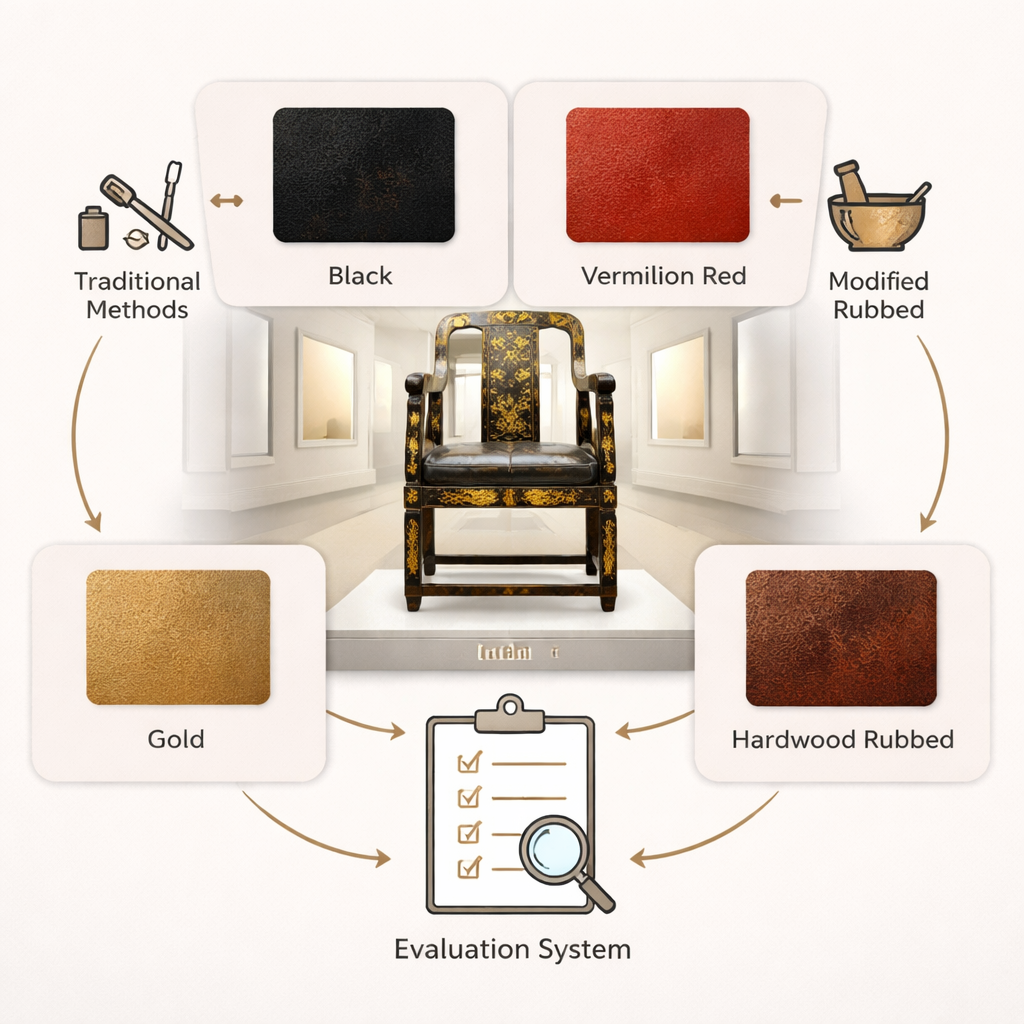
Four Classic Looks, Old and New
The researchers focused on four of the most important traditional lacquer finishes found on palace furniture: deep black, bright vermilion red, rich gold, and a warm “hardwood rubbed” coating that enhances the grain of the wood. For each type, they reconstructed historically documented methods using natural tree lacquer and traditional pigments, then created modern variants: slightly simplified traditional processes, versions using cheaper cashew-based lacquer, and fully industrial coatings like water-based paints and putties. In total, they produced 95 test panels, all cut to the same size, and carefully controlled drying conditions and layer structures so that differences in appearance and performance could be traced back to the coating systems themselves.
Measuring Shine, Smoothness, and Color
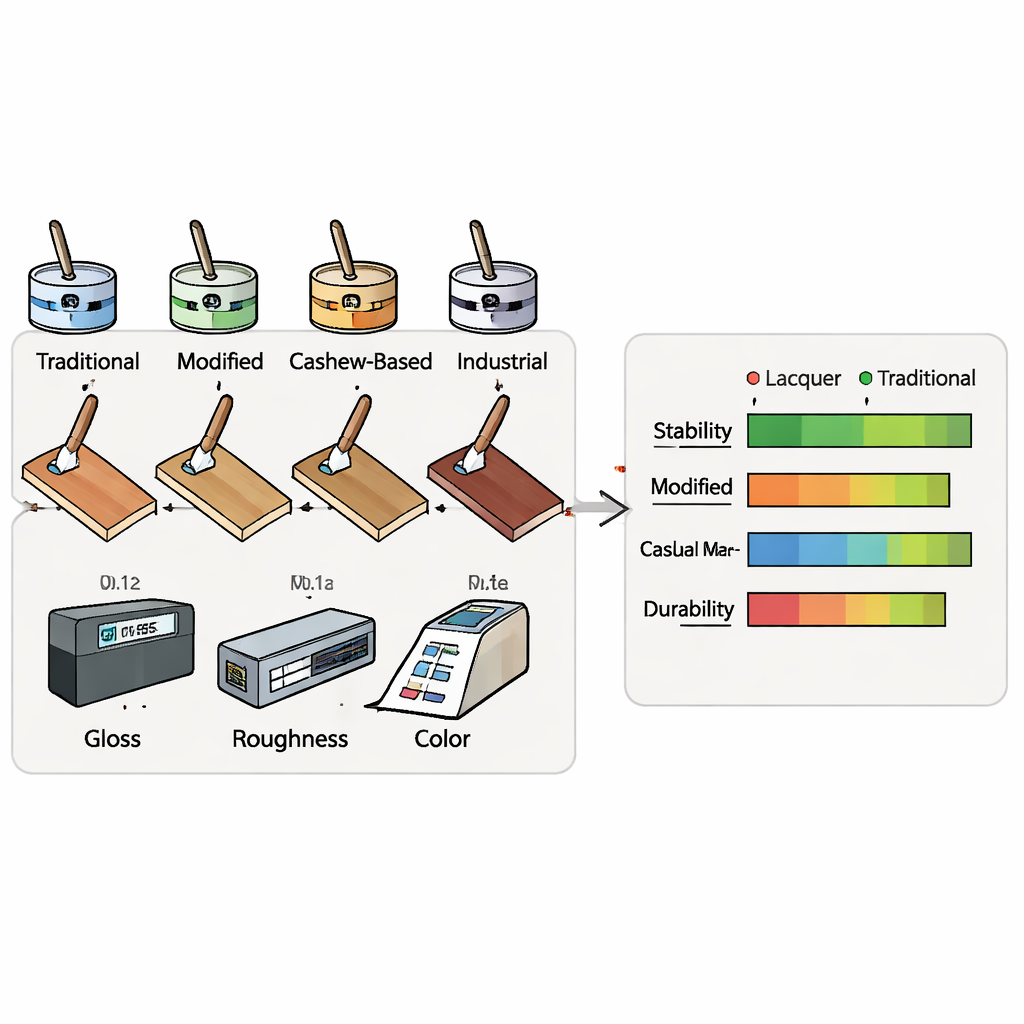
To move beyond subjective visual judgment, the team treated each panel like a sample in a materials science lab. They measured gloss (how shiny the surface is), surface roughness (how smooth or textured it feels), and color values across the visible spectrum. They also tested how firmly the lacquer film clung to the wood by cutting a grid into the surface and checking how much flaked off, and they cycled samples through hot, humid conditions and deep cold to mimic transport and unstable gallery climates. Statistical tools helped them separate real, repeatable differences among techniques from random variation, and box plots and confidence intervals revealed how stable each process was—not just on average, but from one spot on a panel to another.
What Modern Shortcuts Gain—and Lose
The results were striking. Traditional techniques, especially those using full multi-layer lacquer grounds and natural pigments, produced the most stable surfaces and the closest match to the deep, subtle colors prized in historical furniture. Their black and gold finishes in particular showed low variation in gloss and color and excellent adhesion, even after thermal cycling. Modified traditional methods that used modern pigments but kept the old layer structure performed nearly as well, offering a workable balance between authenticity, cost, and time. Cashew lacquer and industrial paints told a different story. Cashew-based coatings often looked bright and attractive at first glance but showed weaker stability and a “shallower” visual impression. Industrial lacquers tended to give very consistent numbers for gloss and color, yet their reds and golds were overly bright and commercial-looking, lacking the visual weight and depth seen in palace objects. In adhesion tests, traditional lacquer again came out on top, while water-based industrial systems were most prone to flaking.
A Practical Grading System for Museums
Combining all these findings, the authors propose a clear grading scheme that links specific processes to recommended uses. First-class replicas, made with traditional lacquer and full ash layers, are reserved for top-tier exhibitions where close visual fidelity is essential, such as reconstructions of imperial interiors. Second-class techniques, often simplified but still using natural lacquer and careful polishing, are suited to high-quality supporting pieces. Lower-cost cashew and industrial finishes are designated for educational props, temporary shows, or settings where budget and speed matter more than perfect authenticity. Crucially, the authors also provide numerical thresholds for acceptable gloss, roughness, color variation, and adhesion, turning subjective craft judgments into a repeatable evaluation system. For museum visitors, the takeaway is that the “fake” throne or cabinet you see on display may be backed by sophisticated science: the best replicas are not only visually convincing but also engineered and graded to convey traditional aesthetics as faithfully—and sustainably—as possible.
Citation: Li, Q., Zhang, F., Jia, W. et al. Comparative analysis of lacquer application techniques for heritage museum-quality lacquered furniture imitations and establishment of a standardized evaluation system. npj Herit. Sci. 14, 111 (2026). https://doi.org/10.1038/s40494-026-02376-z
Keywords: lacquered furniture, museum replicas, cultural heritage conservation, surface coatings, Chinese decorative arts