Clear Sky Science · en
Automated detection and topic mining of ancient murals across different styles
Why decoding ancient wall art matters today
Across Asia, ancient murals line the walls of caves, temples, and tombs, preserving stories of everyday life, religion, and power that have long since vanished from the written record. Yet these paintings now exist in huge digital collections, far too large for experts to examine one by one. This study shows how modern artificial intelligence can automatically sort murals by style and uncover their recurring themes, helping historians, curators, and the public navigate this visual universe and better understand how beliefs and ways of life evolved over centuries.
Reading murals with digital eyes
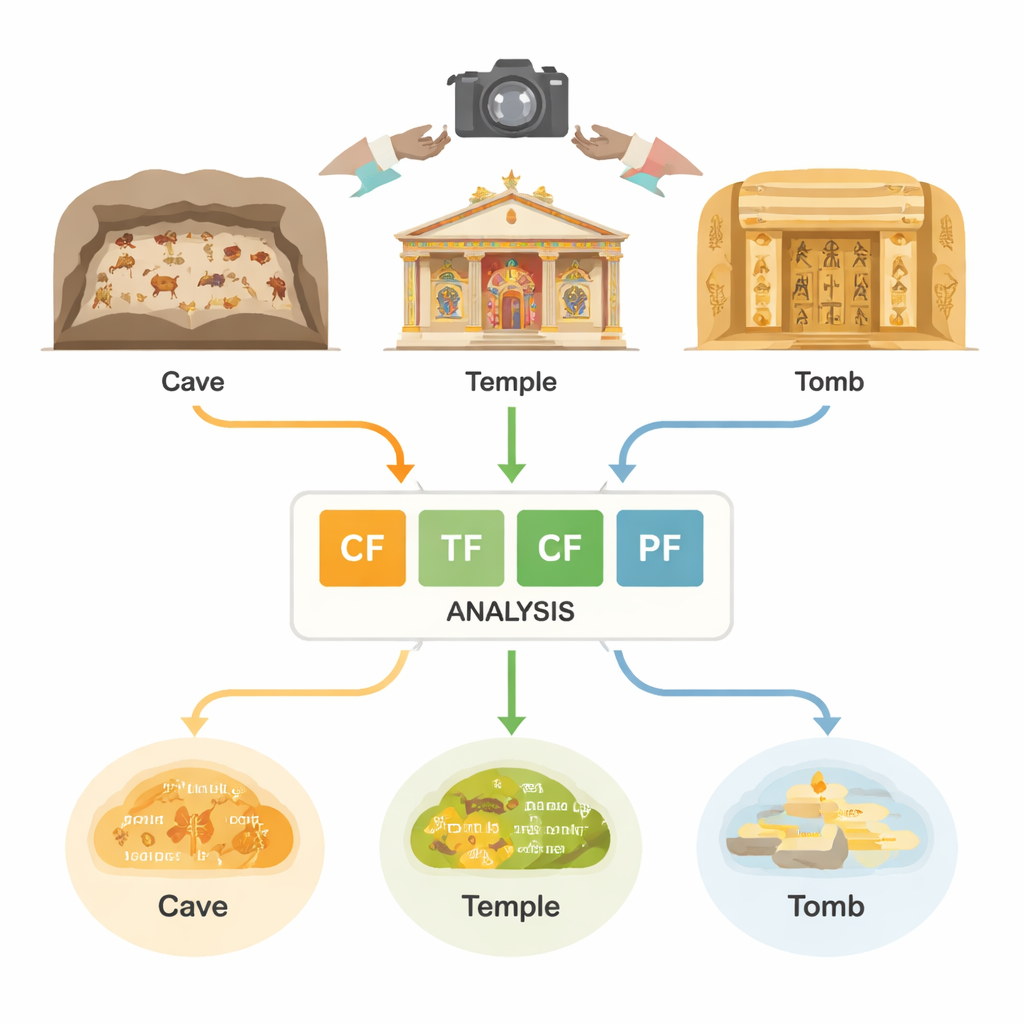
Instead of relying on a specialist’s trained eye, the authors build a computer framework that treats each mural as a bundle of visual clues. They gather nearly 5,400 images from three settings: cave murals from long rock-cut shrines, temple murals from above-ground religious buildings, and tomb murals buried with the dead. The system first turns each picture into several kinds of numerical descriptions that capture its color palette, surface texture, small local details such as edges or ornaments, and broader arrangements of figures and scenes. By combining these different "views" of the same image, the computer gains a rich, multi-layered sense of what distinguishes one mural style from another.
Teaching a computer to recognize mural styles
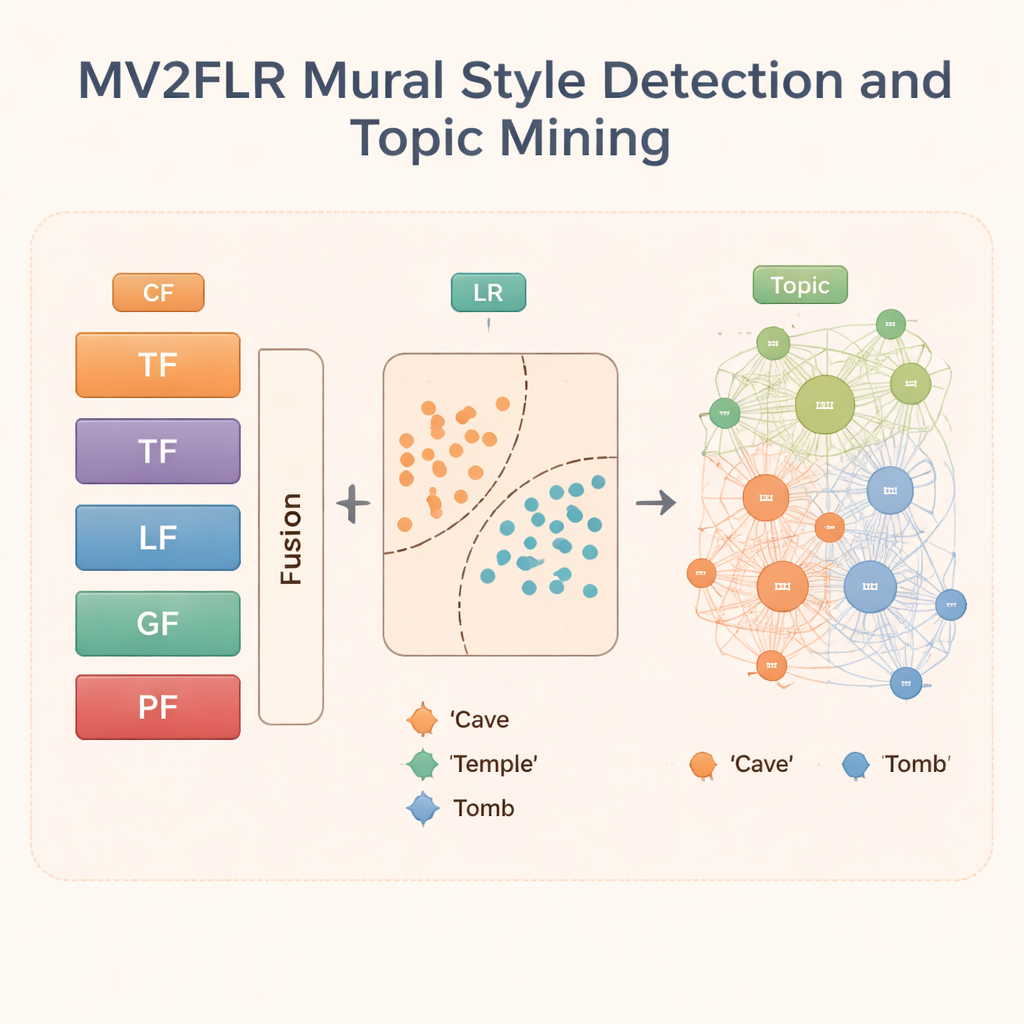
Once these visual fingerprints are extracted, the authors train a machine-learning model to learn which patterns go with cave, temple, or tomb murals. The heart of the system, which they call MV2FLR, fuses five feature types and then feeds them into a simple but powerful statistical classifier known as logistic regression. Tested on unseen murals, the model correctly identifies the style almost 99 percent of the time, outperforming more complex deep-learning networks that look only at one aspect of the image. The study also shows that patch-based features, which capture how small image regions relate to one another across the whole painting, are especially good at distinguishing styles, while color and texture alone are not enough.
Finding stories hidden in mural descriptions
Murals are not just images; they are also carefully cataloged with short text descriptions. To explore what these paintings are about, the researchers use a modern topic-mining method called BERTopic on the accompanying Chinese texts. This approach groups together murals that share key words, such as “Bodhisattva,” “feast,” “travel,” or “preaching Dharma,” and maps how often each cluster appears in cave, temple, or tomb settings. In doing so, it reveals both striking overlaps and clear differences in subject matter. All three mural types repeatedly feature Buddhist figures, protective deities, attendants, and flying celestial beings, suggesting a shared visual language rooted in scripture and ritual.
How different spaces shape the art
At the same time, each mural setting develops its own favorite themes. Temple murals lean heavily toward religious teaching: narrative scenes from Buddhist scriptures, formal preaching assemblies, and ordered ranks of heavenly kings and other deities. Tomb murals dwell on the earthly and hoped-for lives of the dead, highlighting banquets, music and dance, processions with horses and carriages, and idealized domestic scenes. Cave murals often sit between these worlds, mixing Pure Land paradises and devotional offerings with glimpses of regional customs. By tracing how these topics rise and fall across dynasties, the authors show that shifts in political power, religious fashion, and everyday practice all leave their mark on the wall paintings.
What this means for understanding the past
For non-specialists, the message is straightforward: by combining smart image analysis with text mining, computers can now help us sort vast mural collections, highlight what makes different traditions unique, and show where they share common ground. Rather than replacing human expertise, this automated approach gives historians and curators a powerful set of searchlights to find patterns that would be impossible to see by eye alone. In the process, it makes it easier to preserve, organize, and present these fragile works so that future generations can explore how ancient artists pictured gods, rulers, ordinary people, and the worlds they imagined beyond death.
Citation: Sun, S., Li, T. & Li, Q. Automated detection and topic mining of ancient murals across different styles. npj Herit. Sci. 14, 112 (2026). https://doi.org/10.1038/s40494-026-02374-1
Keywords: ancient murals, cultural heritage AI, image style classification, Buddhist art, topic modeling