Clear Sky Science · en
Modeling visual perception of Chinese classical private gardens with image parsing and interpretable machine learning
Why Garden Views Still Matter Today
In many cities, historic Chinese gardens now sit beside high-rises and highways, yet they continue to feel calm, rich, and carefully composed. This study asks a simple question with modern tools: what is it, exactly, about the views inside these classical private gardens that makes them feel clear, intriguing, or sometimes confusing to today’s visitors? By turning garden photographs into data and pairing them with people’s reactions, the researchers show how specific visual ingredients and spatial layouts shape our experience—and how ancient design wisdom can guide future green spaces.
Looking Closely at Classic Suzhou Gardens
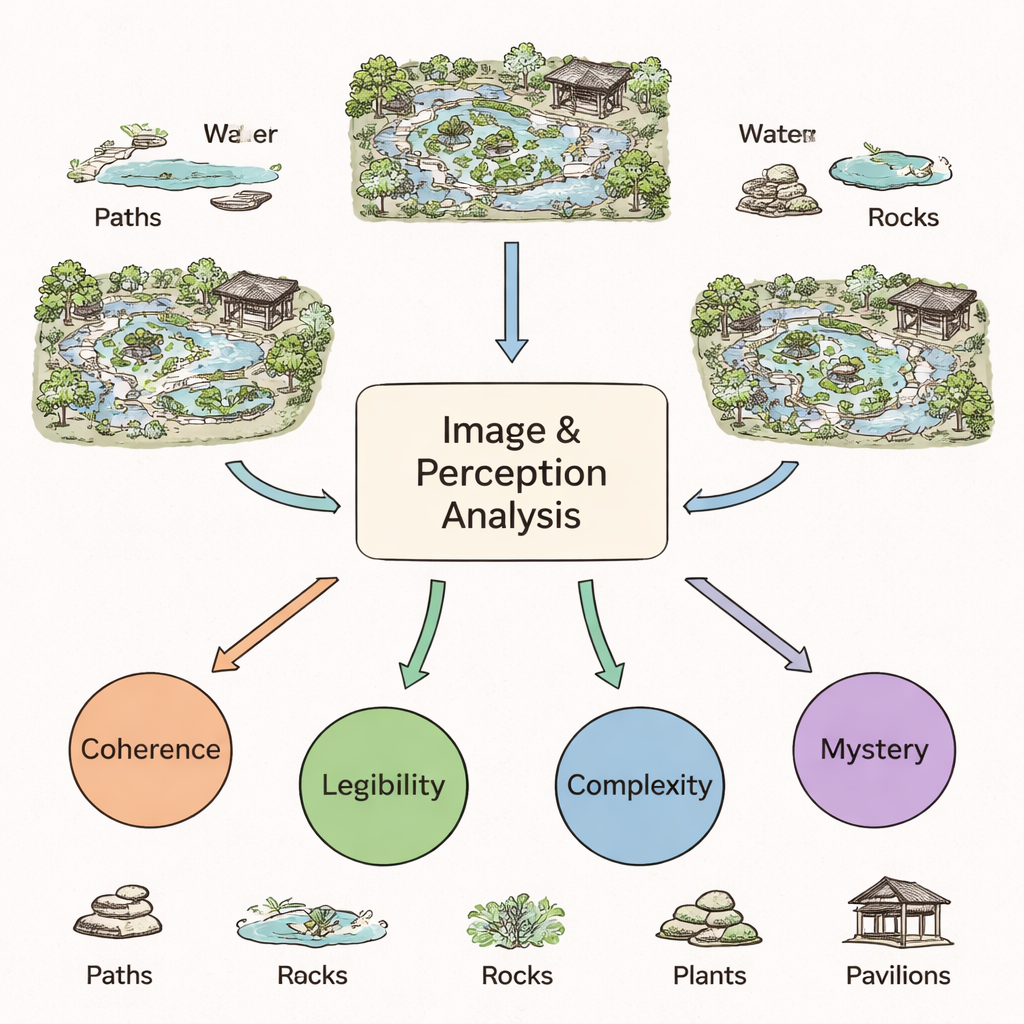
The team focused on three famous private gardens in Suzhou, China, all on the World Heritage List: the Garden of Cultivation, the Canglang Pavilion, and the Net Master’s Garden. Though similar in size, each one favors a different theme—balanced mountain and water, mountain-focused, or water-focused. Researchers walked the main paths and, every ten meters or so, took photos at eye level in four directions, building a set of 300 images that mimic what a visitor actually sees while moving through the space. Volunteers then viewed these images online and rated how each scene felt along four simple dimensions: how orderly it seemed (coherence), how easy it would be to find one’s way (legibility), how rich and varied it looked (complexity), and how much it invited exploration (mystery).
Turning Scenery into Numbers
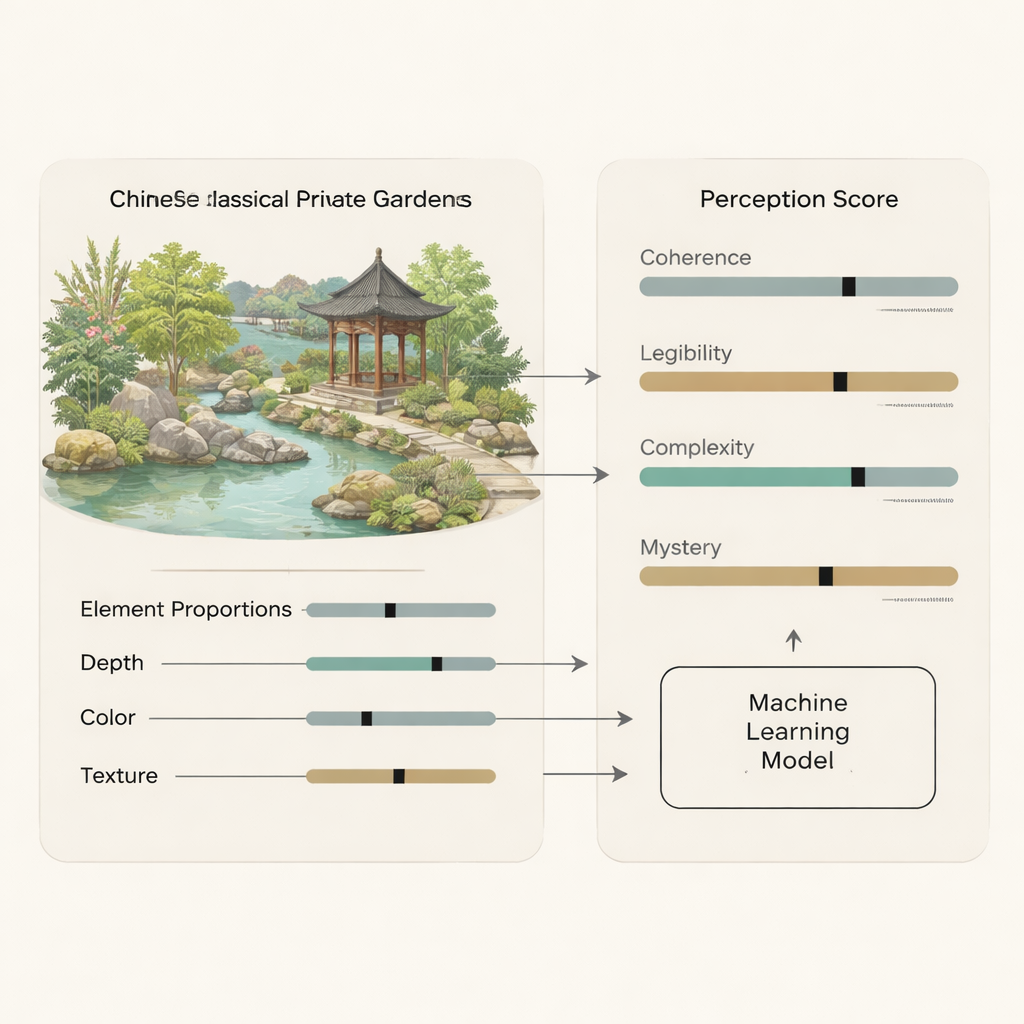
To connect what visitors see with how they feel, the authors used computer vision and artificial intelligence to parse each photo. A segmentation model identified key elements—plants, rocks, buildings, water, and paths—and measured how much of the view each occupied. Another model estimated depth, separating foreground from midground and background, while color analysis captured brightness, saturation, and the mix of warm and cool tones. Texture was summarized using a fractal measure of visual roughness. In total, 35 different visual indicators were extracted for every image. A machine-learning model then learned how combinations of these features predicted the four perception scores, and an interpretation method (SHAP) showed which features mattered most and how their effects changed as amounts increased.
What Makes a Garden Scene Clear or Mysterious
The analysis revealed that not all visual ingredients pull their weight equally. Buildings, water, rocks, plants, and paths—especially the share of the view taken by architecture, roads, and rockery—strongly influenced whether scenes felt coherent and legible. Water and rocks tended to boost a sense of richness and mystery, while too much building frontage eventually made scenes feel less complex and more monotonous. Color and texture played subtler but important roles: a wider range of colors lifted perceived complexity, and moderate color saturation helped people recognize structure in the scene without clashing with the gardens’ traditionally muted palettes. Crucially, many effects were nonlinear. For example, a modest amount of water in view (around 15% of the scene) greatly increased mystery, but beyond that, extra water added little. Similarly, some foreground screening and low plants enriched mystery and depth, but when dense shrubs filled more than about one third of the view, visitors felt more lost and less inclined to explore.
How Spatial Layout Directs Experience
The researchers then stepped back from single snapshots to look at how different types of spaces—waterside courts, mountain-view zones, and entrance corridors—used these visual ‘dials’ in distinct ways. In the Net Master’s Garden, a ring of buildings and plants around a central pond creates inward-looking spaces where water, moderate building frontage, and shifting foreground screens combine to deliver high ratings for coherence, legibility, and mystery. In the mountain-centered Canglang Pavilion, dense greenery encloses many paths, fostering immersion; carefully placed clearings and slightly more open paths act as visual “release points,” restoring orientation and opening views. Entrance corridors lined with architecture and clear paving give some of the highest coherence and legibility scores, acting like visual funnels that prepare visitors for more intricate scenes deeper in the garden. Non-corridor entrances achieve something similar by flanking a central path with shade and rockery, narrowing vision while hinting at what lies beyond.
Old Garden Wisdom, New Design Clues
Overall, the study shows that the enduring charm of Chinese classical private gardens is not magic, but a finely tuned control of visual information. Designers historically balanced what is shown and what is hidden, how much water or architecture appears at once, and how dense the foreground feels, keeping each factor within ranges that support both clarity and curiosity. By quantifying these ranges with modern image analysis and machine learning, the authors provide practical guides for restoring historic gardens and for shaping new urban green spaces that feel legible yet inviting. For lay visitors, the message is simple: the pleasure of walking through these gardens comes from the careful rhythm of paths, views, and surprises that gently lead the eye—and the mind—from one moment to the next.
Citation: Huang, X., Li, H., Mei, Z. et al. Modeling visual perception of Chinese classical private gardens with image parsing and interpretable machine learning. npj Herit. Sci. 14, 105 (2026). https://doi.org/10.1038/s40494-026-02372-3
Keywords: Chinese classical gardens, landscape perception, visual preferences, machine learning, urban heritage