Clear Sky Science · en
Research on the digital design of Han Dynasty pottery granary building based on miniature experience
Why Tiny Ancient Buildings Matter Today
In museums across China, visitors can see small clay towers that once stood inside Han Dynasty tombs. These pottery granary buildings are more than charming miniatures: they are clues to how people 2,000 years ago imagined ideal homes, food security, and the afterlife. Yet behind glass, their faded colors and sealed interiors are hard to grasp. This study shows how digital tools and virtual reality can bring these ancient models back to life, turning fragile relics into walk‑through experiences that feel like stepping into history at the size of a toy figure.
From Tomb Discoveries to Digital Models
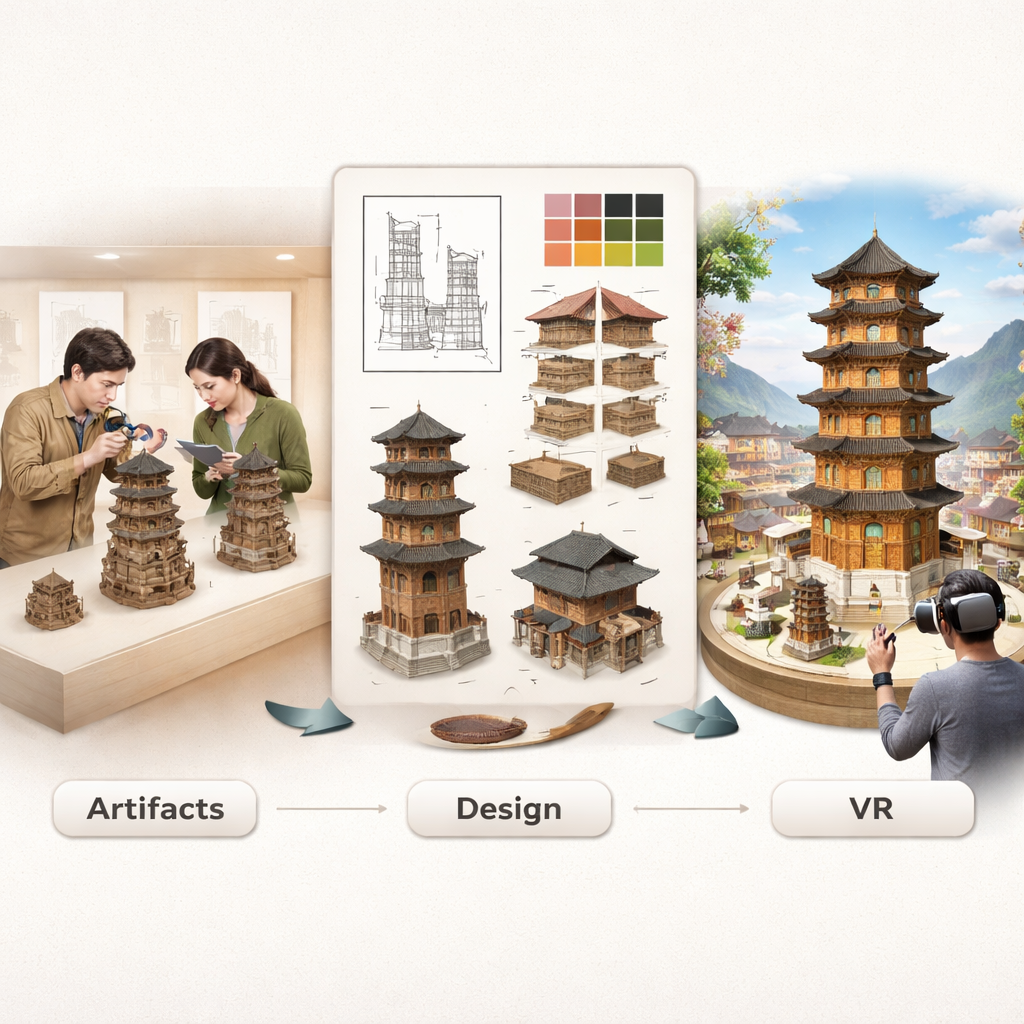
The researchers focused on pottery granary buildings unearthed in Jiaozuo, in China’s Central Plains, a region rich in Han Dynasty finds. Because no full-scale wooden buildings from that era survive, these pottery models are a rare window into historical architecture and beliefs. The team gathered more than 90 images from excavation reports, museum catalogues, online databases, and on-site photography, then narrowed them to 84 well-documented examples. They analyzed three typical forms—courtyard compounds, connected pavilions, and tall granaries—to build a clear picture of common shapes, proportions, and decorative schemes that could serve as the basis for a faithful digital reconstruction.
Reading Shapes, Patterns, and Faded Color
To transform static photos into a coherent 3D design, the team broke each pottery building down into visual ingredients. They traced outlines from multiple examples to arrive at typical silhouettes, then catalogued recurring ornaments: geometric bands, twisting dragons, tigers, trees, and human figures telling stories across the walls. These patterns are not just decoration; they hint at beliefs about protection, rainfall, and abundance. Because burial conditions and time had damaged the paints, the researchers turned to color analysis. Using computer clustering methods, they extracted the main hues from relatively well-preserved pieces. Red, white, and black dominate, with purple and green as accents. In Han thought, these colors linked to life, death, and the balance of forces in the universe. By adjusting brightness and contrast in a virtual setting, the team aimed to approximate how the original towers may have looked when newly fired and vividly painted.
Building a Modular Virtual Tower
Many Han pottery buildings were made from repeatable parts, much like construction toys. Craftsmen produced standard modules—courtyards, gateways, walls, corridors, and stacked rooms—that could be combined in different ways. The researchers mirrored this logic in their digital design. They chose a particularly complex seven‑story granary tower with an attached side building as their main case. Drawing on measurements from three similar finds, they checked and corrected published dimensions to ensure believable proportions. They then built a 3D model floor by floor, unwrapped its surfaces, and applied restored patterns and colors as digital “skins.” To keep the feel of clay, they added subtle wear, roughness, and aging effects, and lit the model carefully so details like brackets, windows, and mural bands would read clearly on screen.
Stepping Inside at Miniature Scale
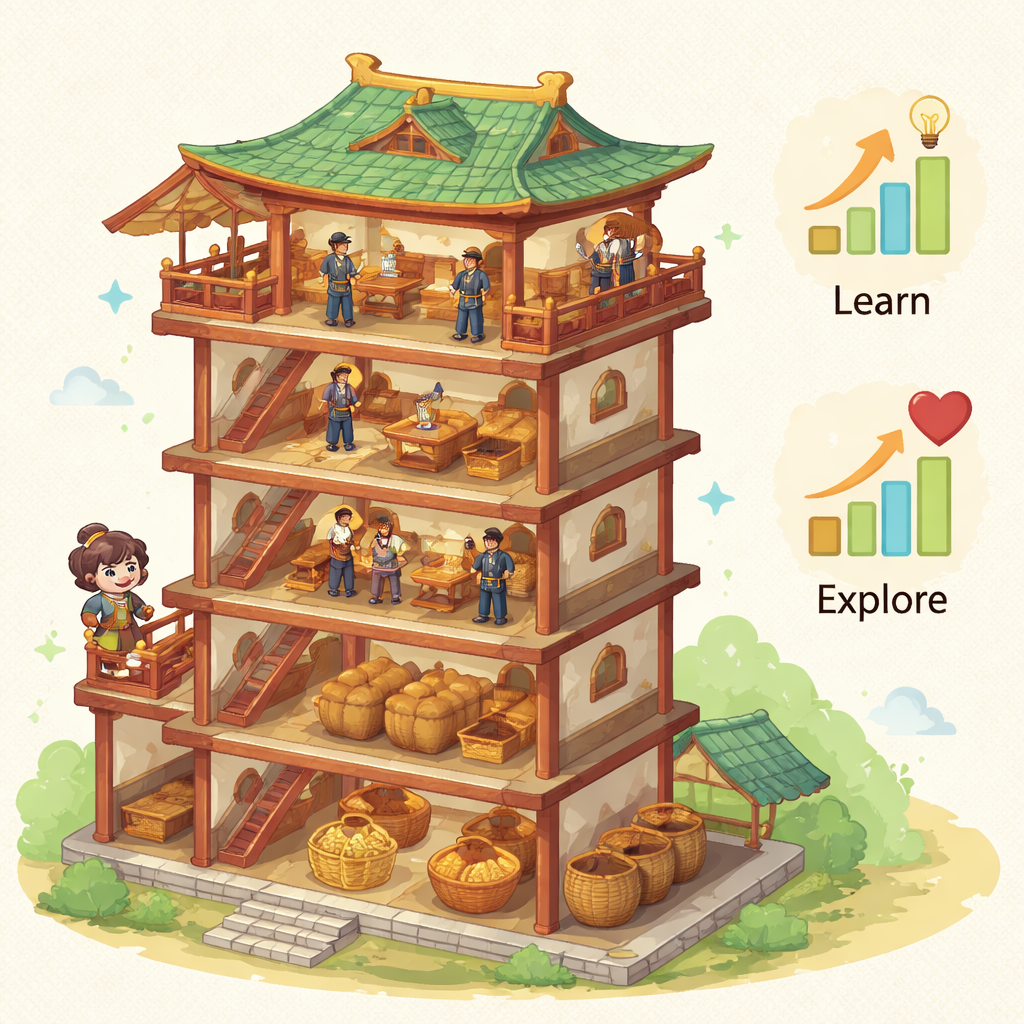
What makes this project distinctive is not only the model, but how visitors experience it. In reality, the pottery towers are sealed, with only small holes left from the firing process. In the virtual version, the team designed internal staircases, passages, and rooms that a tiny avatar can traverse. Each floor has a role: the lower levels store grain, middle levels host guards and board-game players, the upper levels serve as resting and lookout spaces. A cartoon-like character, styled after Han Dynasty clothing and hairstyles but only about eight centimeters tall in relation to the building, acts as the user’s stand-in. Wearing a VR headset, participants guide this miniature figure through the structure, climbing stairs, peering over railings, and discovering murals and carvings close-up—something impossible with the real, fragile artifacts.
Testing Whether Immersion Teaches Better
To see if this “miniature experience” actually improves learning, the researchers compared it with a traditional digital display. Eighty adult volunteers were split into two groups. One group explored the seven-story tower in VR, controlling the small avatar and moving through the interior. The other group viewed static 3D images and explanatory text on a screen, without any chance to enter the model. After equal exploration time, both groups rated their experience and answered questions about the building’s structure and meaning. The VR group reported much higher engagement and satisfaction with the interaction, and they more often correctly described how the tower’s floors were organized and what the decorations represented. Statistical tests showed these differences were not due to chance; the more actively people explored, the better they seemed to understand.
Bringing the Past to Life for Everyone
For non-specialists, this work shows how old clay models can become vivid, explorable spaces rather than distant curios behind glass. By carefully reconstructing shapes, colors, and patterns, then letting users inhabit the building as a tiny visitor, the project turns abstract knowledge about Han architecture and beliefs into an intuitive, spatial story. The results suggest that such miniature virtual worlds can both respect scholarly accuracy and make ancient culture easier to grasp, offering museums and heritage sites a practical way to protect fragile objects while inviting modern audiences to walk, climb, and play their way into the past.
Citation: Liu, Y., Lyu, X., Zhang, X. et al. Research on the digital design of Han Dynasty pottery granary building based on miniature experience. npj Herit. Sci. 14, 104 (2026). https://doi.org/10.1038/s40494-026-02367-0
Keywords: virtual heritage, Han Dynasty, pottery granary, immersive VR, digital reconstruction