Clear Sky Science · en
Topography-driven spatial differentiation in soft capping: vegetation–soil dynamics at Liangzhu earthen sites
Why the Grass on Ancient Walls Matters
Across the world, many ancient earth-built cities and walls now sit in the open air, exposed to sun, wind and rain. One modern strategy to protect them is surprisingly simple: cover them with soil and living plants, a bit like putting a green blanket over fragile ruins. This study looks at how that living cover behaves over time at the 5,000-year-old Liangzhu archaeological site in southern China—and why the shape of the ground itself can make the difference between protection and new damage.
A Green Shield for Fragile Earthworks
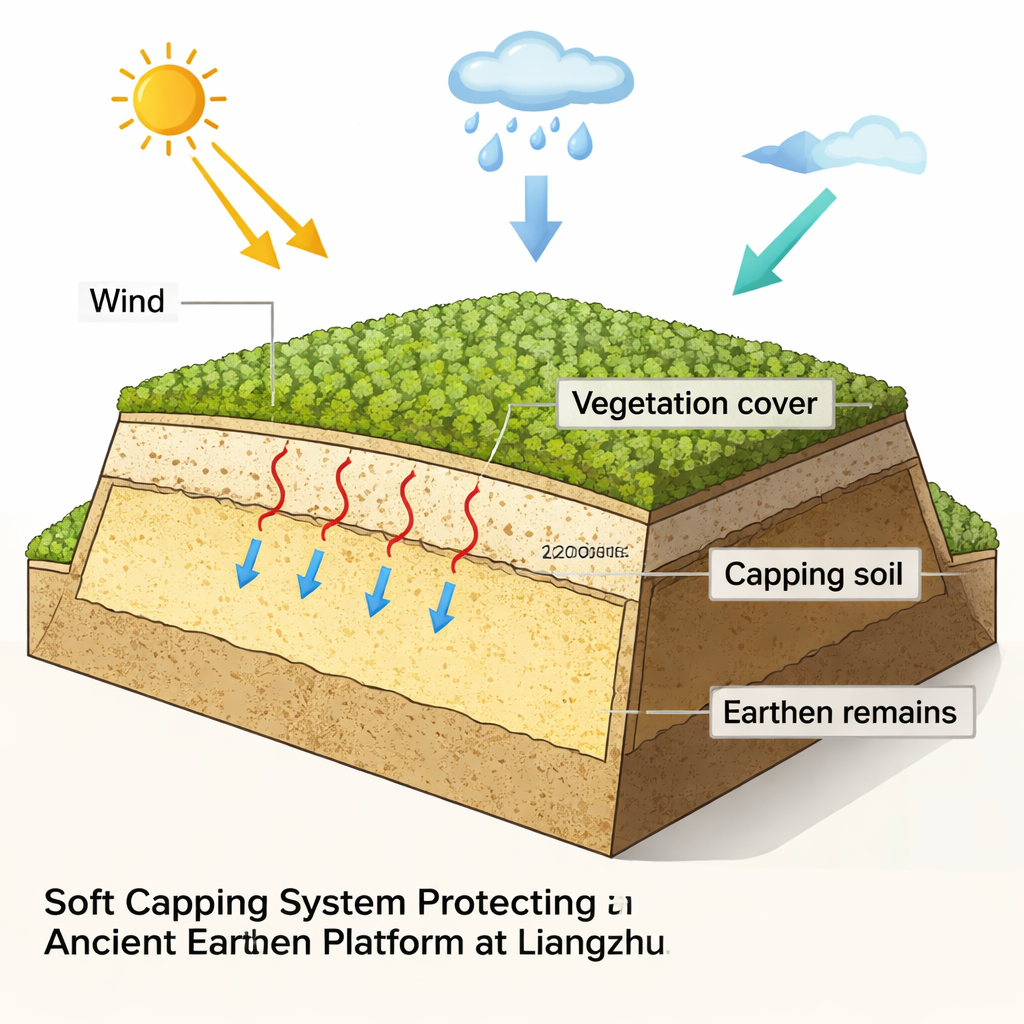
At Liangzhu, conservation teams installed a “soft capping” system on a large, man-made earthen platform called Damojiao Hill. Instead of concrete or brick, they added a shallow layer of soil and planted a low-growing clover, Trifolium repens, chosen because it spreads quickly, fixes nitrogen (a natural fertilizer) and keeps the surface smooth and visually pleasing. The goal was to reduce erosion from rain and temperature swings while helping visitors see the outline of the ancient palace area. For the first few years this green shield appeared to work well, but after six years clear warning signs began to emerge.
When One Plant Fits Some Slopes but Not Others
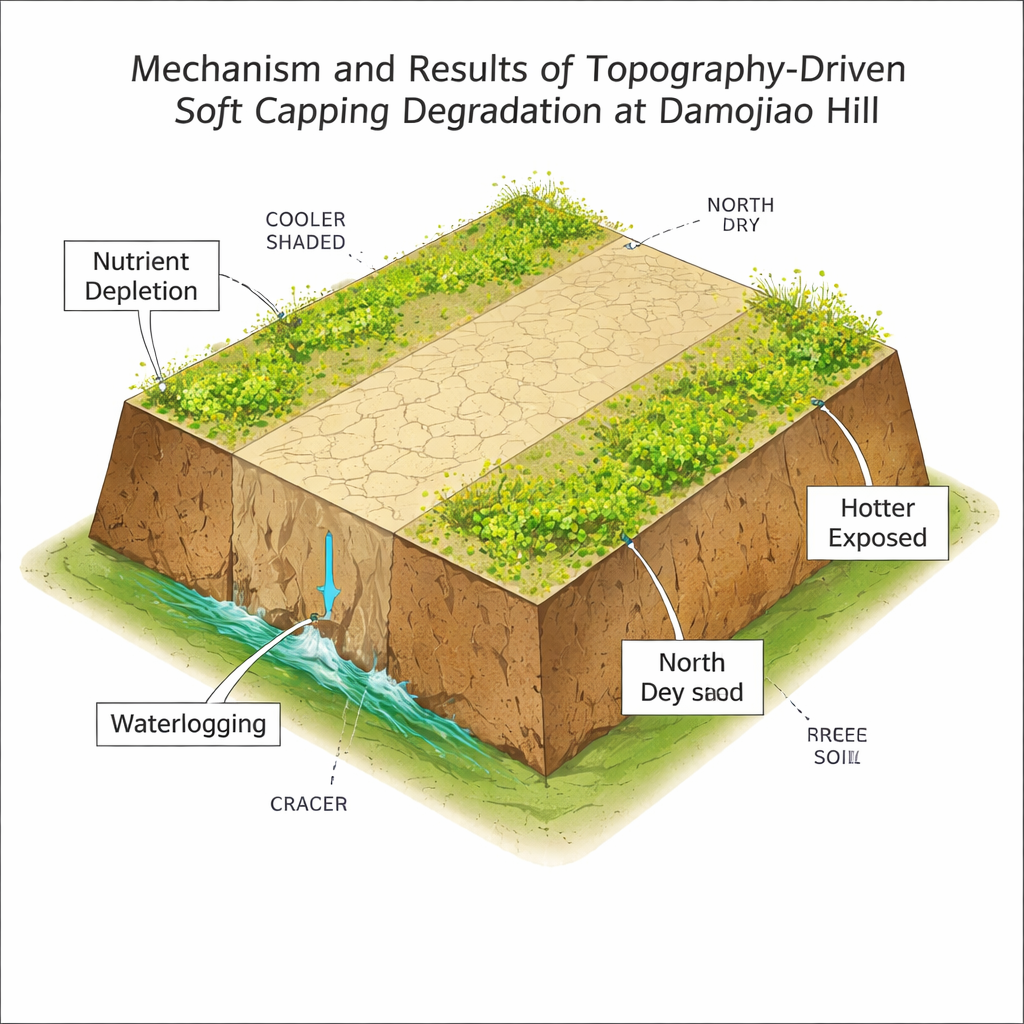
The researchers carefully measured how well the clover was growing on different sides and heights of the hill, and took soil samples from the upper, middle and lower slopes. They found that the direction each slope faced strongly affected plant performance. On the cooler, shadier north and east slopes, the clover cover was denser, taller and more continuous. On the sunnier south and west slopes, cover was patchy and thin, with bare spots, surface cracks and a visibly weakened soil layer. In some places, aggressive local weeds had outcompeted the clover, changing the original, well-planned lawn-like surface into a mixed and uneven plant community.
Hidden Shifts in Water and Soil Nutrients
Soil tests revealed that these visual differences in plant growth were tied to less obvious changes underground. On north and east slopes, soils generally held more organic matter and showed healthier nutrient levels. South and west slopes, by contrast, had lower levels of key plant nutrients such as phosphorus and potassium and often higher bulk density, meaning the soil was more compacted and less able to absorb and store water. Elevation also played a role: lower parts of the hill tended to collect water, creating waterlogged patches at the foot of the north slope, while some upper and middle zones showed signs of nutrient leaching or concentration depending on how water moved through the soil.
Topography as an Invisible Engineer
To understand which factors mattered most, the team used statistical models that compared plant traits—such as how much of the ground the clover covered—with many environmental variables at once. The analyses pointed to slope direction as the leading driver of clover density and cover, ahead of soil chemistry or height on the hill. Nutrients like potassium and phosphorus, and physical traits such as soil density, came next. The findings suggest that the way sunlight and moisture vary from one side of the hill to another quietly shapes how well the green cap works. Over time, these differences can open pathways for degradation: weaker roots, more runoff, weed invasion, nutrient loss and even increased biological attack on the buried earthen structure.
What This Means for Protecting Ancient Sites
For non-specialists, the main message is that “green covers” for ruins are not one-size-fits-all solutions. At Damojiao Hill, the same plant and soil recipe behaved very differently depending on slope and elevation. Some slopes stayed relatively stable, while others slid toward thinning vegetation, nutrient-poor soils and risky water buildup. The authors argue that future conservation should treat soft capping as a living, terrain-sensitive system: managers need regular, slope-by-slope checks of plant health and soil conditions, and may ultimately need different plant mixes or soil treatments for different faces of the same monument. In short, the shape of the ground is quietly engineering the future of these ancient walls, and successful protection will depend on listening closely to what the slopes are telling us.
Citation: Wang, N., Mu, Q., Lu, Y. et al. Topography-driven spatial differentiation in soft capping: vegetation–soil dynamics at Liangzhu earthen sites. npj Herit. Sci. 14, 108 (2026). https://doi.org/10.1038/s40494-026-02364-3
Keywords: soft capping, earthen heritage, Liangzhu, slope aspect, vegetation–soil dynamics