Clear Sky Science · en
Restoration of oracle bone inscriptions using a fast residual shrinkage denoising network with fractal gradient
Ancient words brought back into focus
Long before paper and printing, Chinese diviners carved questions for the gods onto turtle shells and animal bones. These oracle bone inscriptions are among humanity’s oldest written records, but many surviving pieces are cracked, worn, and hard to read. This study presents a new computer method that cleans and sharpens digital images of these fragile artifacts, helping historians and the public alike see their markings more clearly.
Why old bones are hard to see
Oracle bones have endured more than three thousand years of weathering, burial, and handling. When scholars photograph or take rubbings of them today, the resulting images often contain speckled noise, blurring, and missing pieces where the bone has chipped away. The strokes themselves are usually strong, dark lines, but the surrounding surface has very little texture. Standard photo-cleaning tools, designed for everyday pictures filled with rich detail, tend either to leave too much noise or to smooth away the edges of the ancient characters—exactly the parts experts most need to study.
A smarter way to clean up images
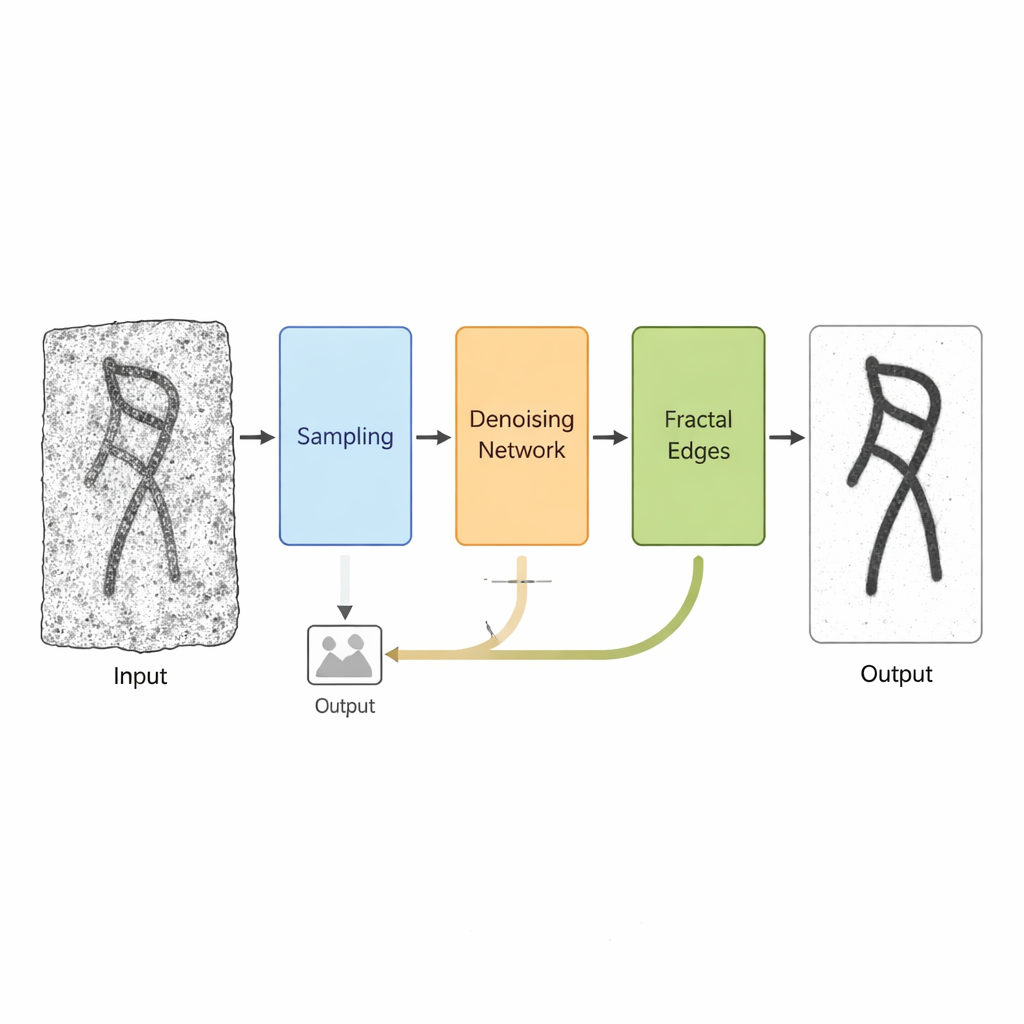
To tackle this, the authors redesign an image “restoration” pipeline around the special look of oracle bones. They start from a common idea in imaging: a damaged picture can be thought of as a clean original that has been distorted by blur, noise, or missing pixels. Mathematically, recovering the original is an ill-posed problem with many possible answers, so additional rules—called regularization—are needed to guide the solution toward realistic images. The team uses a modern type of artificial neural network that learns to remove noise by predicting only what should be subtracted from a picture rather than rebuilding the entire image from scratch. This residual approach makes training easier and more stable.
Borrowing patterns from fractals
A key innovation is how the method protects the crisp lines of the inscriptions. Instead of relying on simple edge detectors, which easily confuse noise with real strokes, the authors use a "fractal" view of the image. Fractals capture how patterns repeat at different scales. By sliding a small window across the picture and counting how brightness changes in that window as the scale changes, the algorithm builds a map of where the image is structurally complex—typically along character strokes—and where it is flat. This fractal gradient map becomes part of the training objective: the network is rewarded not only for making the picture look clean, but also for keeping these multi-scale edge structures intact.
Speed and detail through clever network design
The restoration system also uses reversible sampling to work efficiently. First, the input image is split into several smaller, lower-resolution tiles, which are easier for the network to process quickly. After denoising, an upsampling step stitches them back together to full size. Within the network, layers of small convolution filters extract features, while a soft-thresholding module decides which features are likely to be noise and gently shrinks them instead of cutting them off abruptly. This combination allows the model to suppress speckles and blur while preserving subtle line breaks and corners that carry meaning in the script.
Sharper characters, faster results
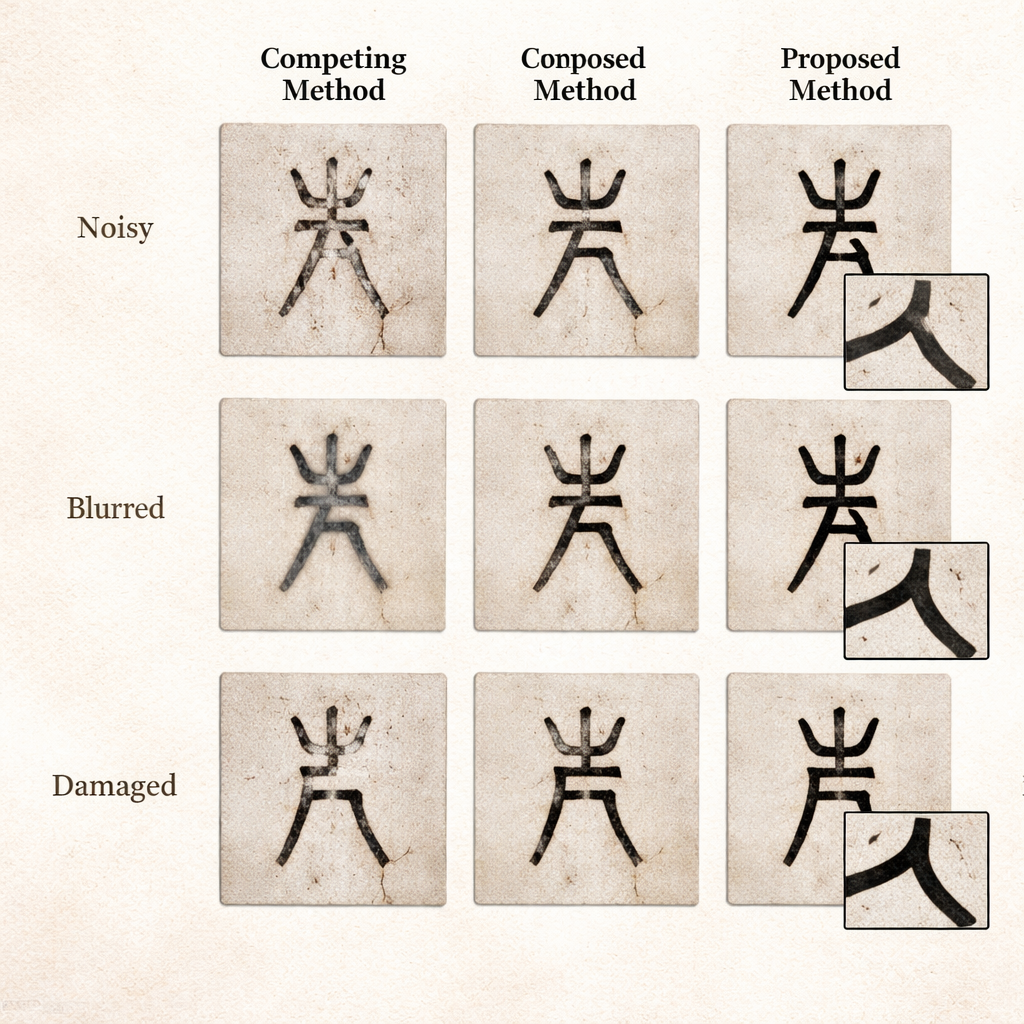
The researchers test their method on images of oracle bone characters for “tiger,” “dragon,” and “dog,” simulating three common problems: random noise, blur from an out-of-focus lens, and scratches or gaps that need filling. They compare their approach to a well-known deep learning method called IRCNN, using both visual inspection and standard measures of image quality. In nearly all cases, the new method produces clearer, more continuous strokes and higher scores for sharpness and structural similarity, while also running in less time. Additional analyses of edge maps and gradient histograms show that it more faithfully reproduces the original direction and strength of the character outlines.
Bringing ancient writing to modern eyes
In plain language, this work offers a faster, smarter digital “cleaning cloth” for some of the world’s oldest texts. By combining a tailored neural network with a fractal-based way of spotting and preserving edges, the technique can strip away noise, undo blur, and patch small gaps without erasing the fine details that specialists rely on. As such tools spread, they promise to make faded oracle bones—and potentially other fragile inscriptions—more legible for scholars, students, and museum visitors, helping to safeguard and share a vital piece of human heritage.
Citation: Li, Z., Zhao, W. Restoration of oracle bone inscriptions using a fast residual shrinkage denoising network with fractal gradient. npj Herit. Sci. 14, 102 (2026). https://doi.org/10.1038/s40494-026-02361-6
Keywords: oracle bone inscriptions, image restoration, deep learning, cultural heritage, denoising