Clear Sky Science · en
Experimental release of elements from rock varnish by industrial compounds indicate increased risk to petroglyphs
Ancient Stories Carved in Stone
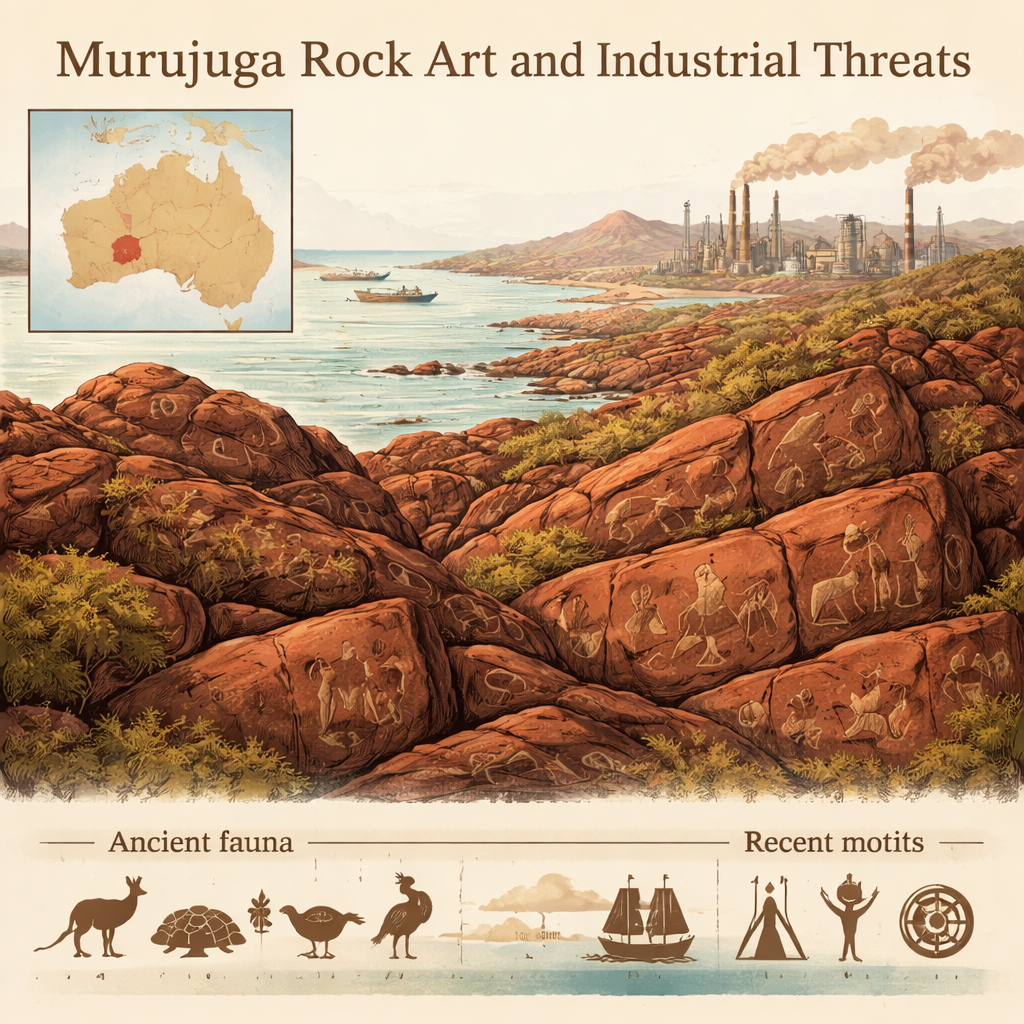
On the remote coast of northwest Western Australia, the rocks of Murujuga hold more than a million petroglyphs—stone engravings that may span over 50,000 years of human history. These images of animals, people and symbols are not only an archaeological treasure; they are living records of the culture and spirituality of the Ngurra-ra Ngarli Aboriginal people. This study asks a pressing question with global relevance: as heavy industry expands around Murujuga, are its emissions quietly eating away at the very rock skin that keeps these carvings alive?
A Harsh Landscape and a Fragile Skin
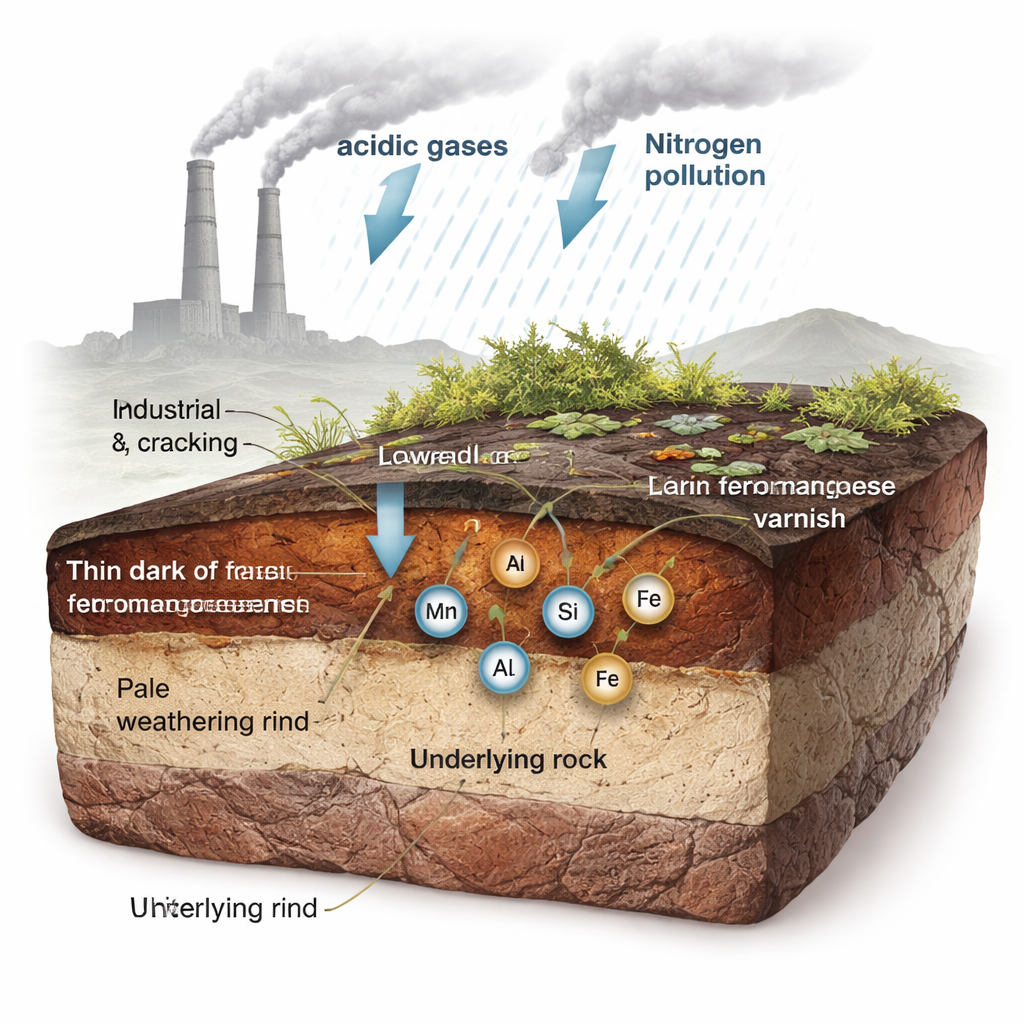
The rocks of Murujuga are tough igneous formations—gabbro and granophyre—formed billions of years ago. Over tens of thousands of years, they develop a pale “weathering rind” covered by an extremely thin but very hard dark coating called rock varnish. This varnish, rich in iron and manganese, is partly built by specialised bacteria that concentrate metals and bind them with clay minerals into a tight lattice. Petroglyphs were created by chipping through this dark surface into the pale layer beneath, so the art literally depends on the survival of this skin. If the varnish dissolves or flakes away, the visual contrast vanishes and the engravings are lost.
Industry Moves In
Despite this cultural importance, Murujuga is now ringed by industrial facilities: gas treatment and liquefaction plants, fertilizer and explosives factories, shipping docks and a new urea operation. These installations release large amounts of sulphur and nitrogen oxides, ammonia and ammonium nitrate into the air each year. In the atmosphere, these gases form strong acids and nitrate, which settle onto the rocks. Measurements show that the surface pH of Murujuga rocks has dropped from close to neutral (about 6.8) in pre‑industrial times to between 4.4 and 5.2 at many sites near industry, with some readings even lower. This acidification also fuels the growth of bacteria, fungi and lichens that produce their own organic acids, further lowering pH and attacking the rock surface.
Testing How Fast the Skin Lets Go
Because the rocks weather naturally at a glacial pace, the authors could not simply wait to see changes. Instead, they removed the outer surface layer—varnish plus weathering rind—from already disturbed rocks, ground it to a fine powder and soaked small samples in solutions that mimic industrial pollutants and the organic acids made by microbes. Over 24 hours at room temperature, they exposed the powders to a wide range of acidity, then measured how much of fifteen elements, including manganese (Mn), iron (Fe), aluminium (Al), silicon (Si), cobalt (Co) and nickel (Ni), leaked into solution. Using statistical “breakpoint” analysis, they pinpointed the pH values at which the release rates of these key elements began to climb sharply.
When Acidity Crosses the Line
The results show that the elements most critical for holding the varnish together start to dissolve at pH values well above the levels now recorded on Murujuga rock surfaces. For inorganic pollutants like sulphuric and nitric acid, manganese began to be stripped from the powdered rock at around pH 6.1–6.5, and silicon and aluminium followed as pH fell below roughly 6.5 and 4.3–4.7, depending on rock type. In solutions of organic acids, which mimic the acids produced by colonising microbes, manganese, aluminium, silicon and nickel all began to be released as pH dipped only slightly below neutral, around 6.7–6.9. At pH 4—typical of the more affected sites—up to about 20% of the manganese and more than half of the cobalt in the granophyre samples could be removed in just 24 hours of laboratory exposure. Although the experimental setup exaggerates contact compared with intact rock, it clearly demonstrates that today’s acidity is high enough to destabilise the varnish’s internal lattice.
What This Means for Rock Art and Beyond
These findings support field observations: the dark varnish on some Murujuga rocks is thinning, becoming more porous, and shifting in colour as manganese-rich minerals are lost and iron phases change. Once these compounds dissolve out of the varnish, they cannot be rebuilt on human timescales. The study concludes that the current rock-surface acidity—driven by industrial emissions and by acid-producing microbes they stimulate—poses a serious, ongoing risk to the long-term survival of Murujuga’s petroglyphs. To protect this globally unique, irreplaceable record of human culture, the authors argue that industries must adopt available technologies to cut acid‑forming gases and particulate nitrogen emissions to virtually zero. The same processes, they note, threaten stone monuments and rock art worldwide wherever air pollution and acid deposition meet vulnerable stone surfaces.
Citation: Black, J.L., Diffey, S.M., Oldmeadow, D.W. et al. Experimental release of elements from rock varnish by industrial compounds indicate increased risk to petroglyphs. npj Herit. Sci. 14, 90 (2026). https://doi.org/10.1038/s40494-026-02358-1
Keywords: rock art conservation, industrial pollution, rock varnish, acid deposition, cultural heritage