Clear Sky Science · en
Inspiration from Chinese paintings of Song Dynasty: the influence of the traditional architectural component Yinyan on indoor wind environments
Old Paintings, New Clues for Greener Buildings
What can a thousand-year-old scroll painting teach us about keeping buildings cool and comfortable without air conditioners? This study looks to the Song Dynasty in China, using detailed landscape paintings as a kind of time machine to rediscover a clever wooden shade panel called “Yinyan.” By rebuilding a historic tavern in the computer and simulating how air flows through it, the researchers show how this simple feature can improve indoor breezes—offering ideas both for preserving heritage and for designing more sustainable buildings today.
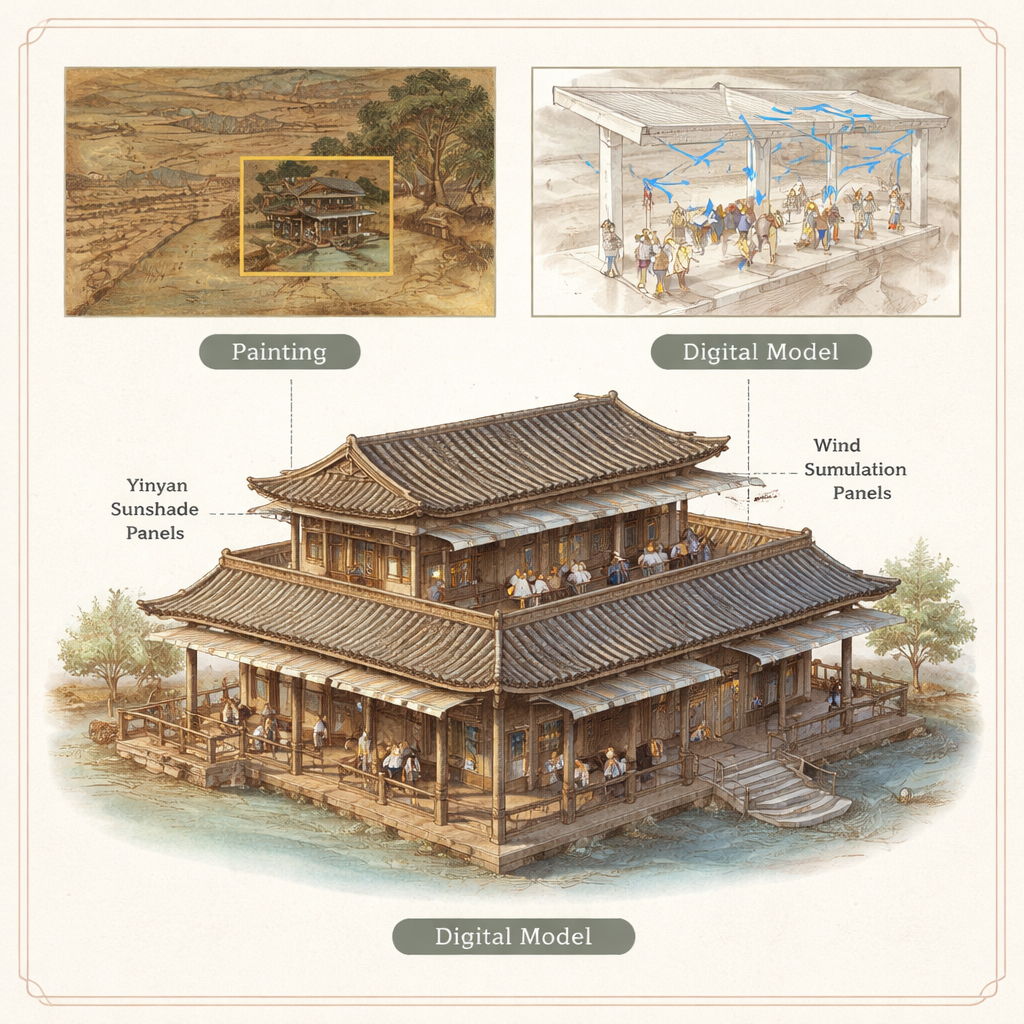
A Window Into the Song Dynasty City
Very few buildings from the Song Dynasty still stand, but its artists left behind remarkably precise cityscapes. Painters worked with rulers and scale-like methods, so their scrolls often function like early technical drawings. In this study, the team focused on the famous painting Life along the Bian River at the Qing Ming Festival, which shows a bustling riverside town. They selected a two-story tavern next to a bridge and, using a historic construction manual called Yingzao Fashi, converted its drawn proportions into real-world sizes such as column height, room width, roof pitch, and floor levels. This let them build a detailed 3D digital model that is likely close to how the tavern actually looked and felt.
The Little Roof That Shapes the Breeze
Across many Song paintings, the researchers noticed a recurring feature: a slim, sloping panel mounted at the edge of roofs or above windows, known as Yinyan. It was common in cities like Bianjing (modern Kaifeng), where dust storms, strong sunlight, and seasonal winds were part of daily life. Yinyan panels could be made from wooden frames filled with boards or bamboo and were easy to add or replace. In drawings, they sometimes hang freely from the eaves and sometimes are propped with braces or extended into longer covered walkways. Historically, they likely offered shade, shelter from rain, and a way to soften harsh winds before they entered a room.
Simulating Airflow in a Reborn Tavern
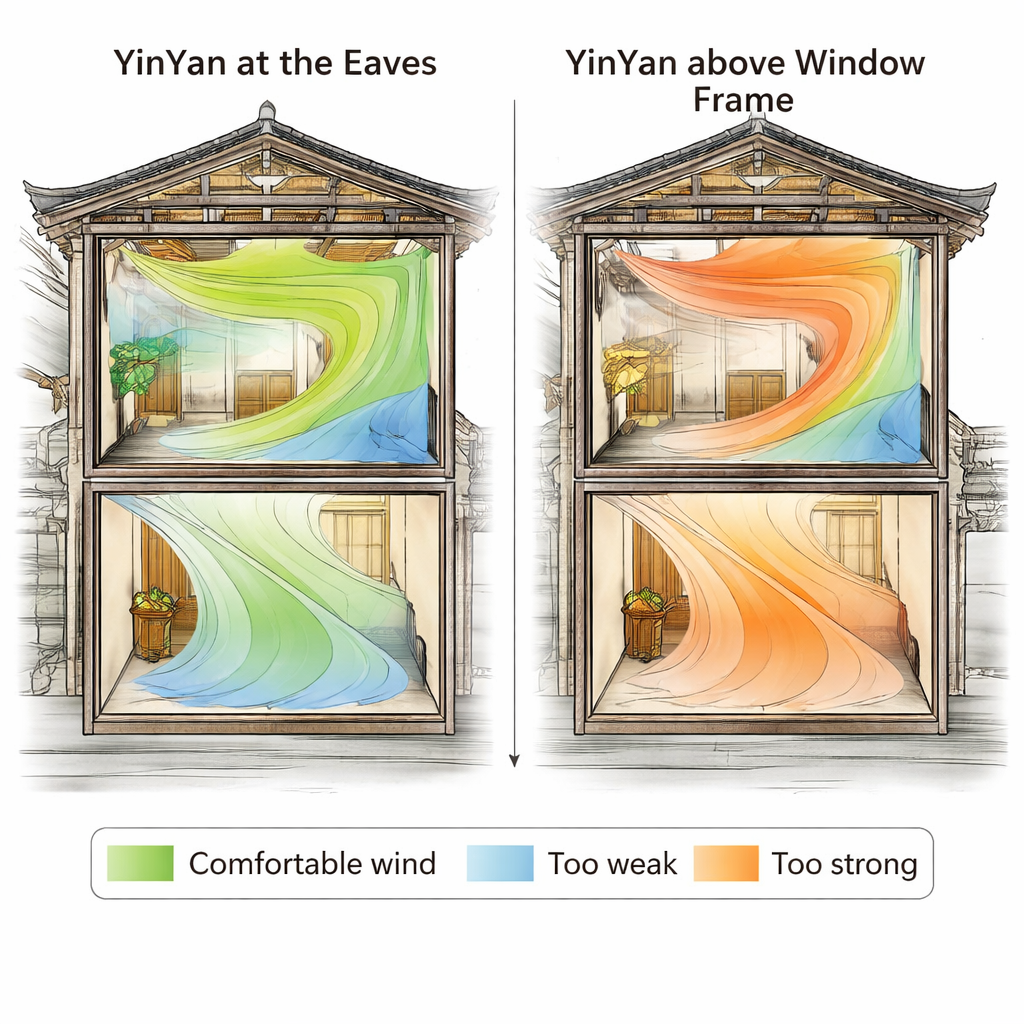
To see how much difference Yinyan really makes, the team used computational fluid dynamics—a digital wind tunnel—to simulate spring breezes blowing through the reconstructed tavern. They focused on the second floor, where people would sit, and tested eight scenarios: Yinyan installed at the eaves or above the window frame, each with four overhang lengths ranging from just under one meter to about one and a half meters. For each case, they mapped wind speeds at seated head height and standing head height, classifying areas as “comfortable” (a gentle breeze), “stagnant” (almost no movement), or “excessive” (gusty enough to be annoying or to move light objects).
How Position and Size Change Comfort
The simulations show that adding Yinyan significantly reshapes indoor airflow, even though it does not drastically change the maximum wind speeds. When mounted at the eaves, the panel guides wind more horizontally through the room and slightly raises the average indoor air speed, helping fresh air penetrate deeper. However, longer eaves panels tend to reduce comfort at standing height by slightly increasing zones where the wind is either too weak or too strong. When Yinyan is installed above the window frame, it acts more like a deflector: it spreads incoming air more evenly through the room and shrinks both stagnant corners and overly windy patches. In these cases, an overhang of about 1.28 meters (roughly four traditional “chi” units) gave the best overall balance, creating the highest share of comfortable wind zones and the lowest share of uncomfortable ones.
Ancient Design Wisdom for Modern Cities
For a general reader, the bottom line is that a small, adjustable wooden shade panel—devised centuries ago and captured only in paintings—can measurably improve comfort indoors by fine-tuning natural ventilation. The study supports more accurate digital reconstructions of Song architecture by showing how to size and place Yinyan panels and highlights that heritage buildings were not just beautiful, but cleverly climate-aware. By combining historical art, old construction manuals, and modern airflow science, the work suggests ways to bring this quiet, low-energy design wisdom into today’s sustainable buildings, especially in hot, breezy cities where a well-shaped breeze can make the difference between stuffy and comfortable rooms.
Citation: Zhang, H., Xiong, M., Chen, B. et al. Inspiration from Chinese paintings of Song Dynasty: the influence of the traditional architectural component Yinyan on indoor wind environments. npj Herit. Sci. 14, 82 (2026). https://doi.org/10.1038/s40494-026-02356-3
Keywords: traditional Chinese architecture, natural ventilation, digital heritage, Song Dynasty paintings, climate-responsive design