Clear Sky Science · en
Monitoring the intensity distribution of earth-air activity around the Mogao Grottoes
Why desert air matters for ancient art
The Mogao Grottoes in northwest China hold thousands of years of Buddhist wall paintings carved into a desert cliff. These paintings are slowly being damaged as tiny salt crystals grow and dissolve inside the walls every time the rock switches from dry to damp. This study asks a simple but crucial question: how does the invisible "breathing" of air through the ground around the grottoes drive those moisture changes, and what can we do about it?
The hidden breath beneath our feet
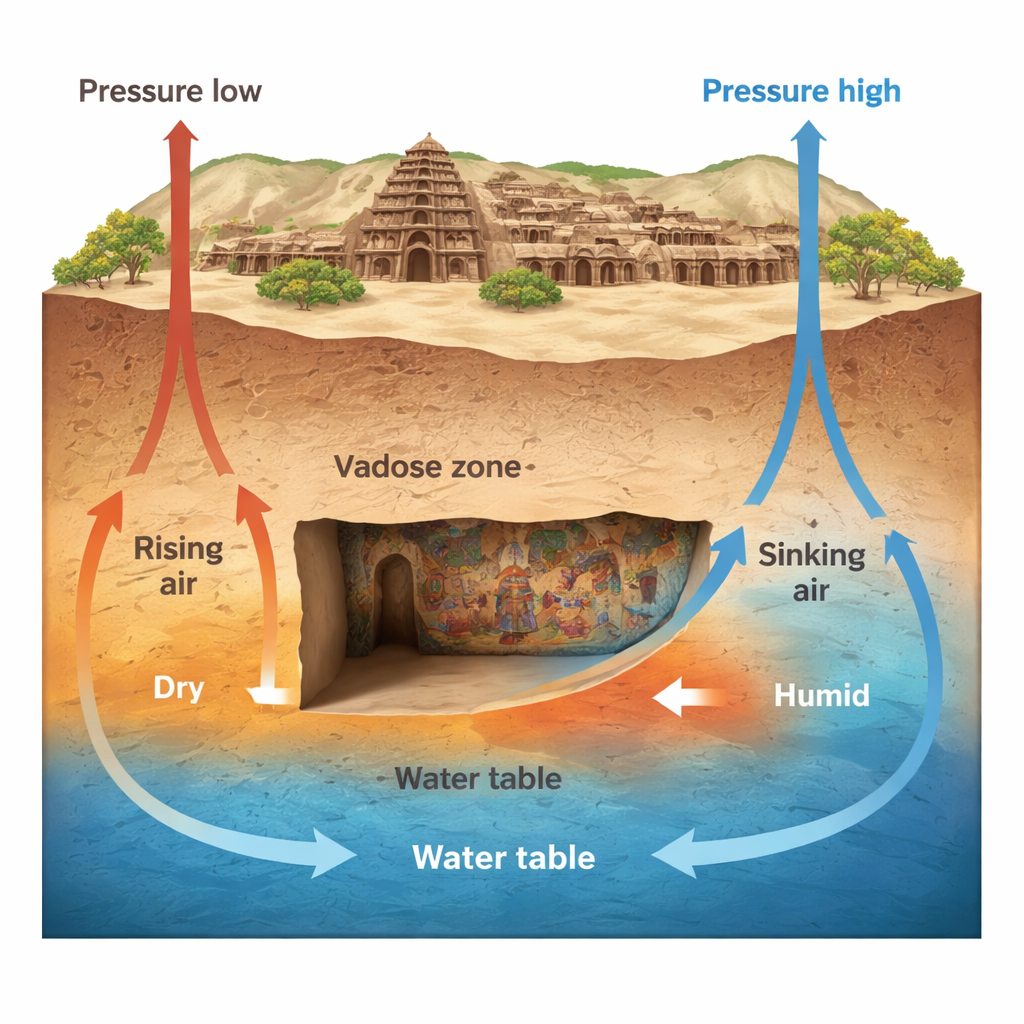
Below the desert surface, the pores between grains of sand and gravel are filled with air. When outside air pressure rises and falls with weather systems, that buried air is squeezed in and out of the ground, a process the authors call earth–air activity. When pressure rises, drier outside air is pushed down into the soil and rock, lowering humidity; when pressure drops, moister air moves upward, raising humidity. The team showed that the strength of this breathing can be tracked by how much relative humidity in the buried air swings back and forth. In other words, bigger humidity swings mean stronger earth–air activity.
Mapping the desert’s invisible currents
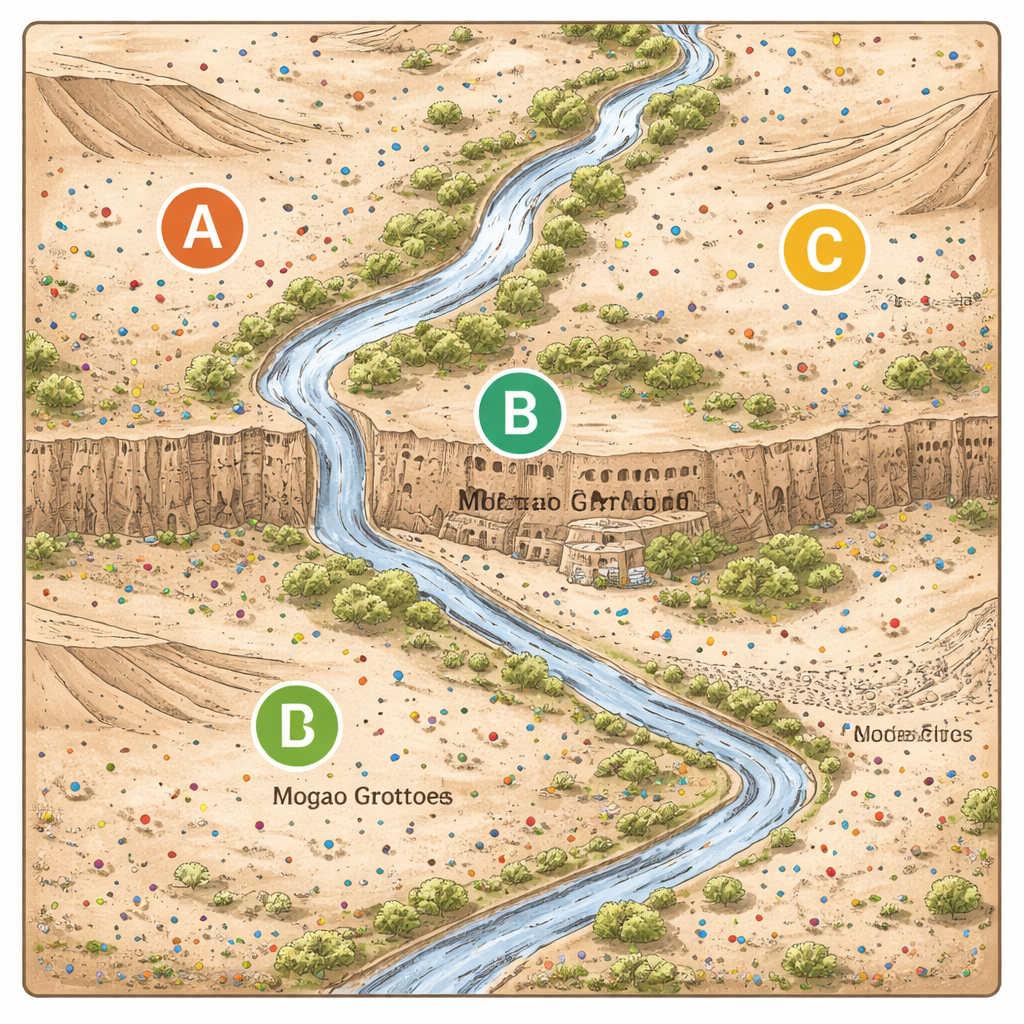
To see how this process varies across the landscape, the researchers buried humidity and temperature sensors at 208 spots (193 good data points) within about two kilometers of the Mogao Grottoes. They divided the area into three zones: a stony Gobi plateau above the cliff, the zone directly in front of the caves with trees, roads, and the Daquan River, and a Gobi area near nearby Sanwei Mountain. By comparing each point to a long‑running reference sensor in a basement, they calculated a relative intensity of earth–air activity and then used mapping software to create a detailed picture of how strongly the ground breathes in different places.
How terrain and soil shape ground breathing
The maps revealed striking patterns. Earth–air activity generally weakens from southeast to northwest and tends to be smaller where the terrain is higher. Flat areas with widely spaced contour lines usually show stronger activity than steep, tightly contoured slopes. Near the top of the cliff above the caves, many points had weak activity, probably because cracks in the cliff let air escape sideways instead of straight up and down. In contrast, some low-lying areas in front of the caves and in nearby gullies showed very strong ground breathing. Places covered by quicksand—a loose but poorly ventilated sand layer—had noticeably weaker activity and smaller humidity swings than nearby bare Gobi gravel.
Different rhythms of rising and falling moisture
Although almost all points showed humidity changes that rose and fell in step with air‑pressure changes, their detailed rhythms differed. The most common pattern looked like gentle waves following the weather. In some spots, humidity showed sharp downward pulses from a high baseline, likely when gusts of dry air were forced into the ground. A few sites showed the opposite: brief upward pulses of humidity, perhaps where air was squeezed out through cracks in the cliff. In rare places, humidity wobbled up and down around a baseline. Overall, however, the study found that air‑pressure changes are the main driver everywhere; local terrain and soil simply modulate how strong the response is.
Protecting wall paintings by guiding the ground’s breath
For conservators, these findings turn an abstract physical process into a practical map. Stronger earth–air activity means larger swings between dry and damp conditions at the cave walls, which in turn encourages salts to repeatedly crystallize and dissolve, slowly tearing the paintings apart. By knowing where the ground breathes most strongly, managers can target actions such as sealing key cliff fractures, adding breathable barriers between irrigated green belts and the cliff, stabilizing gully soils, or reconsidering road surfacing that redirects underground air. In short, this work shows that preserving fragile desert art is not just about controlling the air inside the caves, but also about understanding and managing the subtle, pressure‑driven breathing of the land around them.
Citation: Li, F., Li, H., Wang, S. et al. Monitoring the intensity distribution of earth-air activity around the Mogao Grottoes. npj Herit. Sci. 14, 83 (2026). https://doi.org/10.1038/s40494-026-02354-5
Keywords: Mogao Grottoes, earth-air activity, humidity and wall paintings, barometric pumping, cultural heritage conservation