Clear Sky Science · en
Digital heritage integration of Kunqu opera and Suzhou classical gardens
A Dreamlike Walk Through History
Imagine stepping into a centuries‑old Chinese garden, hearing the delicate singing of classical opera while strolling past ponds and pavilions, all without leaving your living room. This study explores how cutting‑edge 3D imaging and virtual reality can bring together two famous treasures of Chinese culture—Kunqu opera and the classical gardens of Suzhou—so that people today can experience them as a living whole rather than as separate museum pieces.
Why Place Matters to Tradition
Cultural heritage is more than objects in glass cases or recordings in an archive. It includes both physical settings, such as historic buildings and gardens, and living practices like music, theatre, and crafts. International bodies such as UNESCO stress that these two sides depend on each other: performances give meaning and life to places, while places shape how performances are understood. Yet most digital projects split them apart—either scanning buildings in 3D without people, or capturing performers in empty studios. The authors argue that this split damages the “spirit of place,” making it harder for audiences to feel the emotional and historical depth of a tradition.
From Laser Scans to Living Scenes
Early attempts to digitize historic sites relied on expensive laser scanners and later on photogrammetry, which rebuilds 3D shapes from many photos. At the same time, motion‑capture suits became popular for recording dancers and actors, driving animated characters in virtual environments. While powerful, these tools have limits: they often struggle with fine fabrics, shiny surfaces, water, and realistic faces, and they tend to produce avatars that feel slightly artificial. A newer technique called 3D Gaussian Splatting offers a different route, using millions of tiny colored blobs to recreate how light actually moves through a scene. This study builds on that method, extending it over time to create “volumetric video” of real performers that viewers can walk around in 3D.
Weaving Opera and Garden into One World
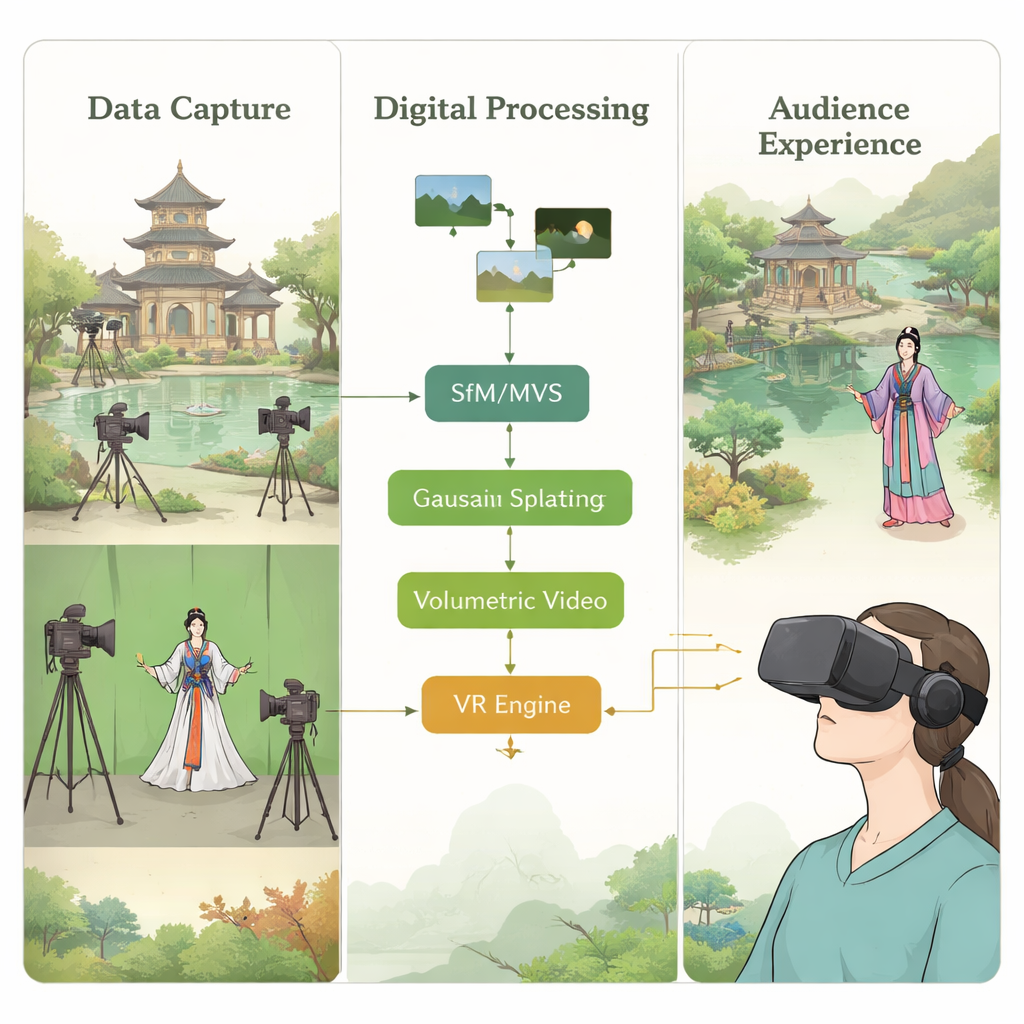
The team chose two cultural icons from Suzhou: the World Heritage‑listed Humble Administrator’s Garden and a classic Kunqu opera scene, “A Stroll in the Garden, An Interrupted Dream,” from The Peony Pavilion. They first designed a walking route through the garden that matches the story beats of the opera scene, then captured the garden using multi‑camera rigs, drones, and advanced processing to remove tourists from the images. In a studio equipped with 81 cameras and green screens, they filmed Kunqu performers in full costume and turned the footage into volumetric video using an optimized version of Gaussian Splatting that keeps motion smooth and costumes crisp. These garden reconstructions and living 3D actors were then brought together in a virtual reality system built in Unity, forming what the authors call an Integrated Digital Theater.
Testing How People Actually Feel Inside
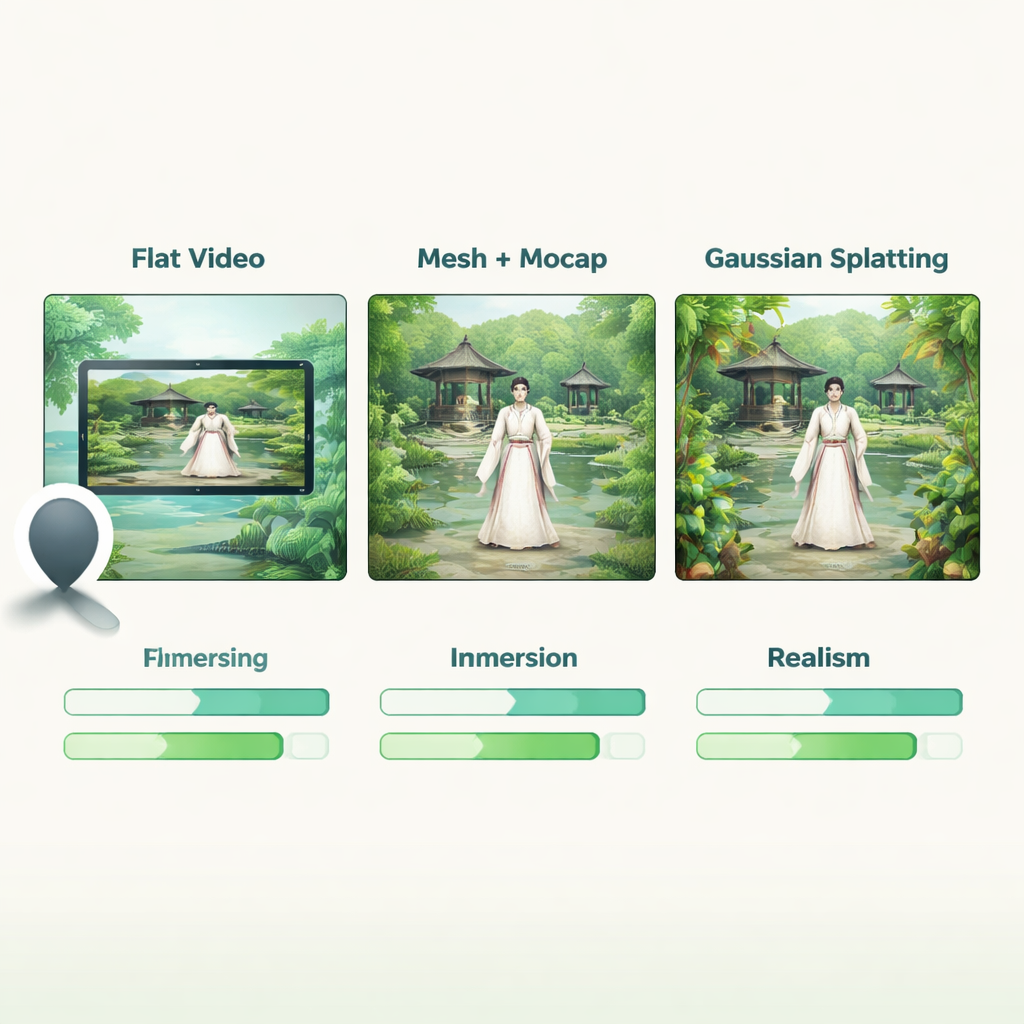
To see whether this integrated approach really matters, the researchers ran two rounds of user studies with volunteers wearing VR headsets. In the first, participants experienced the same Kunqu excerpt in three ways: as ordinary flat video, as a 3D scene built from traditional photogrammetry plus animated motion‑capture characters, and as a fully Gaussian‑based garden with volumetric performers. Viewers rated each version on interest, visual quality, immersion, understanding, emotional resonance, and motivation to learn more. The Gaussian version came out on top across all measures. People described the traditional animation as “puppet‑like,” while the volumetric opera singer felt present, richly detailed, and naturally embedded in the garden, down to the trees, lotus leaves, and reflections on the water.
When Background Becomes Story
The second experiment asked a more pointed question: is the garden itself essential to how people understand and value the opera? Participants compared two Gaussian‑based versions—one showing only the Kunqu performer in empty space, the other placing her back in the Humble Administrator’s Garden. Most preferred the integrated version. They said it felt like “stepping inside the screen,” finally seeing the long‑imagined springtime garden that the lyrics describe. For some, the digital setting even surpassed an on‑site visit, avoiding crowds and noise while preserving the mood. A few viewers did favor the simpler stage‑like version, worrying that too much scenery might distract from the singing, but they were in the minority.
A New Way to Keep Traditions Alive
In plain terms, the study shows that when traditional performance and historic setting are reunited in a high‑fidelity virtual world, people not only enjoy the experience more but also understand and care about the culture more deeply. The Integrated Digital Theater turns Kunqu in the garden into a shared, explorable “living document” rather than a static record. Looking ahead, the authors see this approach as a blueprint for safeguarding many kinds of heritage—linking rituals, music, or crafts back to the streets, courtyards, and landscapes where they belong, and inviting global audiences to wander through those worlds as if they were really there.
Citation: Tian, F., Lu, Y., Tu, M. et al. Digital heritage integration of Kunqu opera and Suzhou classical gardens. npj Herit. Sci. 14, 78 (2026). https://doi.org/10.1038/s40494-026-02353-6
Keywords: virtual reality heritage, Kunqu opera, Suzhou classical gardens, 3D Gaussian splatting, intangible cultural heritage