Clear Sky Science · en
A layered model for glyph identity and transformation in scripts
Why changing letters matter
Every time we read, we instinctively recognize letters and symbols, even when they appear in different fonts, handwriting styles, or damaged inscriptions. This paper asks a deceptively simple question: what makes a symbol “the same” when its shape, sound, or style changes over centuries? The authors propose a general model for describing symbols in any writing system, from ancient carvings to modern alphabets, in a way that both historians and computers can use.
Peeling back the layers of a symbol
To tackle this puzzle, the authors describe symbols as if they were built in layers, each capturing a different side of what we see and understand when we read. At the base is the topology layer, which describes the raw geometry of a written mark: lines, curves, angles, and how they connect. Above that sits a visual identity layer, which encodes the key visual features that allow us to recognize a symbol even when its exact shape varies. Higher layers connect these visual forms to spoken sounds, meanings in language, and finally to stylistic flourishes such as calligraphy or the look of chisel marks in stone. 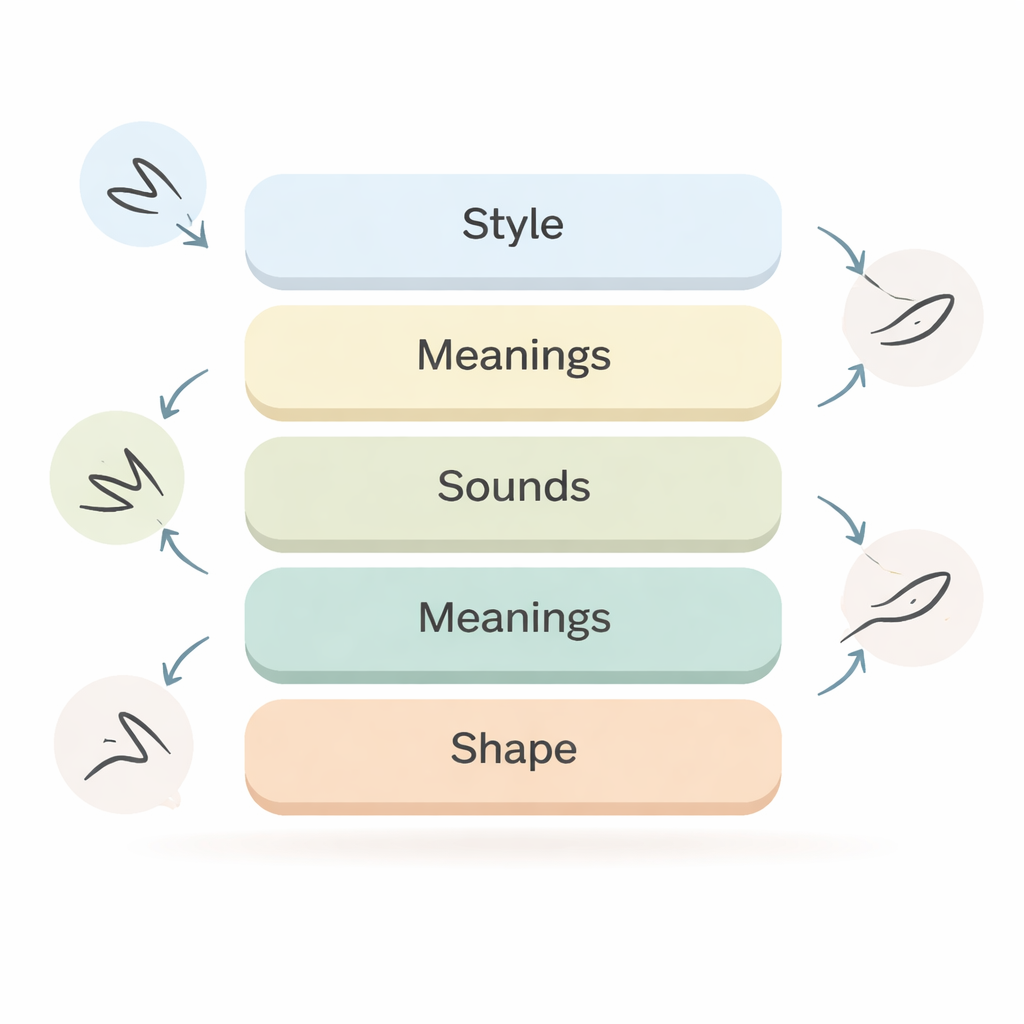
From strokes on a page to recognizable patterns
The topology layer looks closely at how a glyph, or written form of a symbol, can be broken down into simple strokes. The model defines a small toolkit of basic operations—such as extending, shortening, rotating, mirroring, or shifting a line—that can gradually turn one glyph into another. By chaining these operations, the authors show how to describe historical changes in shape with step‑by‑step precision. But geometry alone does not explain why different shapes still “count” as the same letter. That role belongs to the visual identity layer, which records the core arrangement of parts—like an apex and two supporting lines for an “A”-like shape—that stays constant even as stroke lengths or angles shift.
Connecting marks to speech and meaning
Once visual identity is fixed, the model moves into the realm of language. In the phonetic layer, each class of visually related glyphs is linked to one or more sound values, depending on the writing system. Some scripts map one symbol to one sound, while others allow a single symbol to represent several sounds depending on context. The semantic layer then links those same symbol classes to meaning—whether a symbol stands for a whole word, a meaningful part of a word, or just a sound that must be combined with others to form words. This structure lets researchers describe how the same basic sign can shift pronunciation or meaning over time, or across related languages, without losing track of its identity.
Style as cultural fingerprint
The final layer, style, captures how culture, tools, and materials shape the look of writing without changing its underlying structure, sound, or meaning. The same symbol carved into stone may appear sharp and angular, while written with a brush it might become flowing and curved. Medieval European manuscripts, for instance, show the same alphabet in very different styles, from compact Gothic lettering to sweeping humanist scripts. The model treats these as surface variations layered on top of a stable symbolic core. This helps scholars separate genuine changes in a writing system from differences caused by fashion, individual handwriting, or the switch from stone to parchment to digital screens. 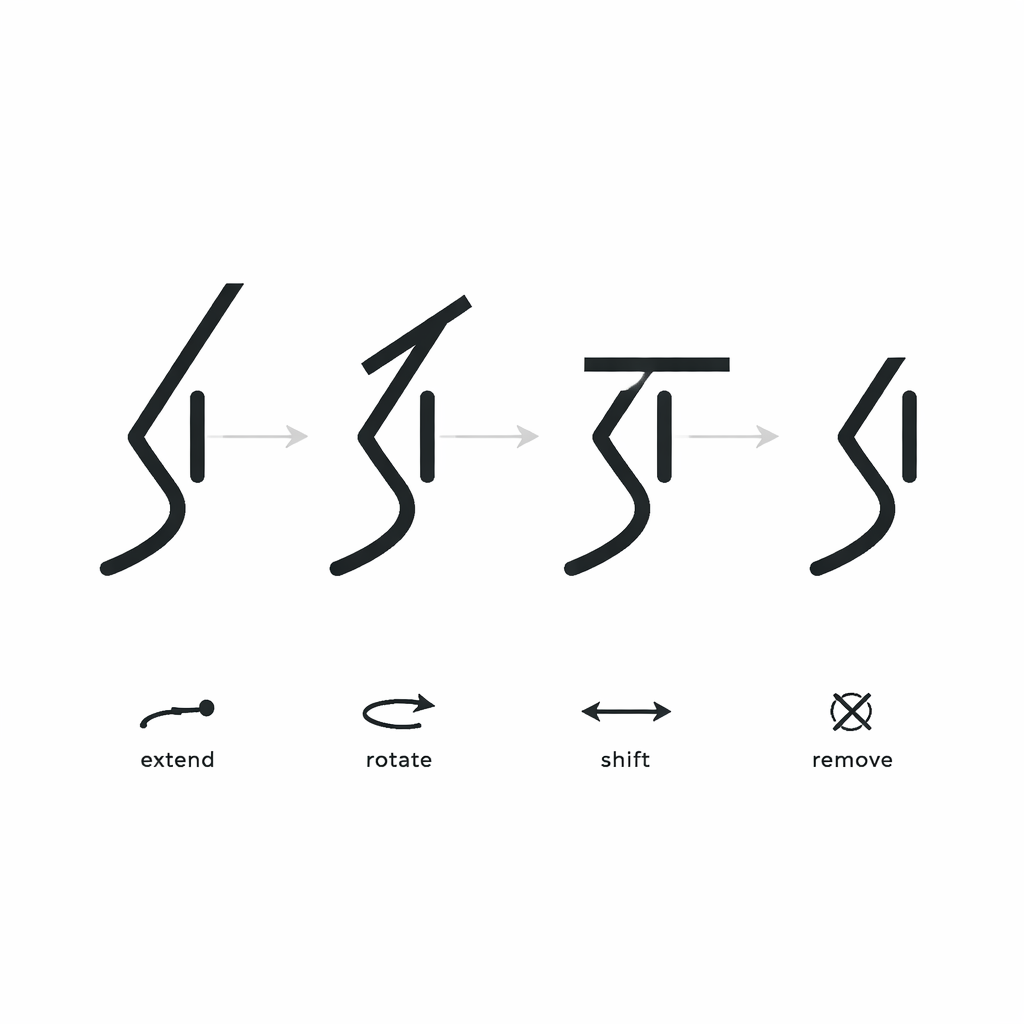
Putting the model to work on real inscriptions
To show that their layered approach is more than a theory, the authors apply it to several case studies. They analyze a complex Székely‑Hungarian Rovash inscription by moving systematically through all five layers, from geometric strokes to cultural style. They then examine two South Semitic inscriptions from ancient Arabia, one only partly understood and one fully deciphered. In each case, the model helps group different glyph shapes under a shared identity, link them to possible sounds and meanings, and tease apart stylistic quirks from deeper structural changes. This demonstrates that the same framework can be used on both familiar and undeciphered scripts.
Why this matters for the past and the future
For a general reader, the key takeaway is that writing is far more than a set of letter shapes. It is a layered system where geometry, pattern recognition, language, and culture all interact. The multilayer model offers a common language for historians, linguists, and computer scientists to describe that system. It could guide the design of smarter tools for reading damaged texts, comparing unrelated scripts, or simulating how writing systems evolve. In plain terms, the article shows how to formally define what we intuitively do when we recognize a “letter” across fonts, eras, and materials—and turns that intuition into a blueprint for understanding the written record of human history.
Citation: Pardede, R., Hosszú, G. & Kovács, F. A layered model for glyph identity and transformation in scripts. npj Herit. Sci. 14, 86 (2026). https://doi.org/10.1038/s40494-026-02351-8
Keywords: writing systems, glyph evolution, computational paleography, script comparison, digital epigraphy