Clear Sky Science · en
The Pompeiian ‘Blue Room’: in situ detection and economic estimation of Egyptian blue pigment in an ancient domestic sacrarium
A Hidden Blue Treasure in Pompeii
Most visitors picture Pompeii in dusty shades of gray and brown, but the ancient city was once bursting with color. This paper tells the story of the “Blue Room,” a small shrine in a Pompeian house whose walls are entirely covered with a rare, brilliant pigment called Egyptian blue. By combining clever imaging tools and microscopic analysis, the researchers show not only how this striking color was used, but also how much of it was needed and what that would have cost in Roman times—offering a vivid glimpse into the wealth and priorities of one ancient household.
A Small Room with a Big Story
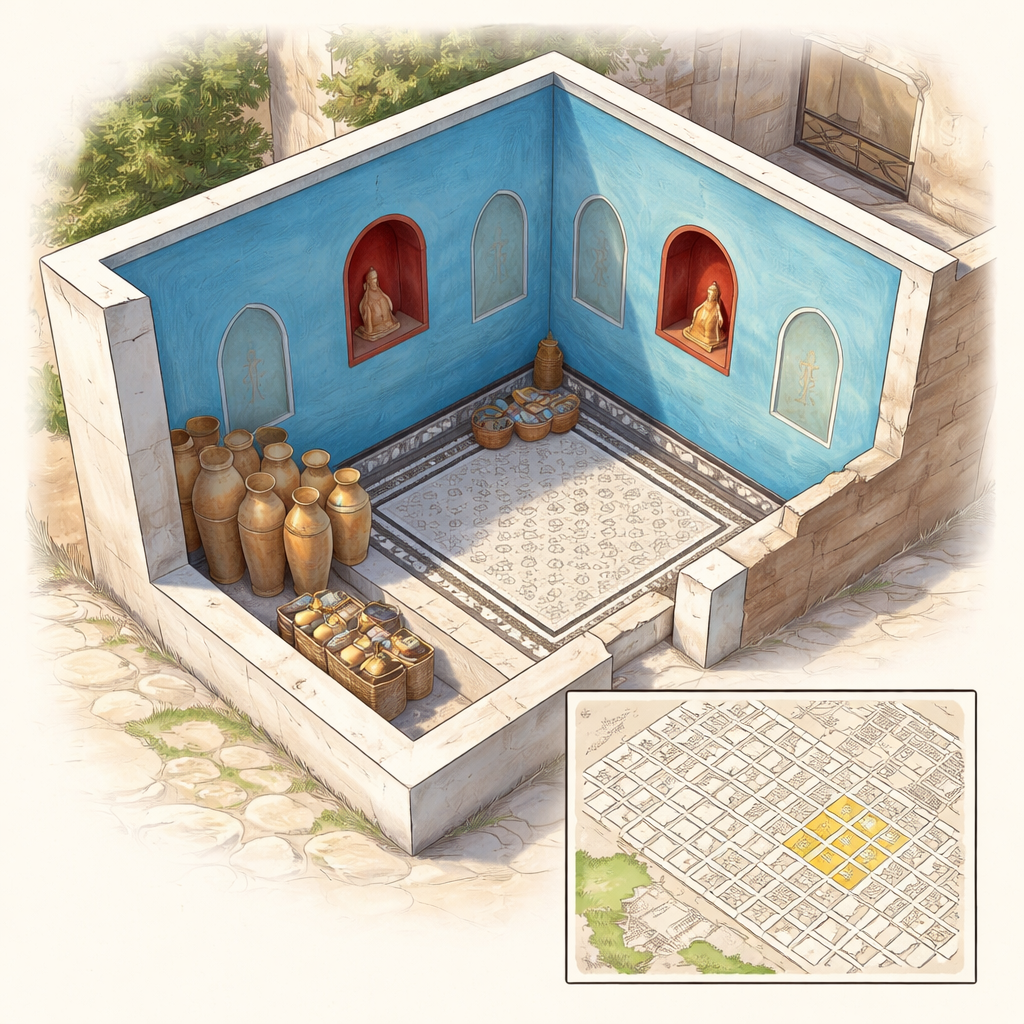
The Blue Room sits inside a private home in Regio IX of Pompeii. Though physically modest—just a few meters on a side—it was richly decorated in the fashionable Fourth Style of Roman wall painting. Sky-blue walls formed the backdrop for red niches likely used for offerings, flanked by painted goddesses, seasonal figures, and scenes of ideal country life. Amphorae, piles of building materials, and even a heap of oyster shells were left on the mosaic floor, apparently just as workers had been using the space before the eruption of Mount Vesuvius in 79 CE froze everything in place. This mix of sacred function and everyday clutter makes the Blue Room a rare snapshot of life, work, and belief in a wealthy Roman house.
The First Synthetic Blue
Egyptian blue is no ordinary paint. It is the earliest known synthetic pigment, first made more than three thousand years earlier by heating sand, limestone, copper minerals, and alkali until they fused into a glassy material filled with vivid blue crystals. In the Roman world, this color was closely tied to status and the divine, and blue pigments of any kind were uncommon. At Pompeii, Egyptian blue turns up here and there—in clothing, in the whites of painted eyes, on fountains and mosaics—but usually in small touches. The Blue Room is different: nearly every wall surface carries a base layer of this pigment, making it a showcase of both the technology and the social meaning of color in antiquity.
Seeing Invisible Blue in Sunlight
One of the pigment’s unusual traits is that when you shine visible light on it, it glows in the near-infrared, a kind of invisible light. Museums often exploit this with special cameras in dark rooms, but that is hard to do outdoors at a bright archaeological site. The team adapted inexpensive night-vision goggles fitted with a filter, then developed an “image subtraction” trick so they could hunt for Egyptian blue in full daylight. They took one image of a wall under normal sunlight and a second with an added LED spotlight, then used software to subtract the two, leaving behind only the glow from the pigment. This method confirmed that the Blue Room’s walls were first coated in a continuous Egyptian blue layer, with reds, yellows, and other colors painted on top.

Weighing the Paint and Counting the Cost
To understand the scale of this investment, the researchers needed to estimate how much pigment the painters used. They measured the total painted area of the walls, studied tiny cross-sections of wall fragments to find the average thickness of the blue layer, and used electron microscopes and image-analysis software to calculate how much of that layer was actually Egyptian blue versus lime plaster. Combining these measurements with the mineral’s density, they calculated that the shrine probably required between 2.7 and 4.9 kilograms of Egyptian blue. Drawing on the ancient writer Pliny the Elder’s price lists, they translated that mass into a cost of roughly 93 to 168 Roman denarii for the pigment alone—equivalent to hundreds of loaves of bread and roughly half to nearly a full year’s pay for a Roman foot soldier.
What This Blue Says About Ancient Wealth
For a room that was small and, by the time of the eruption, apparently used partly for storage, this was a striking outlay. The Blue Room shows that Egyptian blue, though not the priciest pigment available, was still valuable enough that using it as a full undercoat signaled serious resources. The study demonstrates how modern, largely non-destructive tools can reveal not only what colors ancient artists chose, but also what those choices meant in economic and social terms. In this case, the lavish use of a prestigious blue inside a private shrine underscores just how far Pompeii’s elites were willing to go—and pay—to surround themselves with vivid signs of status and piety.
Citation: Quraishi, M.A., Nicola, M., Weaver, J.C. et al. The Pompeiian ‘Blue Room’: in situ detection and economic estimation of Egyptian blue pigment in an ancient domestic sacrarium. npj Herit. Sci. 14, 132 (2026). https://doi.org/10.1038/s40494-026-02349-2
Keywords: Pompeii, Egyptian blue, Roman wall painting, ancient pigments, cultural heritage