Clear Sky Science · en
3D reconstruction and material analysis of Neolithic wattle-and-daub houses at Fenghuangzui site in China
Ancient homes with modern surprises
Imagine stepping into a 5,000-year-old neighborhood and finding houses that were not only carefully planned, but also strengthened with something very close to early concrete. This study of Neolithic houses at the Fenghuangzui site in central China shows how everyday people in prehistory used fire, earth, and ingenious white plasters to build durable homes and stable communities long before cities and written records appeared.
A buried town on a river terrace
The Fenghuangzui site lies on a raised river terrace in the middle Yangtze region and once formed a 15-hectare walled town encircled by a moat. Between about 3300 and 2200 BCE, it was a regional center linked by waterways and cultural contacts to both southern and northern China. Excavations since 2020 have revealed earthen enclosures, house foundations, ash pits, and burial jars, painting a picture of a densely organized settlement rather than scattered huts. Within one central enclosure, archaeologists uncovered a cluster of single- and multi-room houses, trash pits, and thick spreads of red-burnt clay and white-coated fragments—clues that these were once sturdy wattle-and-daub buildings with carefully finished walls and floors. 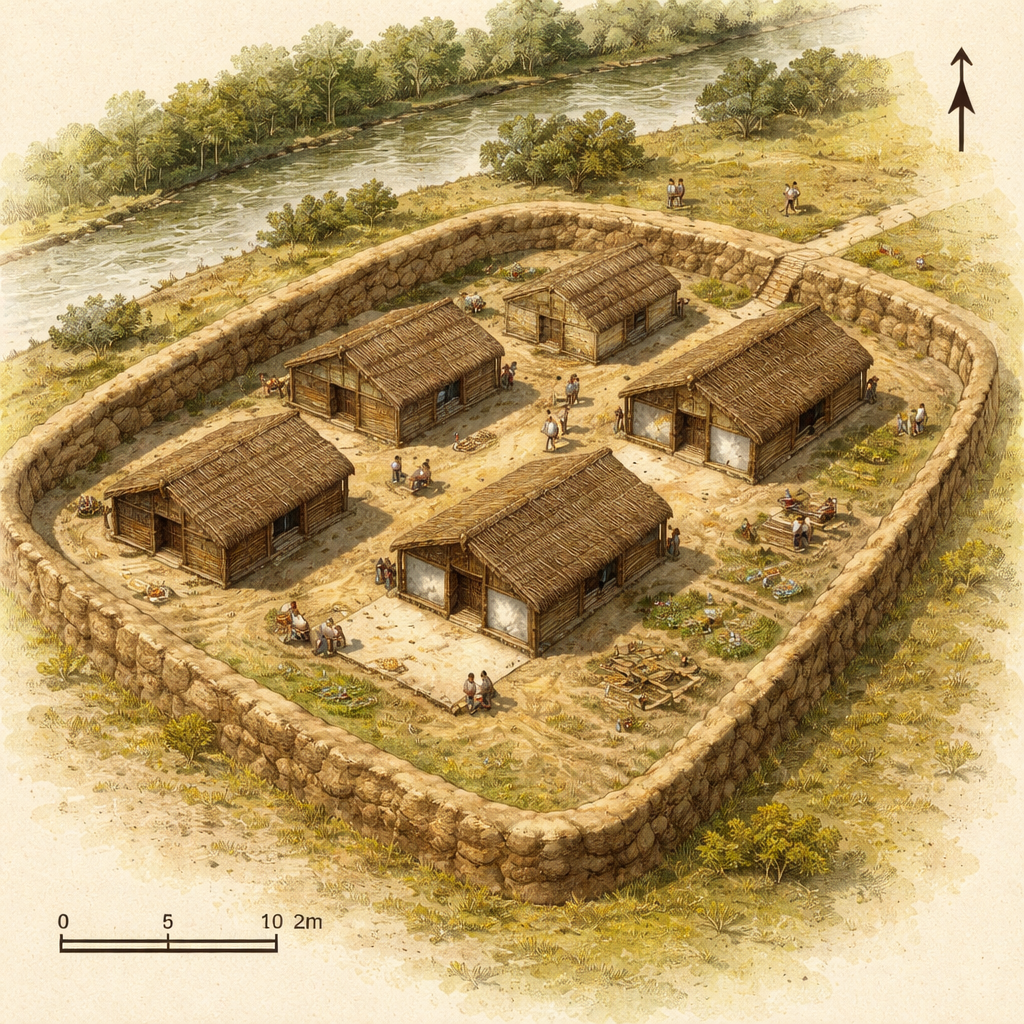
Rebuilding houses from broken clay
Wattle-and-daub houses are made from a frame of wood or bamboo, woven together and packed with wet clay. At Fenghuangzui, the key evidence for this building method came from hundreds of chunky red-burnt clay pieces. Many preserved imprints of rice husks, straw, wooden planks, round posts, and bamboo poles, even fingerprints left in soft clay. By sorting these pieces by size, shape, and texture, and then placing them in a digital model, the team created three-dimensional reconstructions of the houses. They identified thin, flat pieces likely from clay-coated roofs and thicker blocks from walls with corners and joints still visible. The resulting models show rectangular houses with two or more rooms, surrounded in some cases by raised earthen banks that defined compact residential yards.
Firing the house to make it last
The red color and hardness of the clay chunks show that the buildings were deliberately fired, not simply destroyed in accidental blazes. Earlier scholars proposed that such burning might be symbolic, but the even heating and high temperatures here point to a practical goal: hardening the walls and floors so they resisted rain, insects, and cracking. Based on their 3D reconstructions, the authors argue for a two-stage firing sequence. Builders first leveled the ground, dug shallow trenches, and set upright posts. They wove smaller wood and bamboo between them, packed both sides with clay, and then used controlled fires to bake the floors and walls until they were strong enough to bear weight. Only afterwards did they add the roof frame, apply clay to the top, and fire the roof in a second stage, avoiding a collapse that might occur if everything burned at once. This step-by-step “bake to build” process shows a sophisticated understanding of materials and combustion. 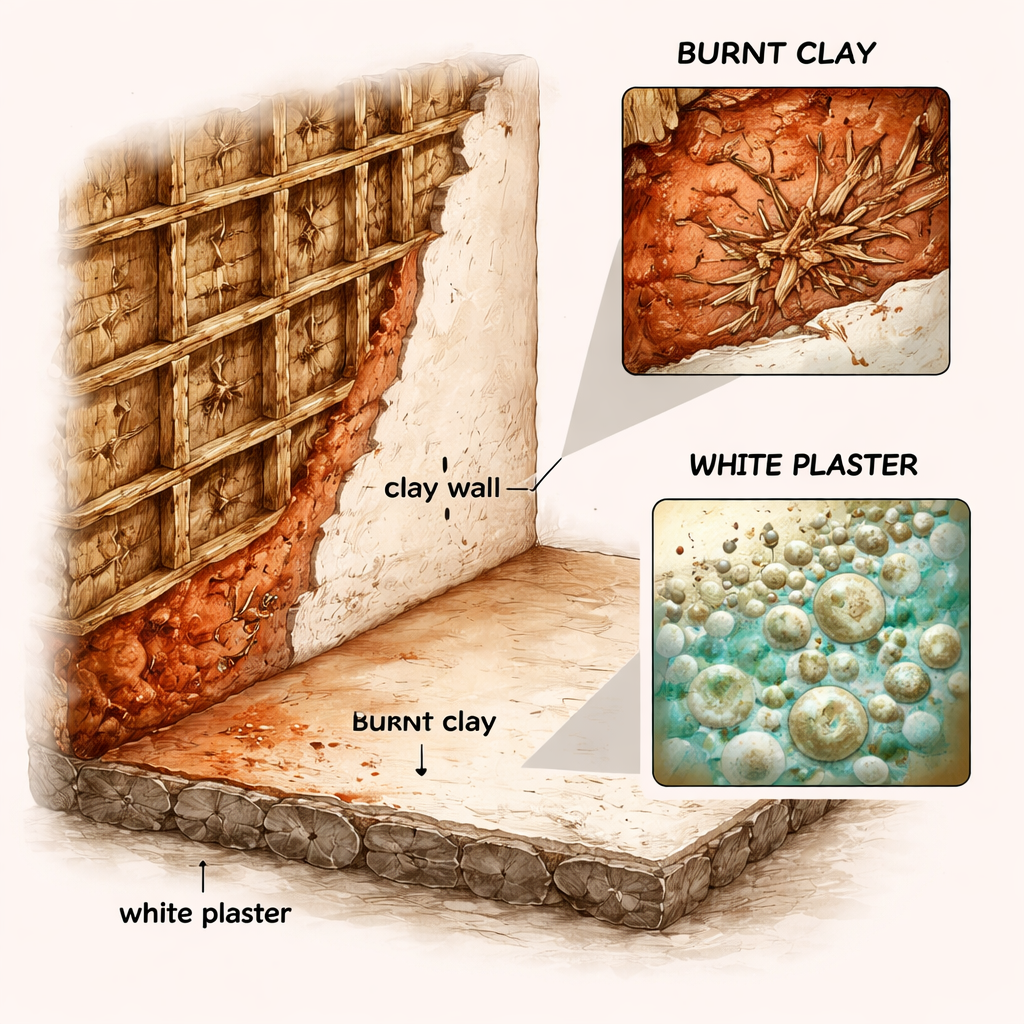
A white coating with cement-like power
Among the most intriguing finds were fragments of white-surfaced plaster from ash pits and house remains dating to the later Shijiahe period. These thin, milky coatings once covered walls and floors, producing smooth, water-resistant surfaces. To understand how they were made, the researchers used a suite of laboratory methods, including X-ray fluorescence, Raman spectroscopy, X-ray diffraction, electron microscopy, and infrared spectroscopy. One sample turned out to be almost pure calcium carbonate, but the others shared a more complex mix rich in calcium, aluminum, and silicon. Their structure was mostly amorphous—lacking sharp crystal patterns—and under the microscope looked like a gel. Together, the evidence points to a calcium aluminosilicate hydrate binder, a “hydraulic” material that sets in the presence of water, much like the binding phase in modern concrete.
Innovation, households, and community life
Finding this kind of hydraulic binder in Neolithic China is exceptional. It suggests that Fenghuangzui’s residents experimented with burning local calcareous nodules and clays to produce strong, durable plasters, independently arriving at a technology that echoes Roman concrete developed millennia later. Architecturally, the wattle-and-daub houses with fired walls, fired roofs, and white plasters formed compact residential compounds enclosed by raised earthen banks. Socially, these compounds likely housed extended families who shared labor and resources and maintained a sense of belonging within clearly marked boundaries. Cooking hearths seem to have been placed outside rather than indoors, and pottery evidence hints that large communal meals helped knit the community together.
What these ancient houses tell us today
To a non-specialist, the Fenghuangzui study shows that early farmers were not simply “living in mud huts,” but were careful planners and inventive builders. By baking their houses and using a primitive but effective cement-like plaster, they created more durable, comfortable, and water-resistant homes. The combination of 3D digital reconstruction and detailed material analysis allows researchers to move from scattered fragments to full-bodied stories about how people organized their neighborhoods, cooperated with relatives, and adapted local earth and stone into advanced building materials. In doing so, this Neolithic town offers a deep-time example of sustainable construction and community design that still resonates with how we build—and live—today.
Citation: Kang, Y., Wu, T., Wang, J. et al. 3D reconstruction and material analysis of Neolithic wattle-and-daub houses at Fenghuangzui site in China. npj Herit. Sci. 14, 91 (2026). https://doi.org/10.1038/s40494-026-02347-4
Keywords: Neolithic architecture, wattle-and-daub, Fenghuangzui, ancient plaster, Yangtze River archaeology