Clear Sky Science · en
A method for 3D reconstruction of ancient buildings driven by crowdsourced images
Why holiday photos can help save ancient buildings
All over the world, historic temples, towers, and palaces are quietly wearing away under wind, rain, pollution, and time. Engineers now rely on detailed 3D digital models to watch for cracks, measure tilts, and plan careful repairs. But making those models usually demands expensive lasers, drones, and on‑site teams. This study shows how something much more ordinary—crowds of tourist photos posted online—can be turned into highly accurate 3D reconstructions of a famous ancient wooden pagoda, cutting costs and risks while improving the digital record of a fragile landmark.
The challenge of turning casual photos into solid science
Traditional 3D surveying tools, such as ground-based laser scanners and camera-equipped drones, can capture buildings in great detail but are costly, limited by regulations, and sometimes miss pieces of complex structures. Crowdsourced images, by contrast, are plentiful, cheap, and taken from many angles. The catch is that they are wildly inconsistent: some are blurry, overexposed, or blocked by tourists and trees; others are taken with very different cameras and lenses. When these mixed-quality pictures are fed into standard reconstruction software, errors in shape and surface details reinforce one another, producing warped geometry and muddy textures that are unacceptable for serious heritage conservation.
A smart filter for messy real‑world pictures
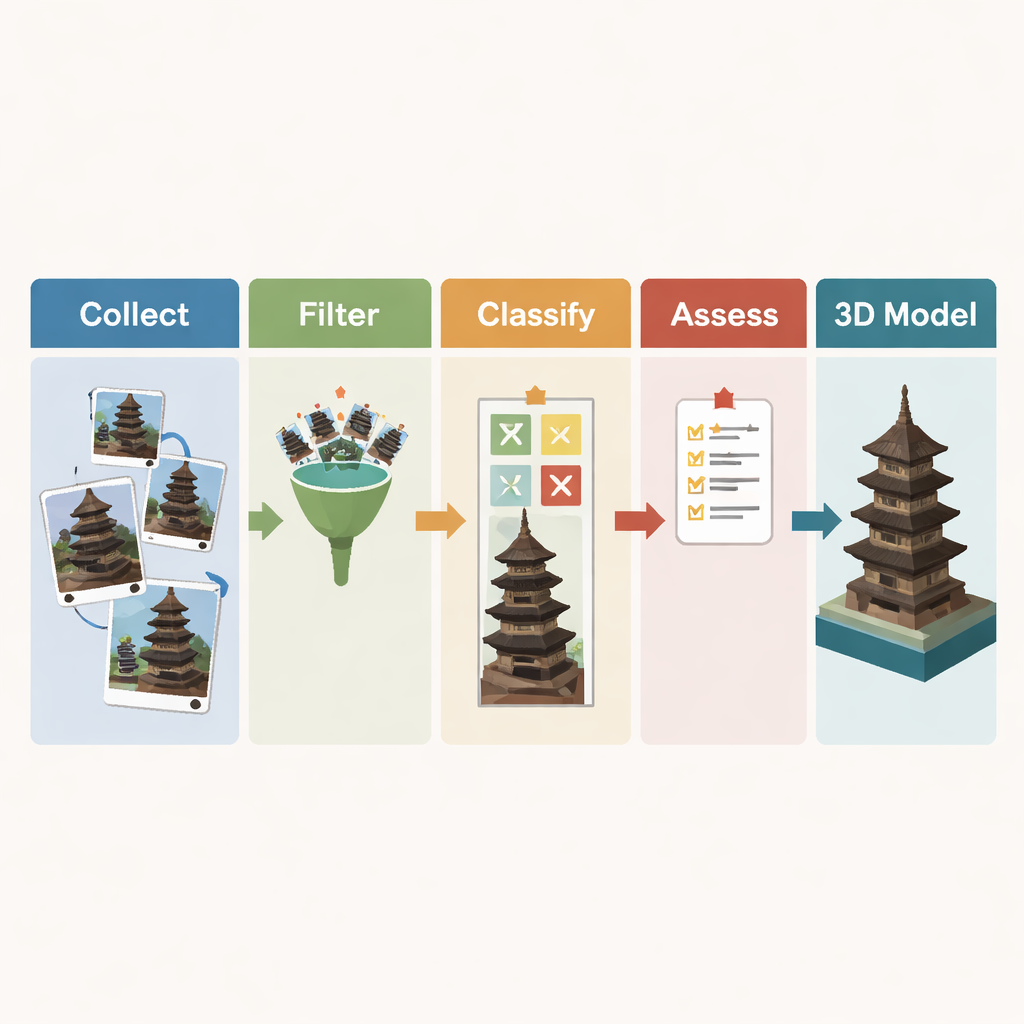
To break this cycle, the authors designed a three-step “smart filter” that cleans and organizes thousands of online images before any 3D modeling begins. First, an automated screening stage quickly removes obviously unhelpful photos: it checks that the pagoda actually appears in the frame, that the resolution is high enough, that the building is not mostly hidden by obstacles, and that parts of the image are not washed out by bright sunlight or buried in noise. Each step uses modern image-recognition tools, and the process stops as soon as a picture fails, which saves considerable computing time. The surviving images then move to a second stage that spots near-duplicates—almost identical shots taken a moment apart—by comparing both overall content and local structure, keeping only the most useful versions.
Judging image quality the way the building “feels” it
Even after screening and deduplication, not every photo is equally helpful for reconstructing fine carvings, layered roofs, and aging wooden beams. The third stage of the framework therefore scores each image from several angles that matter for 3D modeling: how well it preserves sharp edges and outlines, how much visual information its textures carry, how noisy or distorted it is, and how closely its colors match reality. Instead of relying on a single measure, the authors blend five different quality indicators and use statistics to learn how strongly each one relates to errors in the final models. This produces a balanced “report card” that favors images preserving both accurate shapes and rich, believable surface details.
Putting the method to the test on a leaning wooden tower
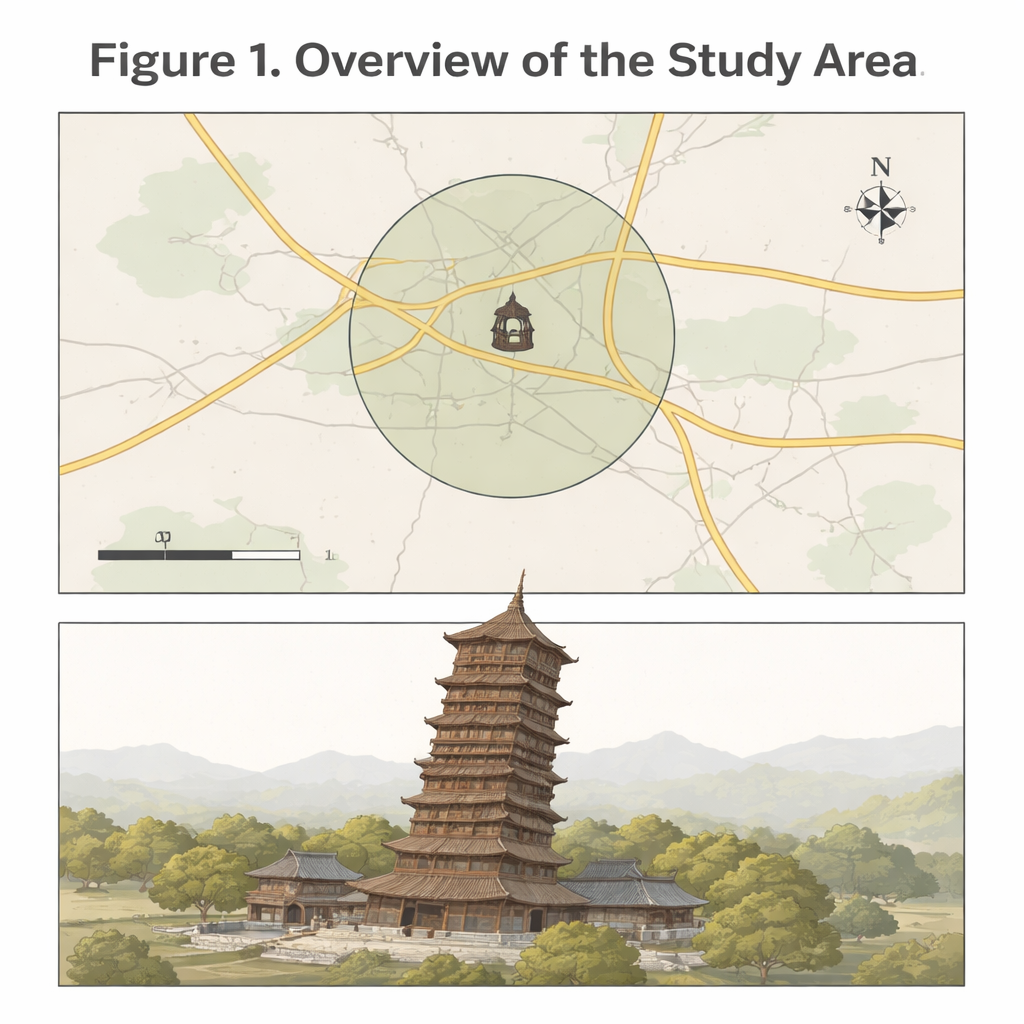
The team applied their framework to the Yingxian Wooden Pagoda in northern China, a towering, centuries-old wooden structure known for its intricate bracket systems and a slight but worrying tilt. They gathered two matching sets of images: one composed of crowdsourced photos from 2015–2024 that were run through the new filtering and scoring pipeline, and a second set of carefully shot, high-quality on-site photographs used as a traditional benchmark. Both sets were then fed into the same state-of-the-art 3D reconstruction engine, allowing a direct comparison of the resulting digital models, from point cloud density to surface sharpness and color accuracy.
Sharper virtual heritage from everyday images
The crowdsourced images, once cleaned and optimized, did more than just match the professionally captured photos—they often outperformed them. The model built from the filtered online images contained about a quarter more points on the building’s surface and within its volume, while noise and stray points were noticeably reduced. Edges of carved plaques and bracket sets appeared clearer, and measured texture sharpness improved by nearly 30 percent. Color differences from a physical reference chart dropped by about one-third, indicating a closer match to how the pagoda actually looks. For heritage conservators, this means that, with the right digital safeguards, public photo collections can deliver high-fidelity 3D models without heavy equipment or intrusive fieldwork.
What this means for protecting the past
For non-specialists, the key message is simple: the photos people casually take and share can, if properly filtered and evaluated, become powerful tools for preserving the world’s architectural treasures. The method in this paper shows how to sort good images from bad in a way that respects both the shapes and the surfaces of historic buildings, producing detailed, trustworthy 3D models from messy real-world data. As these techniques spread, it may become possible to monitor subtle changes in old structures over years using nothing more than carefully curated crowdsourced pictures, turning everyday sightseeing into a quiet force for cultural conservation.
Citation: Liu, Y., Huo, L., Shen, W. et al. A method for 3D reconstruction of ancient buildings driven by crowdsourced images. npj Herit. Sci. 14, 81 (2026). https://doi.org/10.1038/s40494-026-02346-5
Keywords: 3D reconstruction, crowdsourced images, cultural heritage, ancient architecture, digital preservation