Clear Sky Science · en
Ginkgo-derived carbon quantum dots as a novel tracer for water seepage detection in grottoes
Hidden Leaks Threatening Ancient Stone Art
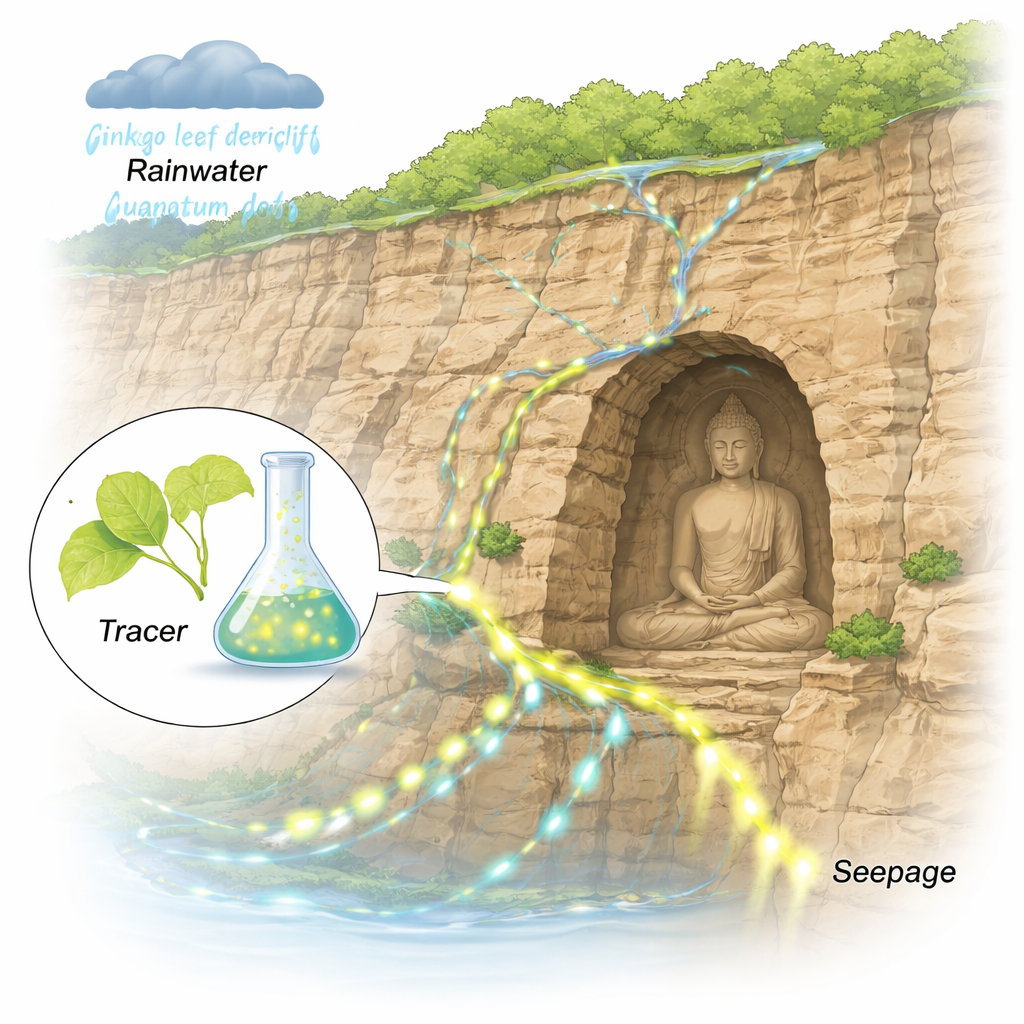
High on the cliffs above China’s river valleys, ancient stone Buddhas and painted grottoes have survived for more than a thousand years. Yet one of their greatest modern enemies is surprisingly ordinary: water slowly leaking through the rock. Finding where that water comes from, and how it travels inside the cliff, is crucial for protecting these treasures—but it must be done without harming the fragile stone. This study introduces a new, plant-based glowing tracer that can safely follow hidden water paths inside rock, helping conservators see what was once invisible.
A New Kind of Safe, Glowing Tracer
Conservators already use a variety of tools—such as underground radar and electrical scans—to look for water in stone. These techniques, however, were designed mainly for oil fields and groundwater studies, not for delicate cultural sites, and they often lack the fine detail needed in complex grotto walls. Another option is the tracer method: adding a detectable substance to suspected water sources and watching where it emerges. But many artificial tracers can stain, react with, or otherwise damage old stone. In this work, the researchers turned to carbon quantum dots, tiny specks of carbon only a few billionths of a meter across, made from common ginkgo leaves. These dots glow strongly under specific light, dissolve easily in water, and are based on simple elements like carbon, hydrogen, oxygen, and nitrogen, making them attractive as gentle tracers.
From Ginkgo Leaves to Bright Nano-Specks
The team produced the dots using a hydrothermal method that can be scaled up for real field work. Fresh ginkgo leaves were washed, mixed with deionized water, and heated in a sealed vessel, then filtered, spun, and purified to yield a clear, glowing liquid of carbon dots. Electron microscopy showed that the particles were typically about 3 nanometers wide—small enough to pass through the fine pores and cracks inside sandstone without clumping. Chemical tests revealed many water-loving groups on their surfaces, which help them stay dispersed rather than settling out. The dots kept a strong and stable glow over a range of acidity, temperature, and water chemistry similar to what is found in natural seepage around the Leshan Giant Buddha, a massive cliff-side statue used here as a real-world test case.
Testing Safety for the Rock Itself
To make sure this new tracer would not quietly eat away at the stone, the researchers collected fresh sandstone from near the Leshan Giant Buddha. They crushed the rock, mixed it with either pure water or tracer solutions, and tracked how metal ions such as calcium, magnesium, sodium, and potassium were released into the water over two weeks. If the tracer were reacting with the minerals, it would change these ion levels compared with plain water. Instead, the differences were so small that they could be explained by normal measurement uncertainty. In other words, almost all of the chemical action came from water interacting with the rock—not from the carbon dots or the two common comparison dyes, fluorescein and rhodamine B. This shows that the ginkgo-based dots are unlikely to cause new damage by changing the rock’s chemistry or pore structure.
Following the Flow Through Sandstone
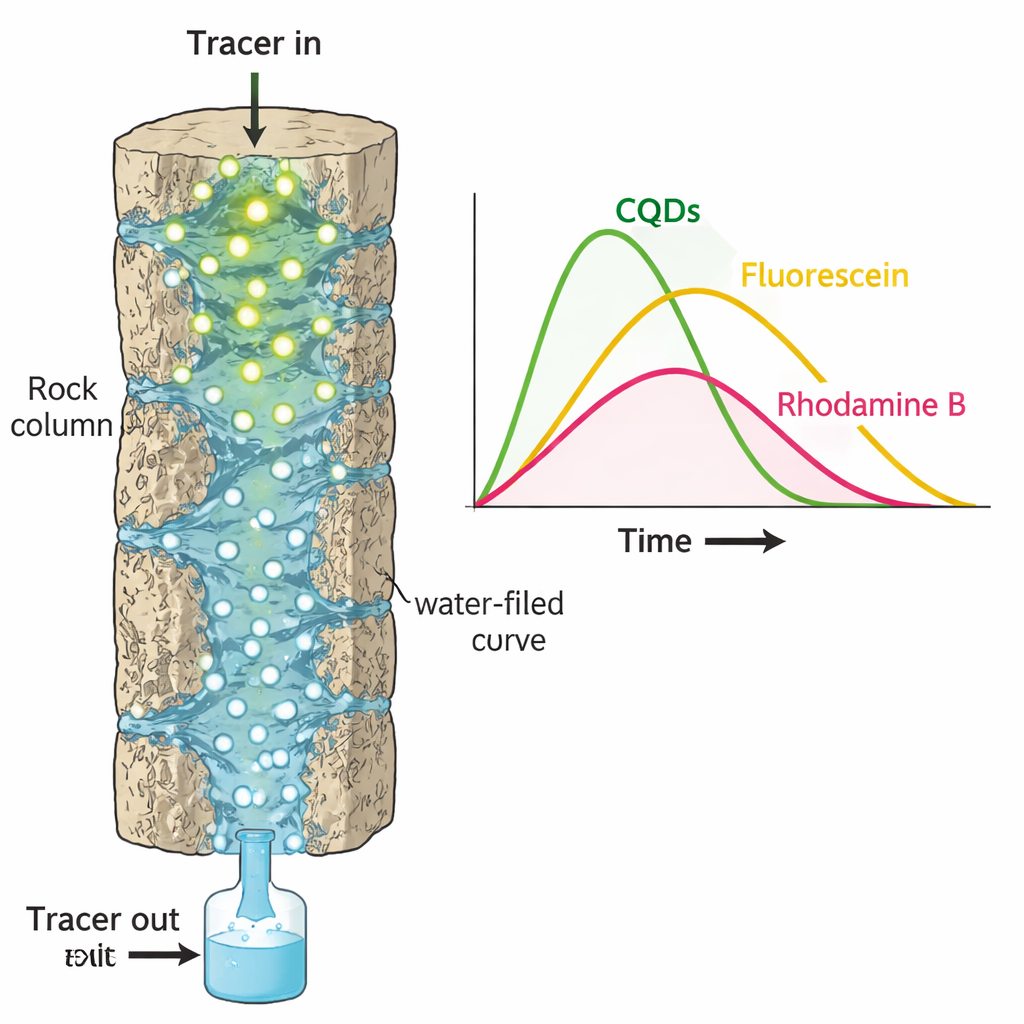
Next, the team examined how well the dots move with water inside rock. They packed a clear column with the crushed sandstone, saturated it with water, and then flowed in solutions of either the carbon dots, fluorescein, or rhodamine B. By collecting water at the outlet and measuring its glow over time, they built "breakthrough curves" that reveal how quickly and completely each tracer travels through the column. The carbon dots and fluorescein appeared at the outlet after about one pore volume of flow and then maintained high, steady signals, before washing out relatively quickly once clean water was reintroduced. Rhodamine B, in contrast, arrived later, built up more slowly, and lingered even after large amounts of fresh water had passed, showing that it sticks to the rock and moves poorly in this sandstone.
What This Means for Protecting Grottoes
Taken together, the results show that ginkgo-derived carbon quantum dots combine three key traits needed for safe tracing in grottoes: they are strongly visible at very low amounts, they travel efficiently with seepage water through typical grotto sandstone, and they barely interact chemically with the rock. Unlike crystalline salts, they do not crystallize in tiny cracks, and unlike some dyes or radioactive tracers, they pose minimal risk to the stone or the surrounding environment. This makes them a promising new tool for mapping where water enters, how it travels, and where it emerges in ancient cliff carvings. With clearer pictures of these hidden water routes, conservators will be better equipped to design drainage, sealing, or other protective measures that keep irreplaceable stone heritage standing for generations to come.
Citation: Sun, B., Shi, W., Ma, F. et al. Ginkgo-derived carbon quantum dots as a novel tracer for water seepage detection in grottoes. npj Herit. Sci. 14, 114 (2026). https://doi.org/10.1038/s40494-026-02344-7
Keywords: cultural heritage conservation, water seepage, carbon quantum dots, grotto sandstone, fluorescent tracer