Clear Sky Science · en
Non-destructive detection and three-dimensional imaging of internal defects in Beijing Ming Great Wall
Seeing Inside a World Wonder Without Touching a Brick
The Great Wall of China is an icon of human history, but many of its bricks and earthwork cores are slowly weakening from the inside out. Cracks, hidden cavities, and seeping moisture can quietly undermine the structure long before damage appears on the surface. Because drilling or cutting into this World Heritage monument risks causing new harm, conservators need ways to "see" inside the wall without touching it. This study shows how a radar-based method can map internal flaws and damp spots in three dimensions, helping caretakers repair the Wall more precisely and with less guesswork. 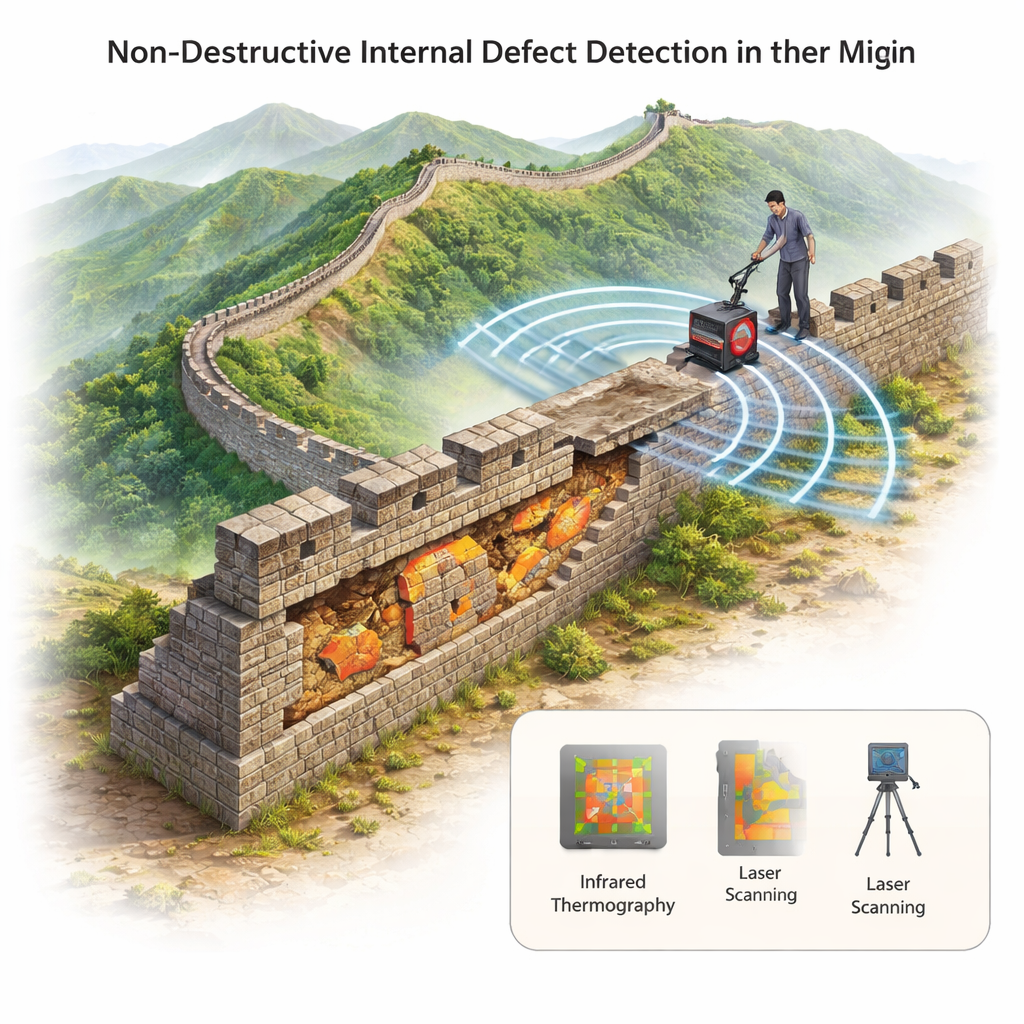
Hidden Problems Inside Ancient Walls
The Ming-era Great Wall in Beijing stretches for hundreds of kilometers across steep mountains, built mainly as a brick shell around a packed core of earth, rubble, and lime mortar. Over centuries, shrinkage of mortar, freezing and thawing, and rainwater have slowly turned tiny cracks into voids and separations between bricks and the inner core. Moisture can sneak in along these pathways, weakening the materials and making collapses more likely. Traditional checks such as visual surveys or drilling out samples are slow, cover only tiny areas, and can chip away original fabric. The authors argue that large, complex monuments like the Great Wall need non-destructive tools that can probe deep inside over long distances, and they focus on ground-penetrating radar (GPR) as the most promising option.
How Radar Looks Through Stone and Earth
Ground-penetrating radar works a bit like an underground echo sounder. A small antenna sends short bursts of radio waves into the wall; whenever those waves pass from one material to another—solid brick to air-filled crack, or dry soil to wet soil—some of the energy bounces back. By recording the strength and timing of these echoes as the antenna is moved along the wall, scientists can build up images of internal layers and hidden features. The team chose a radar frequency of 400 megahertz, which offers a good balance between seeing deep (several meters into brick and rammed earth) and seeing small details (down to a few centimeters). They also compare GPR with other non-destructive methods such as infrared thermography and laser scanning, concluding that only GPR can both penetrate deeply and provide continuous interior images along long stretches of wall.
Building a Mini Great Wall in the Lab
To test and fine-tune their approach, the researchers constructed a scaled physical model of a Great Wall segment using traditional-style gray bricks and a core of crushed stone and earth. Inside this 6.9‑meter-long model they planted ten artificial cavities of different sizes and depths, then filled two of them in 13 different ways: with air, water, slurry, gravel, brick fragments, and loosely packed soil, each in dry and wet states. Scanning this model with the 400 MHz radar, they examined not just basic images but also more detailed "attributes" of the signal—such as overall echo strength, dominant frequency, and how energy was spread out over time and frequency. These tests revealed that certain radar signatures changed in a consistent way as the water content inside a defect increased. For example, wet fills tended to produce stronger echoes overall, a narrower band of main frequencies, and a delayed, longer-lasting low-frequency response compared with dry fills.
Turning Slices of Data into a 3D Map
Collecting radar profiles along many parallel lines allowed the team to stack two-dimensional slices into a three-dimensional block of data representing the interior of the wall segment. Using custom software written in MATLAB, they carefully matched every pixel in the radar images to real-world coordinates, correcting for uneven survey spacing and the irregular geometry of historic masonry. They then used a technique called "isosurface" extraction, which wraps a smooth surface around regions where radar echoes are unusually strong. In the lab model, this 3D reconstruction captured the locations and shapes of most cavities, with an average volume error of about 19 percent—significantly better than many earlier attempts on similarly complex structures. 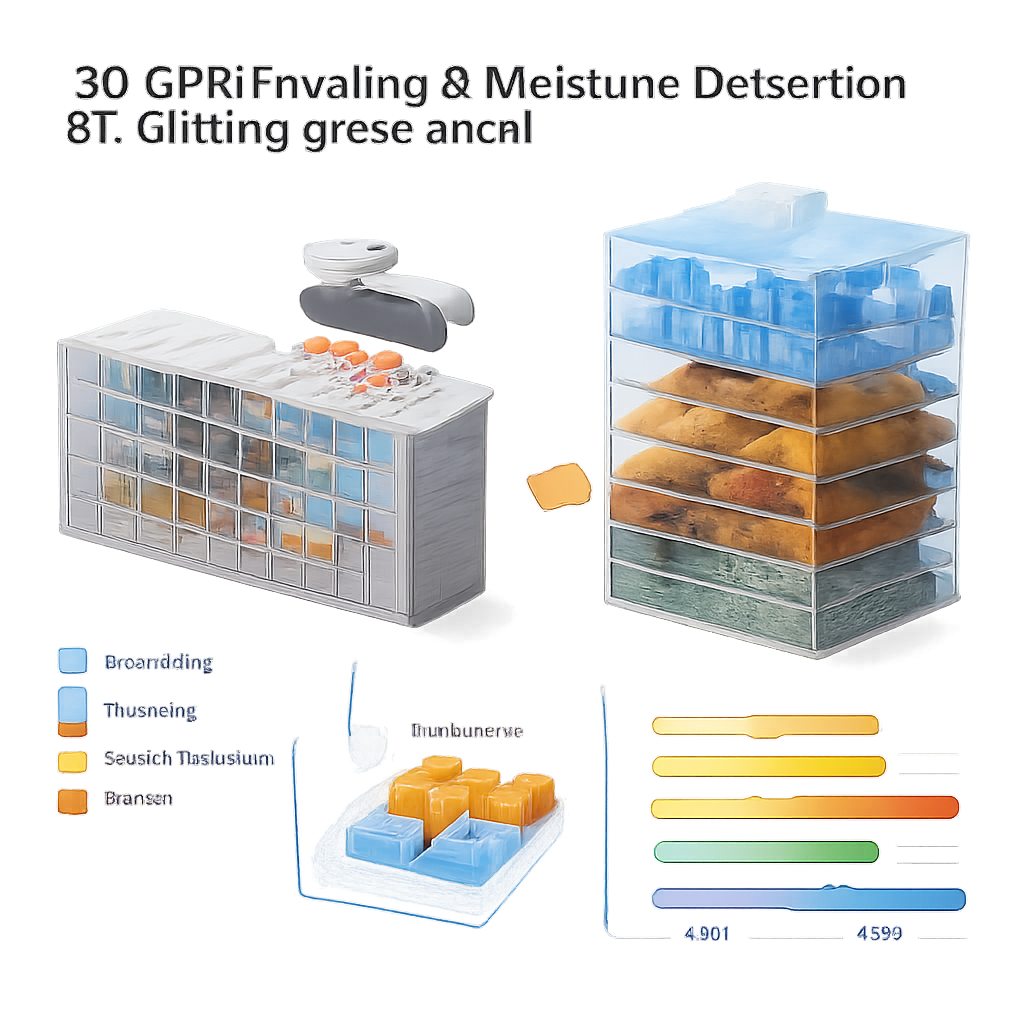
Testing the Method on the Real Great Wall
Armed with their calibrated tools, the researchers surveyed a section of the Panlongshan Great Wall in Beijing, between two beacon towers. Radar scans from the top of the wall showed clear brick layers and distinct clusters of strong echoes deeper inside, at depths of around one to two meters. When they analyzed these zones using the same signal attributes tested in the lab, the patterns most closely matched dry, loosely compacted earth rather than water-soaked material. In other words, the suspicious areas are likely air-filled or dry voids rather than active damp spots. Rebuilding the field data into 3D volumes revealed multiple cavity-like features inside the wall, and while exact volumes were harder to pin down than in the controlled model, the method still provided valuable guidance on where to focus structural checks and future repairs.
What This Means for Protecting Heritage
For non-specialists, the key message is that radar can now do much more than simply flag that "something" is wrong inside an ancient wall. By carefully analyzing how the radar echoes change with moisture and by converting long strips of measurements into a 3D picture, conservators can locate internal voids, estimate their size, and get a first impression of whether they are dry or water-laden—all without drilling a single hole. While each site still needs its own calibration because materials and weather conditions differ, this study offers a practical roadmap for using GPR to support targeted, minimally invasive repairs to the Great Wall and other historic masonry around the world.
Citation: Qian, W., Wu, R., Tian, W. et al. Non-destructive detection and three-dimensional imaging of internal defects in Beijing Ming Great Wall. npj Herit. Sci. 14, 62 (2026). https://doi.org/10.1038/s40494-026-02341-w
Keywords: Great Wall conservation, ground-penetrating radar, non-destructive testing, heritage masonry, moisture detection