Clear Sky Science · en
Experimental and numerical research on the lateral hysteretic behavior and simplified model of typical Dou-Gong in Ming-Qing dynasties
Ancient wooden brackets that protect buildings from earthquakes
Many of China’s grand historic wooden gates, halls, and towers have stood through centuries of earthquakes. A key reason is a curious-looking stack of interlocking wooden blocks and beams called Dou-Gong. This study looks closely at how one important family of these brackets, from the Ming and Qing dynasties, rocks and slides during shaking and how its behavior can be captured in a simple engineering model. Understanding this hidden wooden “shock absorber” helps us better preserve world heritage buildings and design safer modern structures inspired by them.
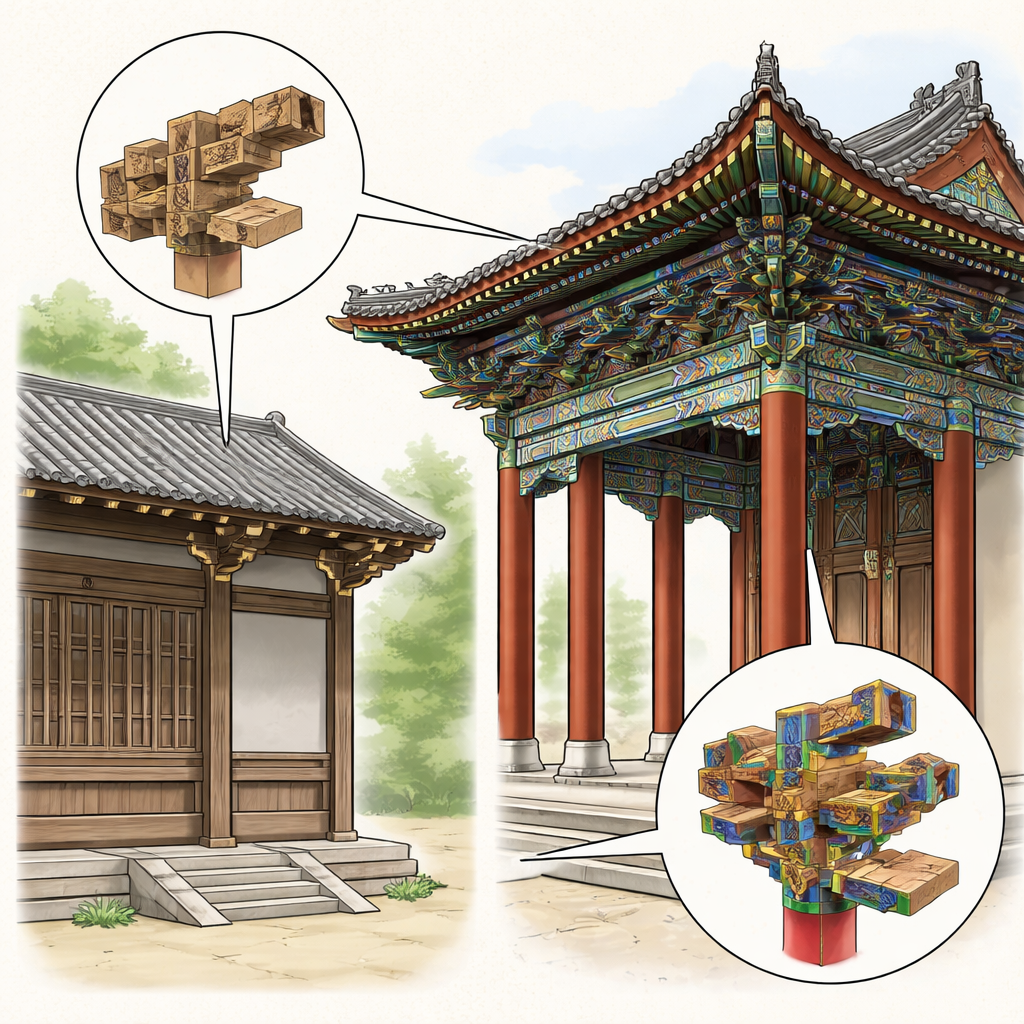
A wooden puzzle with social meaning
Dou-Gong is more than just a structural trick; it is also a symbol of status. In ordinary historic houses only small, simple brackets were allowed, while official city gates and imperial halls carried large, richly painted stacks of wooden blocks. The authors focus on these mid‑to‑high‑level Ming–Qing brackets used in important public buildings. Compared with earlier, more elaborate Song‑dynasty versions, Ming–Qing Dou-Gong is slimmer and more compact, with fewer overhanging arms and a more direct path for forces to travel from the roof into the columns and walls. These differences suggest that it might respond to earthquakes in its own way, rather than behaving like the older brackets that most previous research has studied.
Three bracket types, three positions in a frame
The researchers examined three typical bracket layouts, each occupying a different position in a timber frame. One type sits between columns (DGPS) and is not directly tied into them. A second type rests on top of columns (DGZT), and a third is placed at the corners where two walls meet (DGJ). From careful field surveys of historic gates and towers in Beijing and Shanxi, the team recreated these three arrangements at one‑third scale using the same kind of pine wood found in the originals. They tested the basic strength of the wood itself and then assembled bracket specimens that closely matched the historical shapes.
Shaking the brackets to reveal hidden motion
The brackets were mounted in a sturdy steel frame and pushed back and forth in slow, controlled cycles to mimic earthquake motion. Small weights represented the roof load pressing down from above. As displacement grew, the team watched for cracking, separation, and failure and recorded the push‑and‑pull forces. All three types showed strong sliding between mating wooden surfaces, along with gradual crushing and splitting of wood fibers at key contact spots. The curves of force versus movement formed loops that narrowed in the middle, an effect called “pinching,” which signals that parts of the structure open and close during each cycle and that stiffness gradually degrades. Among the three, the column‑top (DGZT) and corner (DGJ) brackets were better at soaking up energy, while the between‑column bracket (DGPS) kept more of its stiffness but dissipated less energy.
From complex carving to simple lines
Because a real Dou-Gong involves many small blocks and contact surfaces, detailed computer models are time‑consuming and costly to run for an entire building. To address this, the authors built refined three‑dimensional simulations of each bracket and then traced the main internal “force flow” paths where stresses concentrated. They replaced the intricate geometry with just a few idealized beams and braces, including some elements that do not literally exist in the wood but stand in for its overall effect. Special attention was paid to how compressed wood deforms around hidden dowels, which control how far pieces can move before yielding. The result is a simplified beam model that uses a tiny fraction of the original computer resources—on the order of a few percent of the elements and nodes—while still tracking the key rocking and sliding behavior.
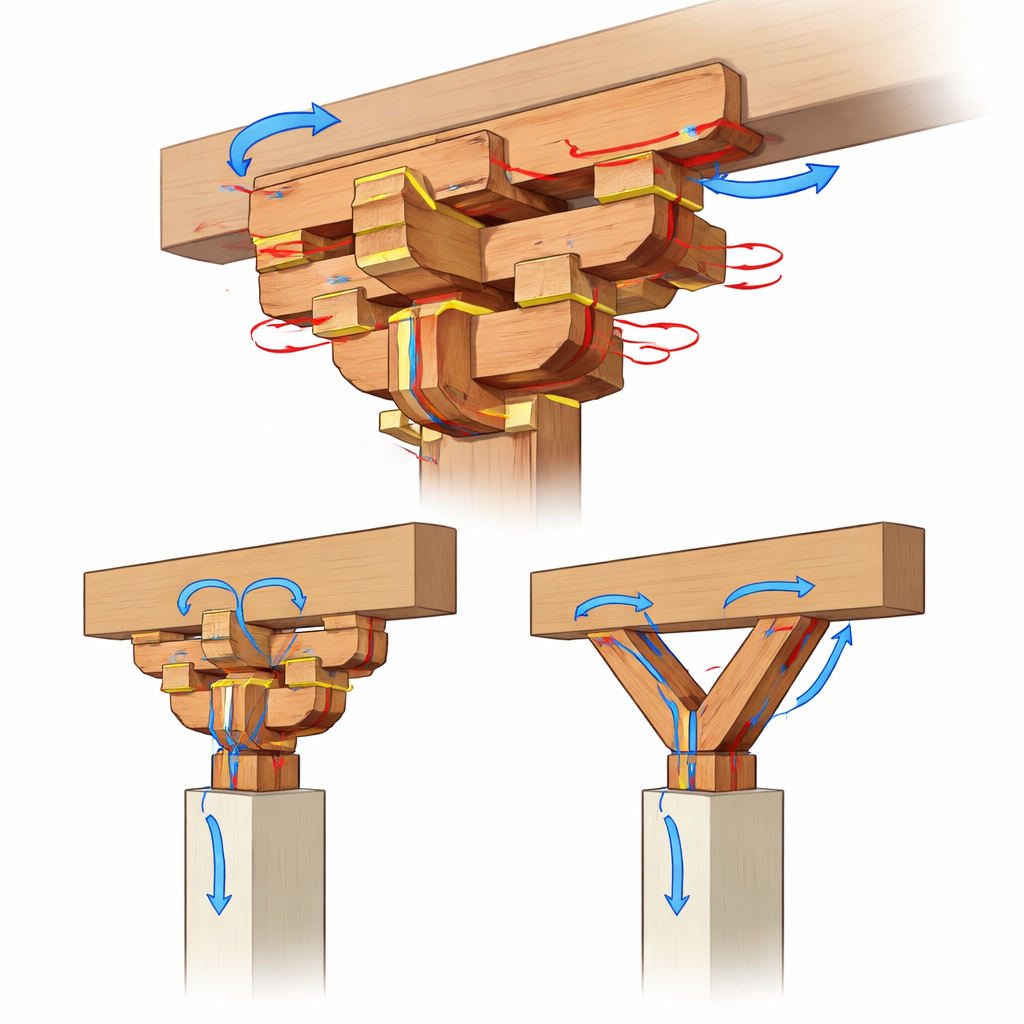
Testing if the shortcut really works
The simplified models were then pushed in the virtual world with the same displacements used in the lab tests. When the researchers compared the outcomes, they found that the streamlined models reproduced the overall shape of the experimental curves and the way stiffness fell as movement grew. The patterns of high and low stress in the simplified versions also matched those in the detailed simulations. Some differences appeared at very large displacements, where real wood defects and complex friction effects become important, but for the range most relevant to structural assessment the agreement was good enough for practical use.
What this means for historic buildings today
For a non‑specialist, the main message is that these layered wooden brackets are not fragile ornaments; they act as built‑in cushions that let historic buildings wiggle, slide, and shed earthquake energy without collapsing. This study shows that even the “simpler” Ming–Qing versions perform this protective role, and it offers engineers a compact way to represent them inside whole‑building computer models. That makes it far easier to check the safety of large timber monuments and to plan repairs or reinforcements that respect their original character.
Citation: Cui, Z., Chun, Q., Yuan, Y. et al. Experimental and numerical research on the lateral hysteretic behavior and simplified model of typical Dou-Gong in Ming-Qing dynasties. npj Herit. Sci. 14, 57 (2026). https://doi.org/10.1038/s40494-026-02340-x
Keywords: Dou-Gong, seismic performance, timber heritage, Ming–Qing architecture, energy dissipation