Clear Sky Science · en
Integrated portable spectroscopy for the analysis of Roman mosaics from Marroquíes Altos, Jaén, Spain
Ancient Floors, New Clues
Roman mosaics are often admired as beautiful pictures made of tiny stones, but they are also like time capsules holding clues about everyday life, trade, and technology in the ancient world. This study looks at three striking mosaics from Jaén, in southern Spain, and uses modern, non-destructive science tools to uncover what they are made of and how they were produced—without removing a single piece from the museum wall.
Hidden Stories in Three Mosaics
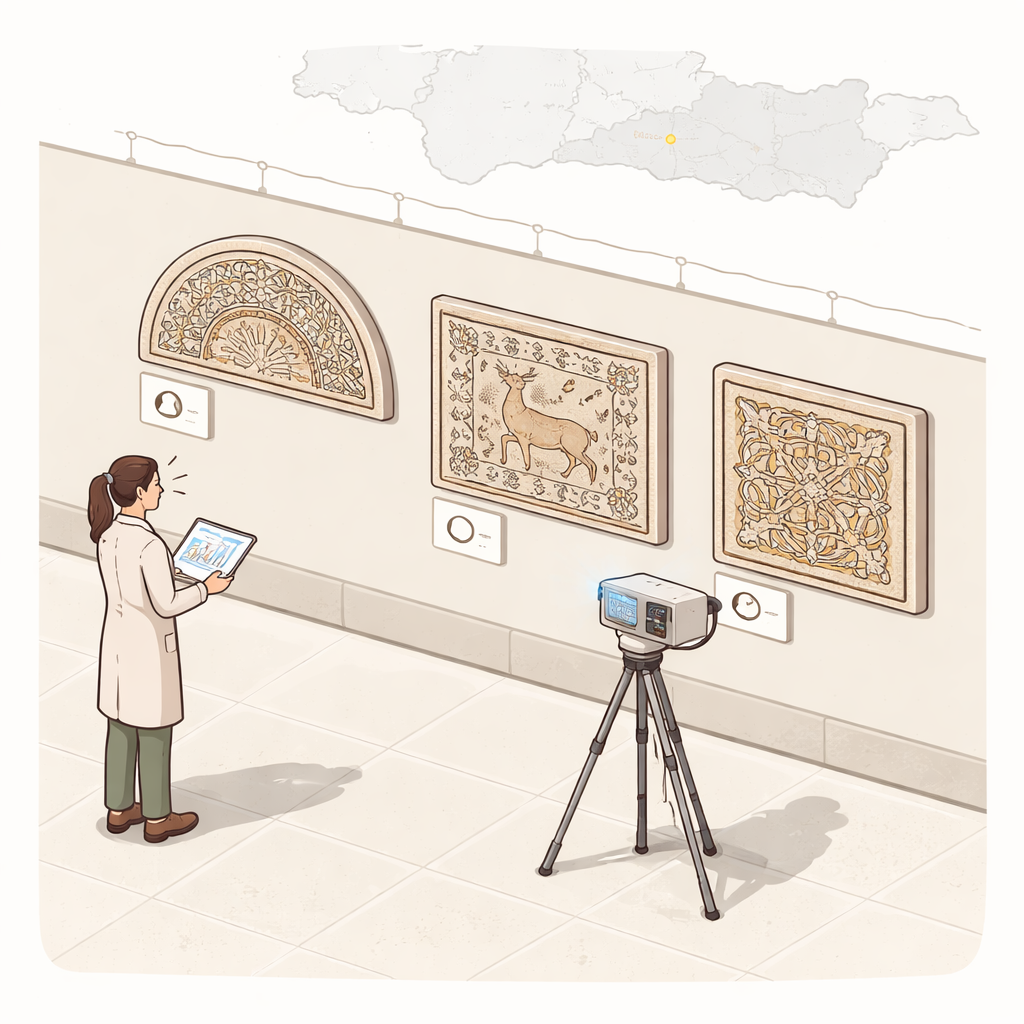
The research focuses on three mosaics found at the Marroquíes Altos site: one showing the sea goddess Tethys, another with playful winged figures called erotes (similar to cupids), and a third decorated with curling plant-like patterns. Today, these mosaics are displayed on the walls of the Museum of Jaén, far from their original Roman building. Over time, much of the archaeological context—who made them, what materials they used, and how they were restored—was lost. The goal of this work was to rebuild some of that missing story by treating the mosaics as historical documents, not just decoration.
Bringing the Mosaics into the Digital Age
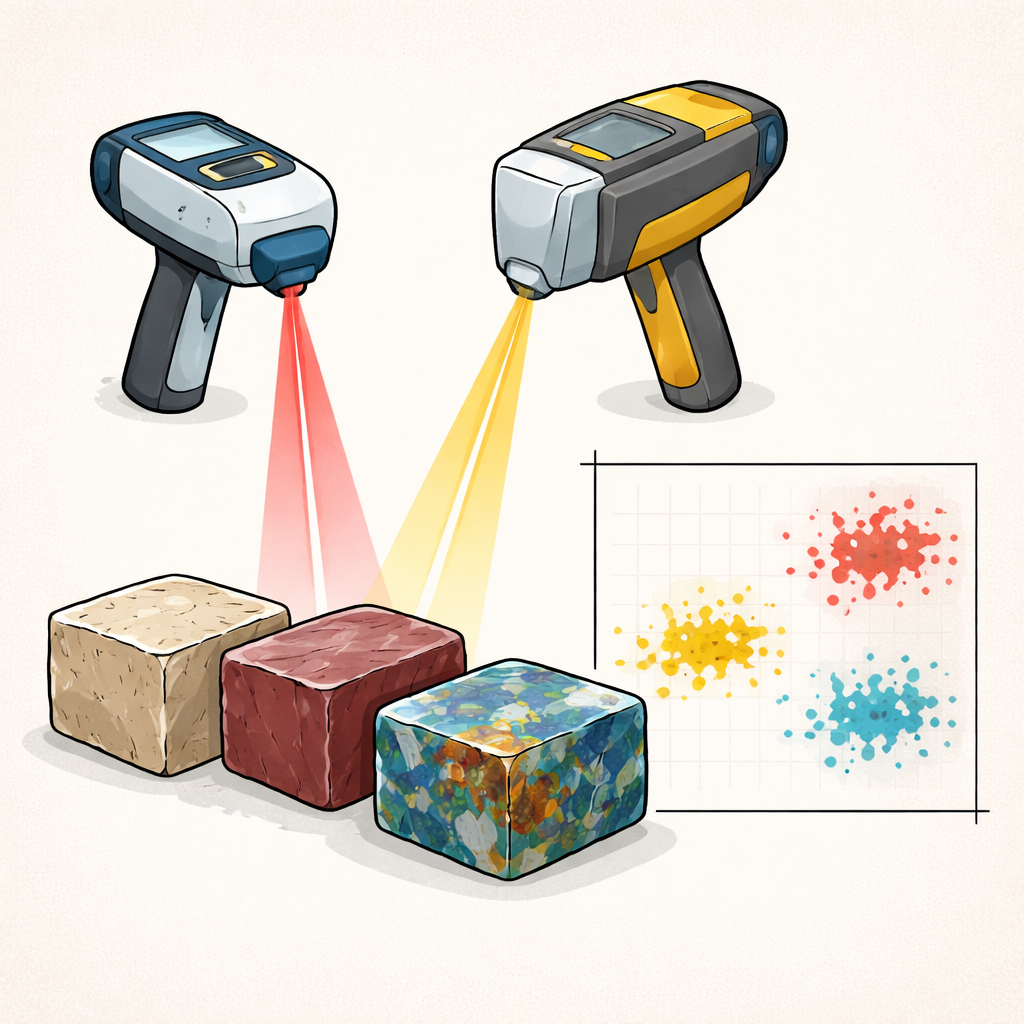
Because the mosaics cannot be moved or sampled, the team began by creating very detailed digital images using photogrammetry: thousands of overlapping photographs were processed into sharp, zoomable 3D models. These images allowed researchers to carefully select representative tiles (tesserae) of different colors and textures from their desks rather than under changing museum lights. They then visited the museum with portable instruments: a handheld Raman device, which uses laser light to identify minerals, and a handheld X‑ray fluorescence (XRF) unit, which reveals which chemical elements are present. Together, these tools provided a kind of “fingerprint” for each tessera without damaging it.
What the Tiny Tiles Are Made Of
The study showed that most tesserae in all three mosaics are made from local limestone, available in many shades around Jaén. Subtle differences in the limestone’s chemistry—such as varying amounts of silicon or strontium—suggest that artisans carefully selected stones from different parts of the same geological area to achieve specific colors and qualities. In some dark stones, the team detected traces of amorphous carbon, explaining their almost black appearance. A smaller number of tesserae are glass, especially in the Erotes mosaic, where bright blues, greens, oranges, reds, and blacks help create a more vivid and sparkling scene. The colors in these glass pieces come from metals like copper, iron, and sometimes lead and antimony, which were added according to recipes well known in Roman glassmaking.
The Surprise of Ironstone
One of the most striking findings was the widespread and deliberate use of a dark red iron-rich rock known as ironstone, dominated by the mineral haematite. These tesserae stand out chemically because they contain far more iron than the surrounding limestone pieces. Ironstone was used selectively in the two more figurative mosaics—Tethys and Erotes—to highlight features like the goddess’s hair and oar, the fish in the sea scene, and details of the erotes and their boat. Although iron ore deposits are common around Jaén and were mined in recent centuries, ironstone is rarely reported in Roman mosaics elsewhere in Europe. Its hardness, deep red color, and even its symbolic associations mentioned in ancient texts may have made it especially attractive to local mosaicists.
A Regional Fingerprint in Stone and Glass
By combining digital imaging, portable spectroscopy, and advanced statistical analysis, the researchers not only catalogued the materials used in these mosaics but also showed how those choices reflect a regional style. The reliance on local limestone, the early and rich use of colored glass in the Erotes mosaic, and the distinctive preference for ironstone all point to a mosaic tradition in Jaén with its own identity within the Roman world. For non-specialists, the key message is that modern scientific techniques can transform ancient artworks into sources of hard evidence about resource use, craftsmanship, and even local taste—helping us see these mosaics not just as surviving floor pictures, but as signatures of a particular community in Roman Hispania.
Citation: Sánchez, A., Montejo, M., Tuñón, J. et al. Integrated portable spectroscopy for the analysis of Roman mosaics from Marroquíes Altos, Jaén, Spain. npj Herit. Sci. 14, 55 (2026). https://doi.org/10.1038/s40494-026-02339-4
Keywords: Roman mosaics, archaeometry, portable spectroscopy, cultural heritage, material analysis