Clear Sky Science · en
Combined approaches of techno-functional and use-wear analysis indicated diverse reuse behaviors of polished bevelled stone tools of Zoumaling site (5500–3900 cal BP), central China
Ancient Tools, Modern Questions
Long before metal was common, people in Neolithic China built towns, houses and defensive walls using tools made of stone. At the walled-town site of Zoumaling in central China, dating from roughly 5500–3900 years ago, archaeologists have unearthed dozens of carefully ground and polished axes and related tools. This study asks not just what these tools were for, but how people actually used, repaired and reused them—offering a rare, close-up look at everyday problem-solving and craftsmanship in a prehistoric community.
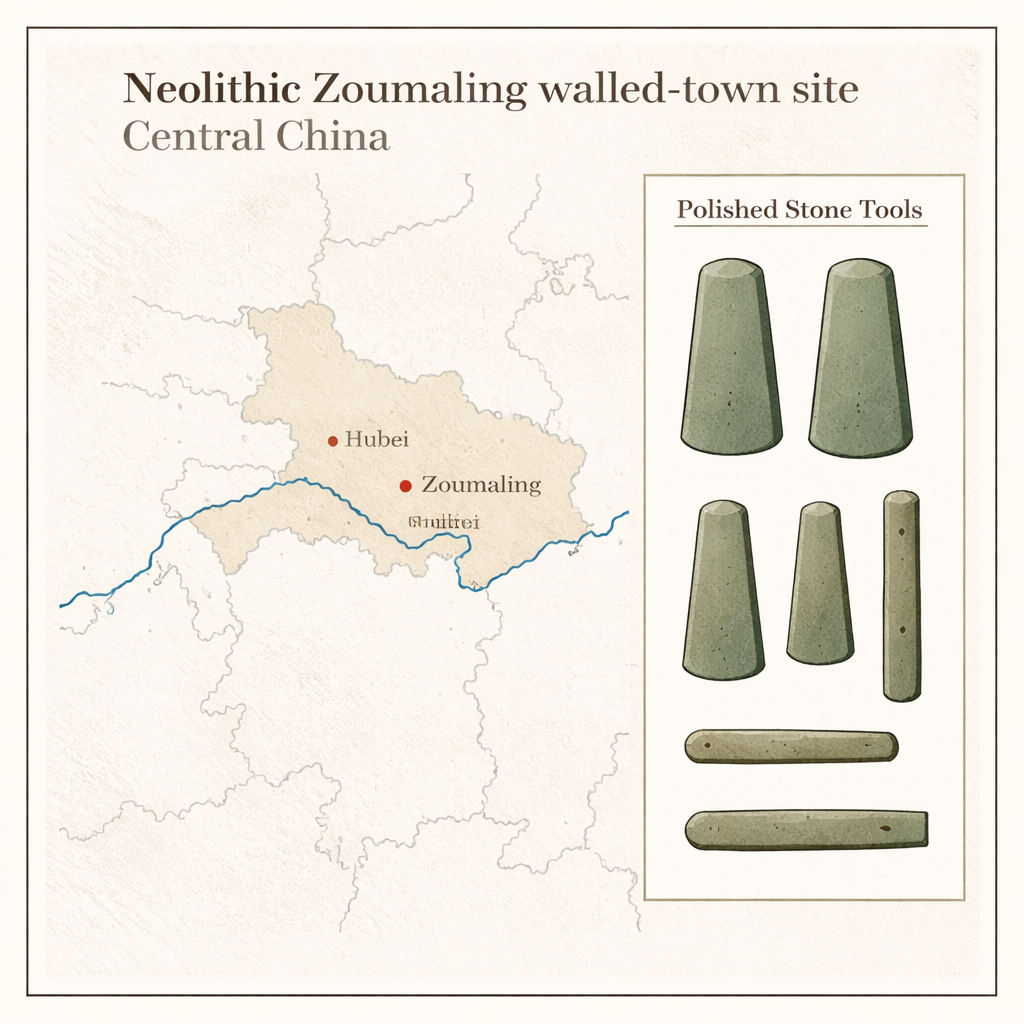
A Walled Town by the Yangtze
Zoumaling lies in today’s Hubei Province, along the middle reaches of the Yangtze River, in a region known for early rice farming and complex Neolithic societies. Excavations since the late 1980s have revealed city walls, houses, pits and graves, along with pottery, jade and nearly 200 stone artifacts. From these, the researchers selected 74 polished bevelled stone tools—mainly axes, adzes, chisels, knives, sickles and ceremonial battle-axes called Yue—for detailed study. These tools were made mostly from coarse sandstone gathered from nearby hills, carefully shaped and ground to form sharp working edges.
Reading the Life Stories of Stone
To reconstruct how these tools were made and used, the team combined two complementary approaches. First, they applied “techno-functional” analysis, which treats each tool as a set of working parts—such as the cutting edge, the hand-held or hafted end, and the middle section that transmits force—and asks how each part was deliberately shaped for a role. Second, they conducted “use-wear” analysis, examining the tools under a microscope to look for tiny scars, polish and rounding produced by contact with different materials and motions over time. Together, these methods allowed the researchers to infer both the makers’ intentions and the tools’ actual working lives.
Woodworking at the Heart of Daily Life
The microscopic traces make it clear that most of Zoumaling’s polished bevelled tools were workhorses for shaping wood. Characteristic damage patterns, including distinctive “rolled-over” scars on the edges, match experimental replicas used to chop and split logs or work dry wood. Axes and larger adzes show heavy, overlapping scars and rounded corners, suggesting repeated chopping and splitting with the tools hafted to handles. Smaller, finely ground adzes, by contrast, seem suited to more delicate woodworking, such as smoothing or shaping finer pieces. Ceremonial Yue-axes, with sharper, thinner edges and unused corners, also bear light wood-chopping marks, hinting that even prestige objects sometimes doubled as practical tools. Overall, the toolkit looks like an integrated woodcraft set capable of building timber structures, crafting shafts for projectiles and exploiting forest resources.
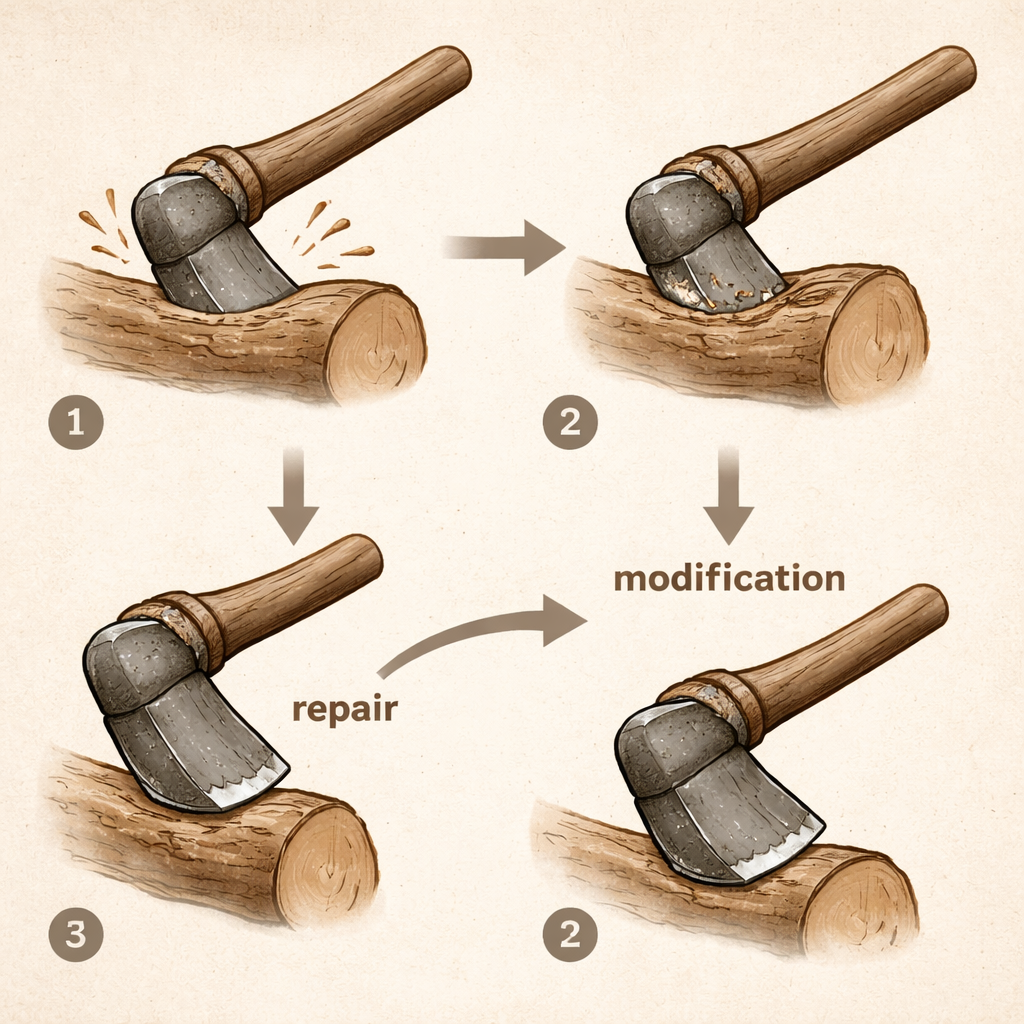
Fixing, Reworking and Saving Effort
Beyond function, the study reveals how people at Zoumaling dealt with wear and accidents. When edges dulled or chipped, one option was repair: grinding away damage to restore a similar edge shape. Under the microscope this shows up as scars whose outlines have been blurred or partly erased by renewed polishing, with edges that are slightly shifted or wavy compared with a fresh tool. The researchers identified successful repairs on several axes, adzes and a Yue-axe, showing that keeping a good tool in service was often worth the effort. In other cases, especially when damage was too severe, people chose modification instead of repair. With just a few well-placed blows, they reshaped broken edges into new forms—zigzag, wave-like or notched—turning an old axe into a different kind of tool rather than starting from scratch.
What This Reveals About Neolithic Lives
To a modern reader, these stone edges may seem like minor details, but together they sketch a picture of a community that planned ahead, valued skilled workmanship and balanced labor costs against practical needs. Zoumaling’s people selected suitable rock, envisioned tool shapes in advance, invested hours of grinding to create sharp bevels and then maintained their tools through repeated repair and creative reuse. Their polished axes and adzes were not single-purpose, throwaway items, but parts of a flexible, long-lived toolkit that underpinned building, farming and perhaps hunting. By tracing microscopic wear and subtle reshaping, this study turns mute stones into evidence of careful planning, technical know-how and everyday ingenuity in a Neolithic walled town.
Citation: Yang, R., Xue, L., Jin, Y. et al. Combined approaches of techno-functional and use-wear analysis indicated diverse reuse behaviors of polished bevelled stone tools of Zoumaling site (5500–3900 cal BP), central China. npj Herit. Sci. 14, 68 (2026). https://doi.org/10.1038/s40494-026-02338-5
Keywords: Neolithic woodworking, polished stone tools, Zoumaling site, tool reuse and repair, Yangtze River archaeology