Clear Sky Science · en
Spatial pattern and species diversity of heritage trees as living monuments in a historic Chinese city
Ancient giants in a changing city
In the Chinese city of Jiaozuo, some of the most important historical monuments are not carved in stone but rooted in soil. These heritage trees—centuries‑old giants scattered through fields, villages, temples and streets—carry memories of how people have lived with nature over thousands of years. This study asks a simple but powerful set of questions: where exactly are these trees, which kinds are they, and how have human choices and the local environment decided which ones survived into the present day?
Living witnesses across town and countryside
Researchers spent 18 months tracking down every officially recognized heritage tree across Jiaozuo’s ten districts. They walked villages and temples, checked government records, talked with elders, and recorded the size, species and location of each tree with GPS and careful measurements. In total they found 975 trees, belonging to 43 species in 21 plant families—an impressive storehouse of living history spread from crowded districts to remote hillsides. These trees are not just old; their thick trunks, broad crowns and deep roots provide shade, shelter for wildlife, and a visible link between past and present for local communities.
A few favorite species and many quiet rarities
Despite this variety, the heritage tree population is dominated by just a handful of species. Two types of legume trees—the Chinese scholar tree (Styphnolobium japonicum) and Gleditsia sinensis—make up nearly three‑quarters of all recorded heritage trees. Their success reflects a powerful mix of traits: they tolerate poor, dry soils; grow large and long‑lived; and offer timber, medicine and other products. Just as important, they are wrapped in cultural meaning. Scholar trees are tied to learning, good fortune and traditional fengshui beliefs, while Gleditsia has long been planted for household uses and as a protective barrier around homes and fields. At the other end of the scale, 35 species appear only as a few scattered individuals. These rare and solitary trees—such as ginkgo, Chinese yew and old fruit trees—show how temples, ancestral halls and family traditions have quietly protected unusual species that would otherwise have disappeared.
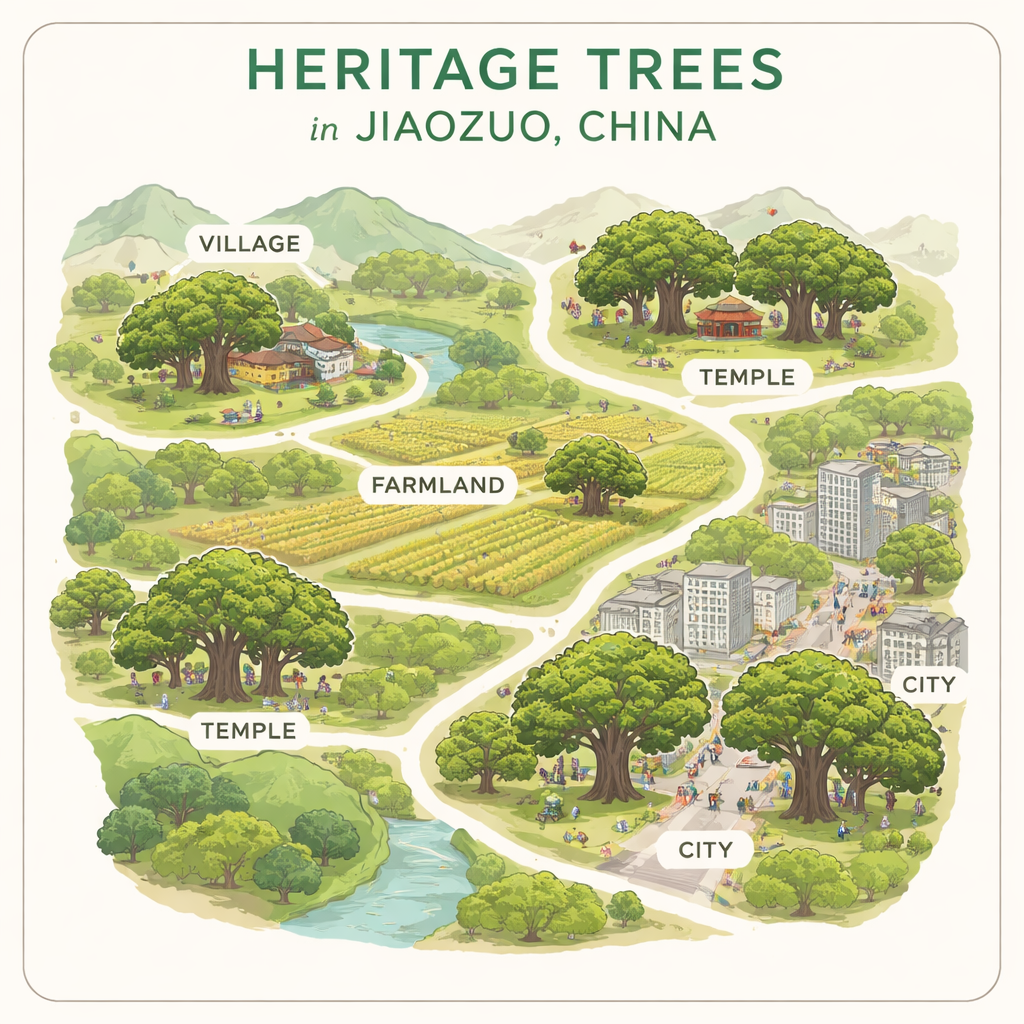
Fields, villages and temples as safe havens
The study reveals that heritage trees do not survive at random. Nearly seven out of ten stand in villages and farmland, woven into the everyday fabric of rural life. Here they shade courtyards, mark property lines, break the wind over crops and serve as meeting places or landmarks. Many districts with strong farming traditions hold especially high counts of such trees, showing how long‑term care by farming families has been crucial for their survival. Religious sites and cemeteries form the second most important refuge: temple courtyards and burial grounds often host old cypresses, elms, poplars and scholar trees that are protected as symbols of longevity, spiritual power and respect for ancestors. Even in dense urban districts, smaller pockets of heritage trees persist in parks, institutions and historic compounds, where formal protection now echoes older customs.
City growth, mountain slopes and the fate of old trees
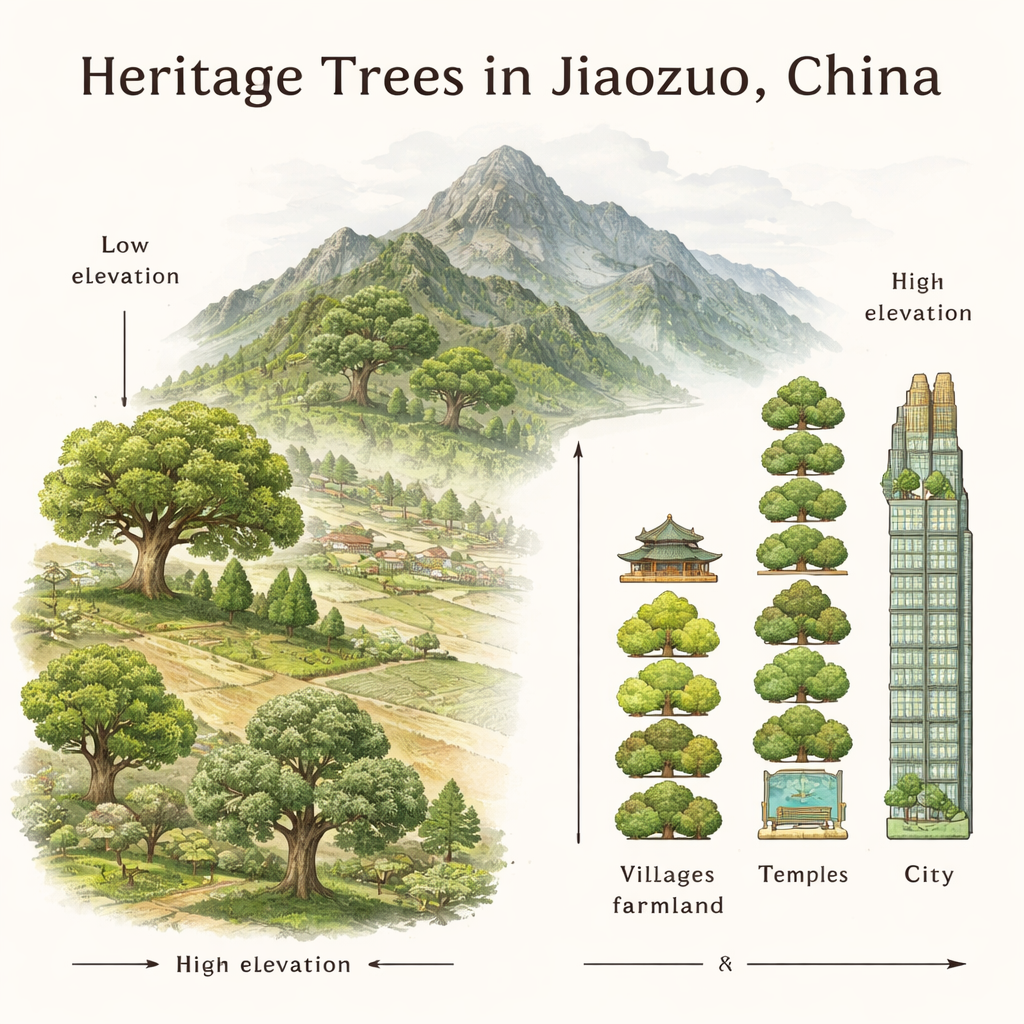
By comparing tree locations with economic and environmental data, the authors uncovered clear patterns. Heritage trees are most abundant at low elevations, especially below about 300 meters. As the land rises into the Taihang Mountains, both the number of trees and the variety of species drop sharply—high, exposed slopes are simply too harsh for most trees to survive long enough to become truly old. City growth also plays a double role. Very dense urban districts hold fewer heritage trees, likely because of land development, pollution and disturbance. Yet districts with moderate levels of urbanization fare best: they still retain large rural areas and traditional practices, while also benefiting from stronger local budgets and laws that can protect old trees. In short, both poverty and unchecked development can be bad for heritage trees, but a middle path of planned growth can help them endure.
What this means for people and their green elders
To a lay observer, this work shows that Jiaozuo’s ancient trees are not just biological curiosities; they are the living outcome of centuries of farming, worship, settlement and more recent city planning. The authors conclude that conserving these trees requires treating them as part of a “people‑and‑nature” system, not just as isolated specimens. Protecting village landscapes, temple grounds and rural enclaves, while steering urban expansion carefully, can keep these living monuments thriving. In doing so, Jiaozuo offers a blueprint for other historic cities: by respecting old trees as both cultural treasures and ecological anchors, communities can carry a deep sense of place into an uncertain future.
Citation: Xie, C., Mao, Z. & Jim, C.Y. Spatial pattern and species diversity of heritage trees as living monuments in a historic Chinese city. npj Herit. Sci. 14, 52 (2026). https://doi.org/10.1038/s40494-026-02336-7
Keywords: heritage trees, urbanization, rural landscapes, cultural ecology, biodiversity conservation