Clear Sky Science · en
A dual-prior driven Gaussian splatting framework for high-fidelity reconstruction of museum artifacts
Why preserving artifacts in 3D matters
Museums around the world are racing to create detailed digital copies of fragile artifacts, from bronze bells to porcelain vases. These virtual stand-ins can be explored online, studied without handling the originals, and preserved even if the physical objects are damaged. But many collections only have raw 3D scan data saved as colored point clouds—millions of dots in space—with no matching photographs. This paper introduces a new way to turn those dots alone into lifelike 3D models, opening up vast archives of “sleeping” heritage data to vivid digital display.
The problem with today’s digital replicas
Until now, high-quality 3D reconstructions have typically followed two paths. One uses ordinary photos from many angles to guess both shape and color, but struggles on smooth, low-texture surfaces that are common in artifacts, and it cannot easily recover true size. The other uses precise laser scanners to capture geometry directly, sometimes with separate cameras for color. That route is accurate but expensive, and it still cannot directly produce the kind of rich, lighting-aware renderings modern virtual exhibits demand. A newer technique called 3D Gaussian splatting can render scenes in real time with impressive realism, yet it normally depends on camera images and on a rough initial point cloud built from those images. For museum items archived only as point clouds, this entire chain breaks down.
A new route from dots to digital doubles
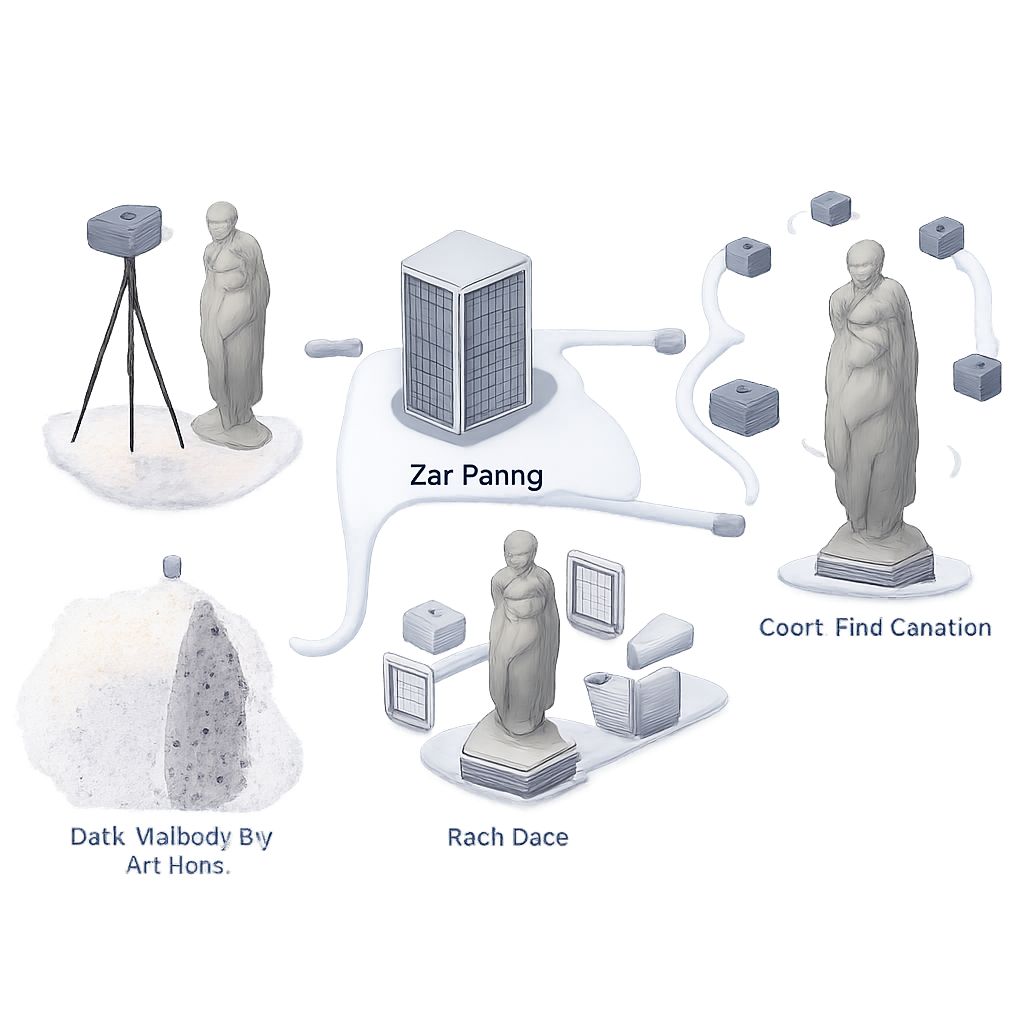
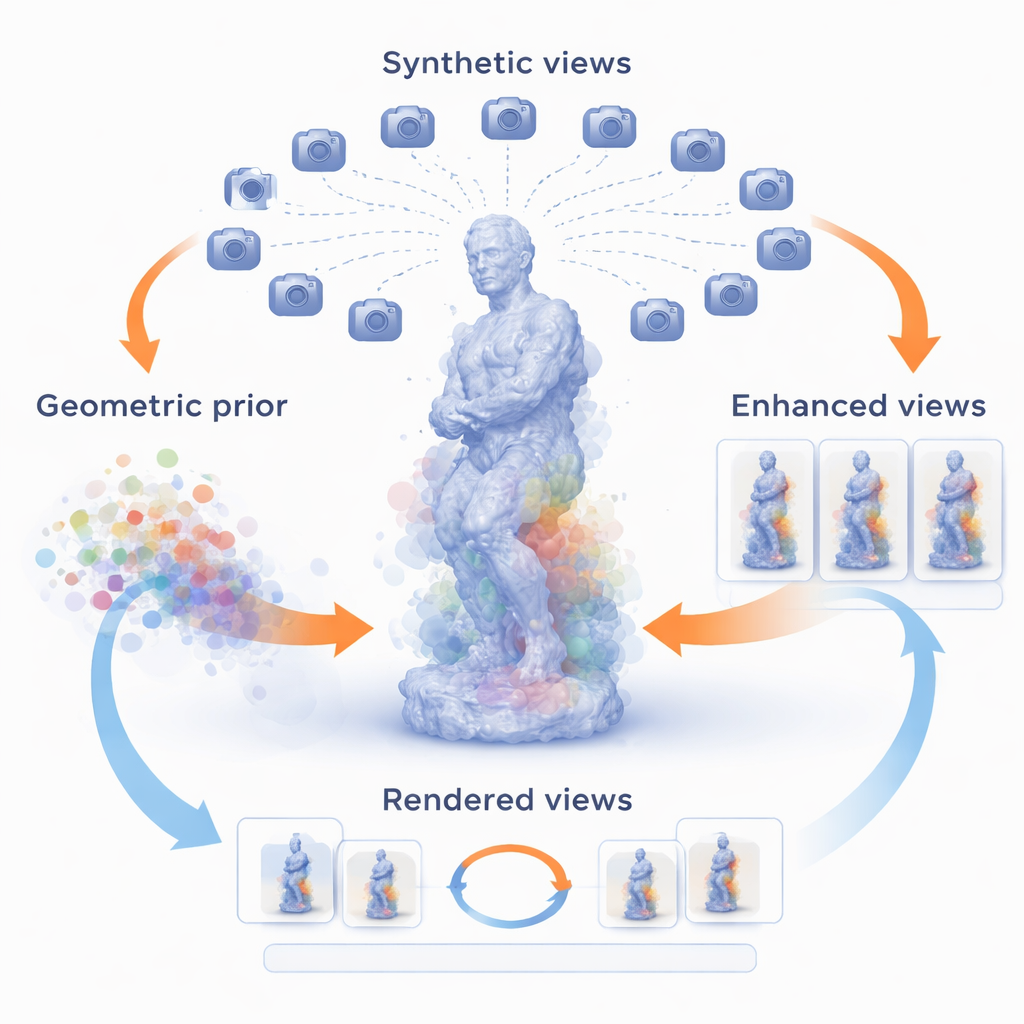
The authors propose a “dual-prior” framework that starts from a high-quality colored point cloud and ends with a detailed, render-ready model—without needing any original photos. The first prior is geometric: a smart sampling method combs through the dense scan, measuring both shape and color variation across many scales. Points that capture surface edges, carvings, cracks, or sharp color changes are given higher importance, while flat or uniform regions are thinned out. A carefully chosen subset of points is then used to initialize millions of tiny 3D building blocks, called Gaussian primitives, that form the backbone of the final model and carry correct real-world scale.
Teaching the model how the object should look
The second prior is visual: instead of using real photographs, the method generates “ideal” training images directly from the point cloud. Virtual cameras are placed all around the artifact, including angles that might be difficult in a real gallery, and each point is projected into these views to create synthetic color images. A visibility algorithm removes points that should be hidden from a given angle, avoiding ghosting where background details wrongly appear in front. Because the images and geometry come from the same source, there is no misalignment between shape and color—a frequent headache in traditional workflows that combine separate scans and photo sets.
Cleaning and sharpening the synthetic views
Raw projections from points tend to look jagged along edges and a bit fuzzy in fine details. To fix this, the synthetic images are passed through an anti-aliasing step that smooths “staircase” contours while preserving patterns, and then through a transformer-based super-resolution network. This network treats the many views like frames in a video and learns to borrow tiny bits of detail from neighboring images that see the same area from slightly different angles. The result is a set of crisp, high-resolution views that serve as a strong teaching signal: the 3D Gaussian model is repeatedly rendered and adjusted so that its outputs match these enhanced images as closely as possible.
What this means for museums and beyond
Tests on a new cultural heritage dataset and on standard 3D benchmarks show that this dual-prior approach produces clearer, more accurate renderings than several leading Gaussian splatting variants, with noticeably better recovery of delicate decorations and more faithful overall shape. For museums that already own precise point clouds but lack usable photographs, the method offers a practical way to breathe new life into old scans, turning them into interactive digital surrogates suitable for exhibitions, education, and research. The main caveat is that the approach assumes the original scans are dense and complete—if the data are sparse or badly corrupted, the benefits fade. Still, for the many collections that meet this requirement, the framework provides a powerful bridge from raw measurements to convincing virtual artifacts.
Citation: He, Y., Zhang, X., Xie, Z. et al. A dual-prior driven Gaussian splatting framework for high-fidelity reconstruction of museum artifacts. npj Herit. Sci. 14, 69 (2026). https://doi.org/10.1038/s40494-026-02330-z
Keywords: digital heritage, 3D reconstruction, point clouds, Gaussian splatting, museum artifacts