Clear Sky Science · en
Archaeometallurgical analysis of bronze Xi from Huofeng hoard in the Wuling Mountains, China
Everyday Objects That Changed an Empire
In ancient China, bronze was not just for grand ritual drums and temple bells. By the Eastern Han Dynasty, it had become part of ordinary life: in basins for washing, pots for cooking, and bowls for eating. This study asks a surprisingly modern question about these humble objects: how did rising trade, private workshops, and cost-cutting shape the way such bronzes were made and moved across the map?
A Mountain Corridor Between Regions
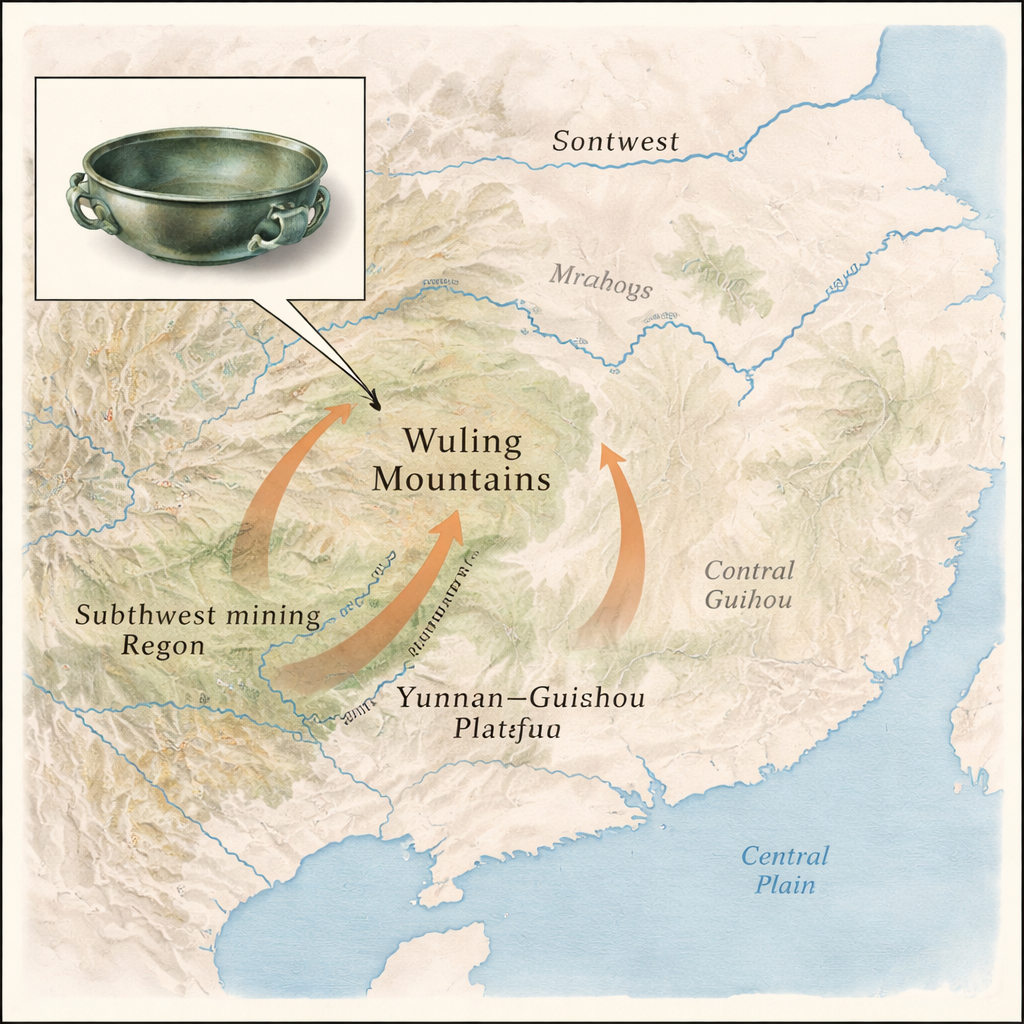
The research centers on the Wuling Mountains, a rugged area bridging central and southwestern China. This region sat on important routes linking the fertile Central Plains with the mineral-rich Yunnan–Guizhou Plateau to the southwest. In 1981, a hoard of 21 bronze objects was uncovered near Huofeng in Badong County, including several washing vessels known as Xi. Though four of these Xi were badly damaged, they still carried key clues: their shapes, decoration, and metal content. Their wide mouths, rounded bodies, and string-like patterns on the sides match a style of Eastern Han washing vessels that was especially popular in the southwest, suggesting that Wuling was plugged into long-distance trade networks.
Reading History from Metal Recipes
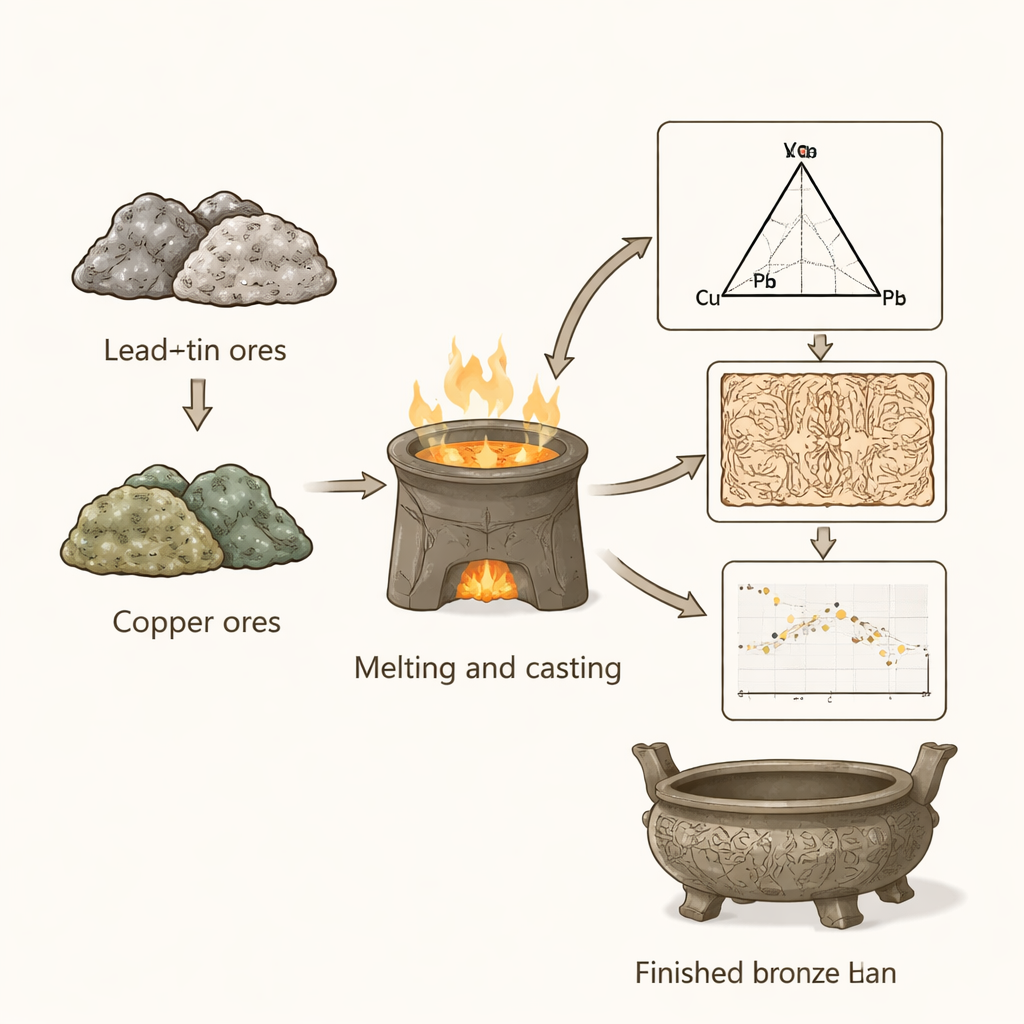
To see how these vessels were made, the team carefully cleaned small samples and studied them under high-powered microscopes and with instruments that reveal chemical make-up. All four Xi turned out to be made from lead–tin bronze: mostly copper, with about 6–8 percent tin and around 9 percent lead. The tin content is notably low, continuing a pattern seen in Western Han bronzes. Under the microscope, the metal shows typical features of casting rather than forging: tree-like crystal patterns, trapped bubbles, and scattered lead droplets. There is no sign that the vessels were hammered or reheated after casting. Together, the similar metal “recipes” of the four pieces hint that they may have come from the same production run, using standardized alloy choices.
Tracing Ancient Supply Chains in Lead Atoms
The study goes further by using lead isotope analysis, a method that treats different lead ores like distinct fingerprints. Because the Xi contain enough lead to be deliberately added, their isotope ratios can point back to the kinds of deposits where the metal was mined. Three of the vessels contain “highly radiogenic” lead—a type especially common in Yunnan—while the fourth contains more ordinary lead. When the researchers compared these signatures with data from bronze finds and ore deposits in Yunnan and Guizhou, they found a close match. The high-radiogenic lead aligns with mines in central and eastern Yunnan, and the common-lead sample fits well with lead–zinc deposits across the Yunnan–Guizhou belt. This indicates that the makers of the Huofeng Xi tapped into the same southwestern metal sources as workshops in places like Wuchuan and Zhaotong.
Mass Production, Cost Cutting, and Craft Choices
Historical records say that by the Eastern Han, the government had largely stepped back from making most bronze household items, allowing private workshops to flourish. Those workshops supplied a growing market and had to balance quality against expenses. Tin was scarce and difficult to obtain, so lowering tin levels while keeping the metal strong enough made economic sense. The Huofeng Xi fit this pattern: their low tin content meets practical needs but saves on a costly ingredient. Another striking shift is in technique. Earlier Western Han basins were often hot-forged—hammered at moderate heat into thin, tough shapes, a slower and more labor-intensive process. In contrast, the Huofeng Xi were simply cast in molds. Casting is quicker, easier to standardize, and better suited to large-scale production, even if it produces thicker walls and more casting flaws. These choices reflect a world where bronzes were everyday goods, churned out to meet steady demand.
What These Basins Reveal About an Ancient Economy
To a modern observer, the Huofeng washing basins might look like ordinary broken dishes. Yet their metal mix and microscopic structure reveal a story of privatized workshops, long-distance trade in ore, and deliberate cost-saving decisions. The study concludes that these four Xi were products of a commercial bronze industry based in southwestern China and sold into the Wuling region. Their low-tin composition and cast manufacture show how craftspeople adapted their methods to produce durable, affordable goods for a wide market. In doing so, they helped knit distant regions together and left behind quiet but telling evidence of how an ancient empire’s everyday economy really worked.
Citation: Wang, Y., Wei, G., Li, Q. et al. Archaeometallurgical analysis of bronze Xi from Huofeng hoard in the Wuling Mountains, China. npj Herit. Sci. 14, 80 (2026). https://doi.org/10.1038/s40494-026-02329-6
Keywords: Eastern Han bronzes, archaeometallurgy, ancient Chinese trade, bronze vessels, lead isotope analysis