Clear Sky Science · en
Evidence from Liao dynasty tombs: an empirical analysis of song greenish-white porcelain trade
Ancient bowls that tell a bigger story
More than a thousand years ago, nobles of the Liao Dynasty in northeast China were buried with elegant greenish-white porcelain bowls and cups. At first glance, these grave goods seem like beautiful but ordinary antiques. Yet by probing their chemical makeup, scientists have turned them into clues about long-distance trade, changing tastes, and how two powerful medieval states—Song and Liao—were more closely linked than old political maps suggest.
Royal graves on a northern hillside
The story begins at the Hongjiajie cemetery near Beizhen, in today’s Liaoning Province. This hillside burial ground belonged to the family of Han Derang, a top minister of the Liao Dynasty, and was used from about 1011 to 1096 CE. Although the tombs were looted long ago, archaeologists still recovered many objects, especially ceramics. Among them were fine greenish-white pieces—known as qingbai ware—such as tea bowls, cup stands, and incense burners. These are shapes associated with refined Han Chinese daily life, not with the older steppe-style gear of the Khitan ruling elite. Their presence hints that the Liao aristocracy was adopting southern customs and luxury goods as part of a broader cultural shift.
Reading chemistry like a fingerprint
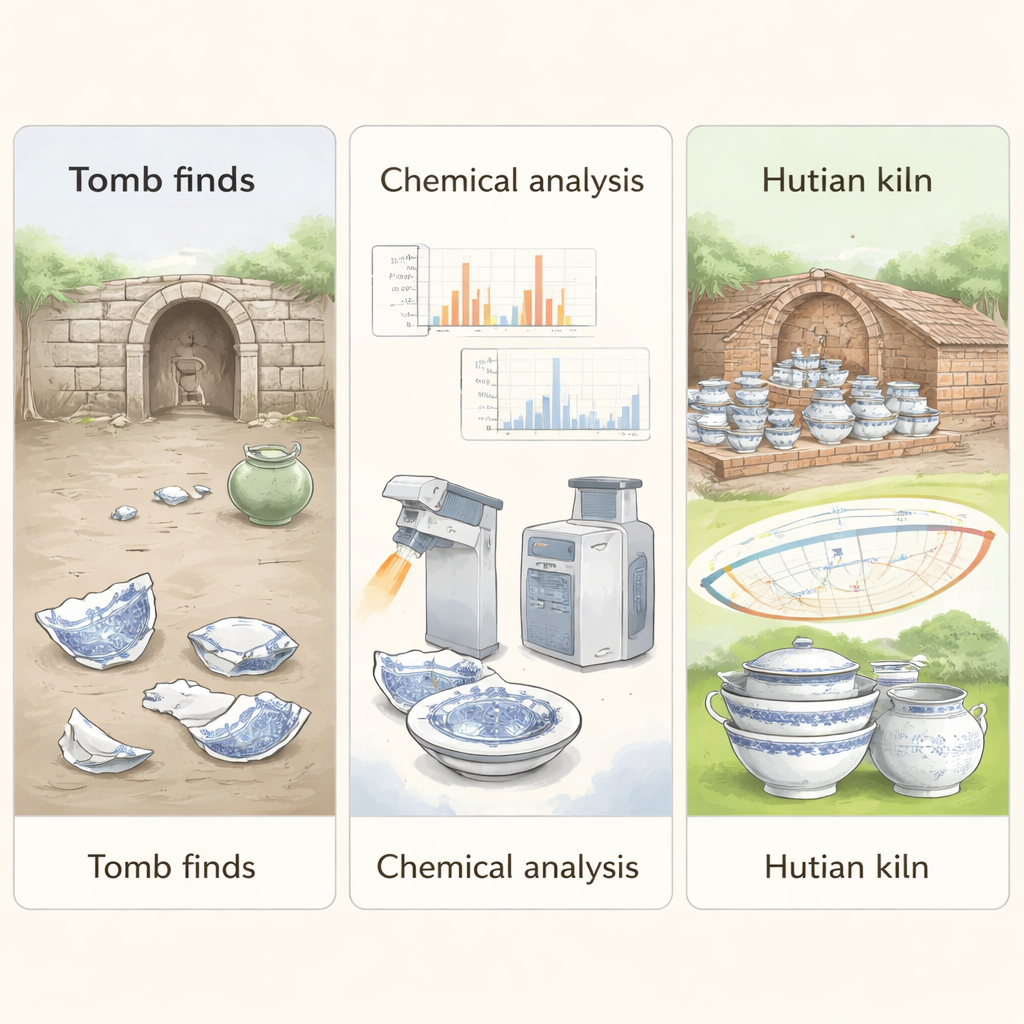
To find out where these porcelains were made, the researchers treated each fragment as if it carried its own passport. They analyzed 16 samples using two non-destructive techniques: one that reads the major elements in the clay and glaze, and another that detects tiny traces of other elements. The bodies of the wares turned out to be rich in silica and relatively low in aluminum, a signature typical of raw materials from southern China. The glazes were high in calcium and contained small but telling amounts of manganese and phosphorus, signs that plant ash was likely used in the recipe. Together, these measurements act like a chemical fingerprint that can be compared with known kiln sites.
Matching tomb pieces to a southern kiln
The team then compared the Hongjiajie data to reference porcelain from several major Song-era production centers. Statistical plots showed that the Liao tomb sherds clustered tightly with samples from the Hutian Kiln in Jingdezhen, a famous hub of greenish-white porcelain in Jiangxi Province, and clearly apart from other kilns in Anhui and Hubei. Even the patterns of rare earth elements—exotic-sounding metals that are especially good at preserving geological “memory”—lined up almost perfectly. These rare earth profiles, enriched in lighter elements and marked by a specific dip in europium, strongly suggest that both the tomb pieces and the Hutian wares drew on the same kind of stone and clay, and were therefore produced in the same region.
From river valleys to distant frontiers
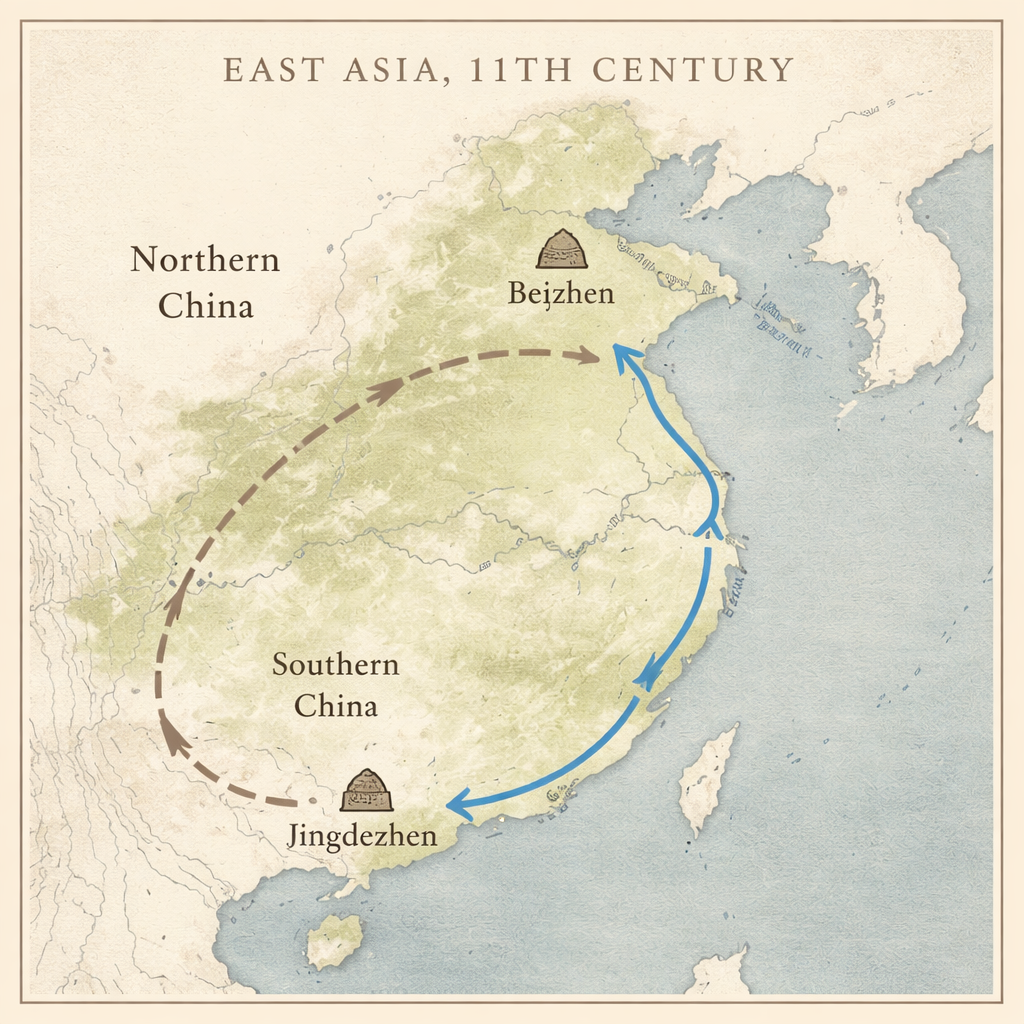
Knowing that the porcelain came from Jingdezhen raises another question: how did these fragile goods travel more than a thousand kilometers to the graves of Liao nobles? Historical documents and the distribution of similar finds across northern sites point to two main routes. Earlier in the Liao period, wares likely moved overland through regulated border markets and diplomatic missions. But by the mid- to late 11th century, the sudden rise in greenish-white porcelain in Liao tombs—paired with evidence from coastal sites—suggests that sea-based commerce had taken the lead. Merchant ships could carry bulk cargo down the Yangtze River from Jingdezhen’s hinterland, enter the Grand Canal, and then sail along the coast and into Bohai Bay, making maritime transport faster and cheaper than long caravans.
What these old wares really mean
When viewed together, the chemistry, archaeology, and written records reveal more than just where a set of bowls was fired. They show that high-ranking Liao families eagerly consumed stylish ceramics from faraway southern kilns, embracing Han Chinese fashions in tea drinking, incense, and everyday refinement. They also confirm that sophisticated trade networks—especially by sea—connected regional craft centers like Jingdezhen to distant political frontiers. In other words, the pale shine of greenish-white porcelain from the Hongjiajie tombs is tangible proof that medieval China’s north and south were bound together by commerce, culture, and shared tastes, despite the formal divide between the Song and Liao states.
Citation: Zhou, X., Zhang, M., Bai, Y. et al. Evidence from Liao dynasty tombs: an empirical analysis of song greenish-white porcelain trade. npj Herit. Sci. 14, 56 (2026). https://doi.org/10.1038/s40494-026-02328-7
Keywords: Qingbai porcelain, Liao Dynasty, Jingdezhen, archaeological science, maritime trade