Clear Sky Science · en
Beyond relighting: RTI for clustering fragmented heritage textiles using deep learning
Piecing Together the Past
Archaeological textiles often reach us as tiny, crumbling scraps rather than complete garments or tapestries. Yet these fragile threads can reveal how people dressed, what stories they told in cloth, and how advanced their craft and trade were. This paper presents a new computer-based way to help curators and archaeologists sort and group such fragments, using a special kind of lighting and modern image analysis to suggest which pieces may once have belonged together.
Shining Light from Many Angles
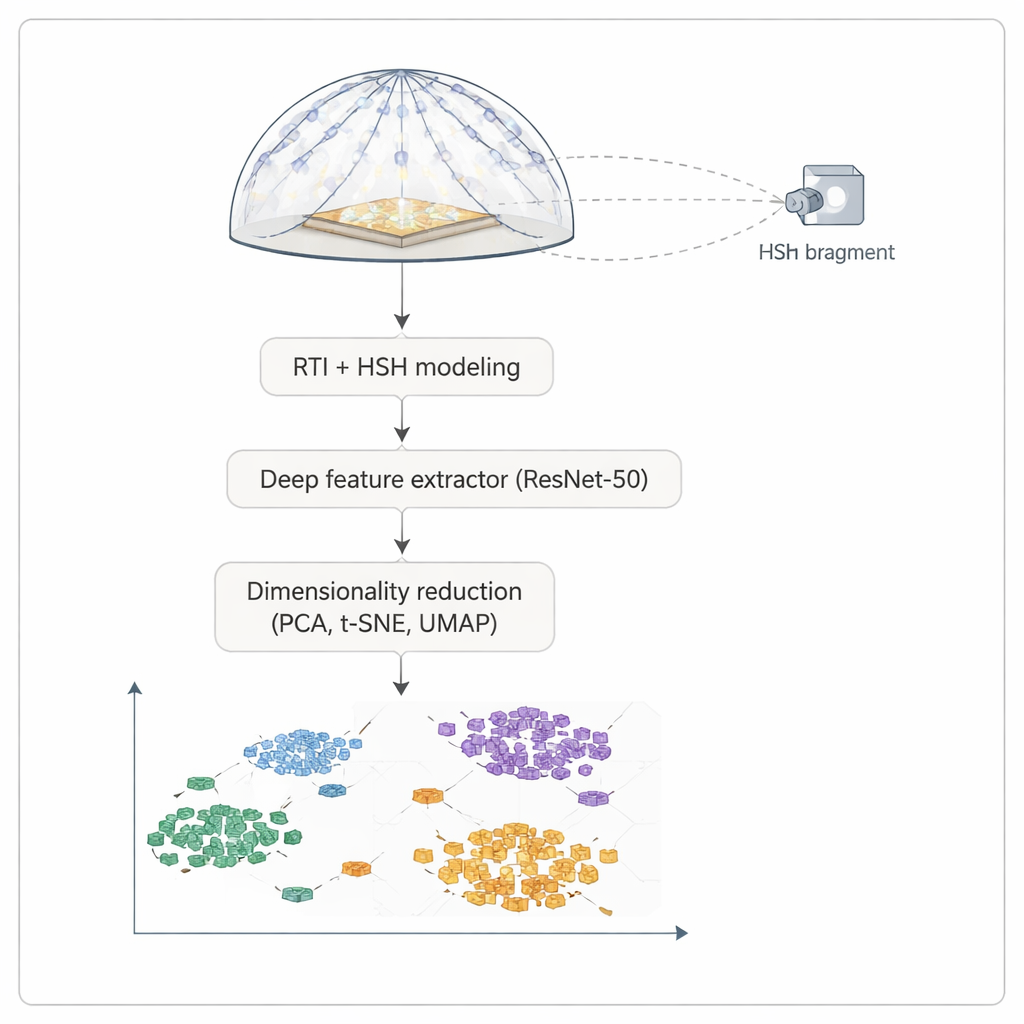
The heart of the work is an imaging method called Reflectance Transformation Imaging, or RTI. Instead of taking just one photograph of a textile, RTI captures dozens of images while shining light from many directions inside a controlled dome. This does not produce a full 3D model, but it does record how the surface reflects light, revealing tiny bumps, threads, and worn areas that a normal color photo cannot show. Compared with standard photography, RTI offers much richer information about texture and surface condition, and it does so without touching or damaging the object.
Turning Light into Numbers
To make use of this rich data, the authors first compress each RTI set into a simplified image that represents the overall, lighting-independent appearance of the textile’s surface. They use a mathematical technique called hemispherical harmonics to describe how each point on the cloth responds to light coming from different directions. By keeping only the base component of this description, they obtain an image that captures the textile’s stable color and diffuse reflectance while downplaying shadows and shiny spots. This is especially important for old, uneven fragments, where small changes in how the piece is positioned or lit could otherwise mislead the analysis.
Teaching the Computer to See Cloth
Next, the team feeds these processed RTI images into a deep learning model originally trained on millions of everyday photographs. Although this model, known as ResNet-50, was not built specifically for archaeology, its early layers are very good at spotting patterns such as lines, textures, and shapes. For each fragment, the model produces a long list of numbers—a feature vector—that summarizes the visual character of the cloth, including weave structure, decoration, color distribution, and signs of damage. Because this description is so detailed, it lives in a space of more than two thousand dimensions, far beyond what humans can easily interpret.
Seeing Clusters in the Chaos
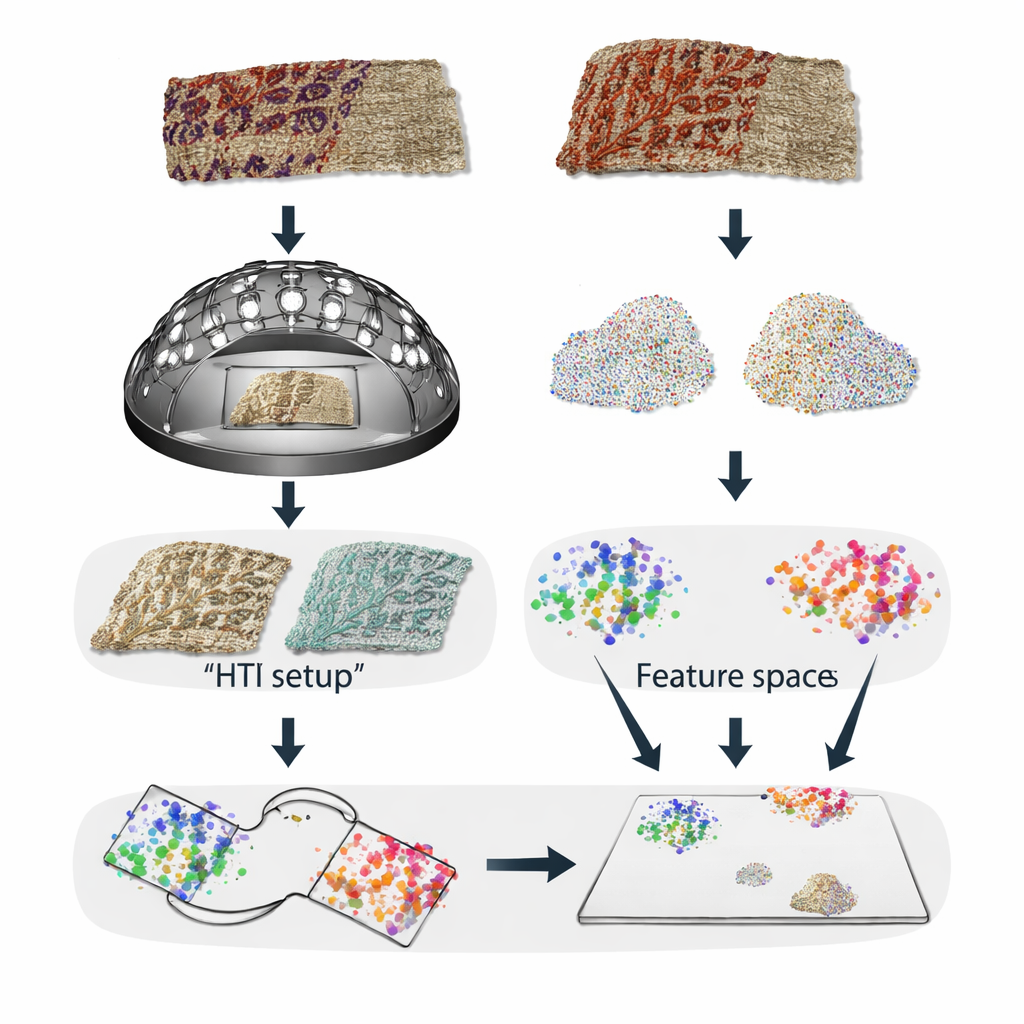
To turn this complex description into something archaeologists can use, the researchers apply dimensionality-reduction tools that squeeze the high‑dimensional features down into a two‑dimensional map. On this map, fragments with similar surface properties tend to lie close together, while different ones are farther apart. They then apply standard clustering methods, such as k‑means and spectral clustering, to automatically group fragments that appear related. The method is tested on two textile collections: the famous Viking Age Oseberg burial textiles, which survive only as scattered pieces, and a Polish Dragoon banner, where the original whole object is known and digitally cut into test fragments.
Outperforming Ordinary Photographs
By comparing RTI-based results with those from single, well-lit color photographs of the same fragments, the authors show that RTI gives clearer and more consistent groupings. Split pieces of the same original textile are placed nearer to each other in the RTI feature space, and known sets from the control banner collection form tight, separate clusters. The RTI framework also supports a simple “image search” task: given one fragment, the system can suggest other fragments that are most likely to match, which could greatly reduce the manual effort of experts sorting through large collections.
What This Means for Rebuilding History
In plain terms, the study demonstrates that shining light on textiles from many directions and analyzing the resulting patterns with deep learning helps computers “notice” the same subtle clues that human experts use: thread thickness, weave, wear, and faint motifs. While the approach does not yet reconstruct entire garments by itself—and is limited by the lack of firm ground truth for many archaeological finds—it offers a powerful, non-destructive way to narrow down which fragments probably belong to the same original object. Over time, such tools could help museums and archaeologists turn disordered piles of ancient cloth into more complete and trustworthy stories about the people who wove and wore them.
Citation: Khawaja, M.A., Gigilashvili, D., Łojewski, T. et al. Beyond relighting: RTI for clustering fragmented heritage textiles using deep learning. npj Herit. Sci. 14, 95 (2026). https://doi.org/10.1038/s40494-026-02326-9
Keywords: archaeological textiles, reflectance transformation imaging, deep learning, cultural heritage reconstruction, image clustering