Clear Sky Science · en
Bibliometric analysis of knowledge structures and evolution in global painting art from 1994 to 2024
Why the Story of Painting Research Matters
Behind every famous painting hangs an invisible web of science, history, and global collaboration. This article peels back the curtain on that hidden world by tracing how scholars around the globe have studied painting over the last thirty years. Instead of focusing on a single artist or masterpiece, it looks at thousands of research papers at once to see who is doing the work, what questions they ask, and how new tools—from chemistry labs to artificial intelligence—are changing what we can learn from painted surfaces.
Following Three Decades of Growing Curiosity
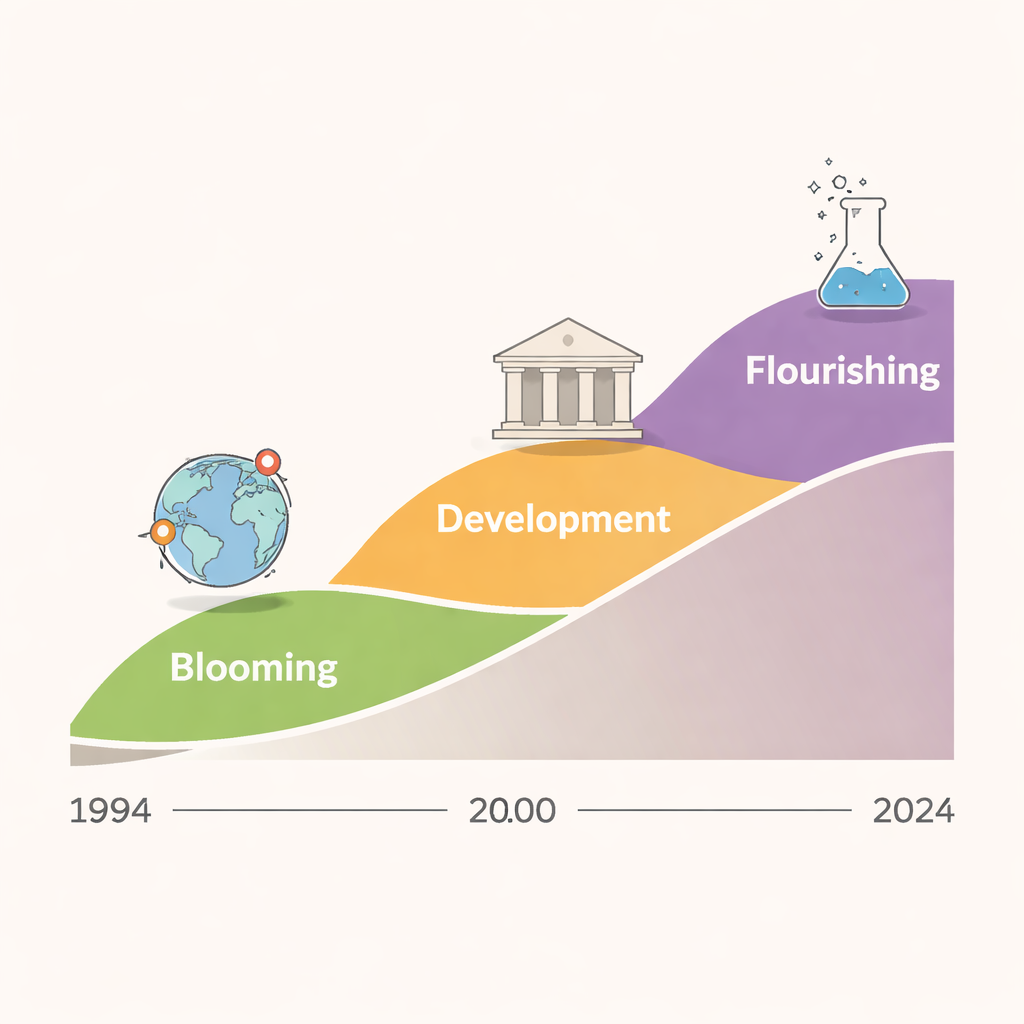
The authors examined 5457 research articles on painting published between 1994 and 2024. By using bibliometrics—essentially statistics about publications and their connections—they tracked how interest in painting has grown over time. They found three main phases. In the “Blooming” years up to the mid-2000s, output rose steadily as more museums and labs began to apply scientific tests to artworks. A “Development” phase brought faster growth and more variety in topics. Since around 2016, a “Flourishing” phase has seen consistently high numbers of papers each year, suggesting that the field has become both mature and firmly established in universities, museums, and conservation studios worldwide.
Where Painting Research Happens and Who Leads It
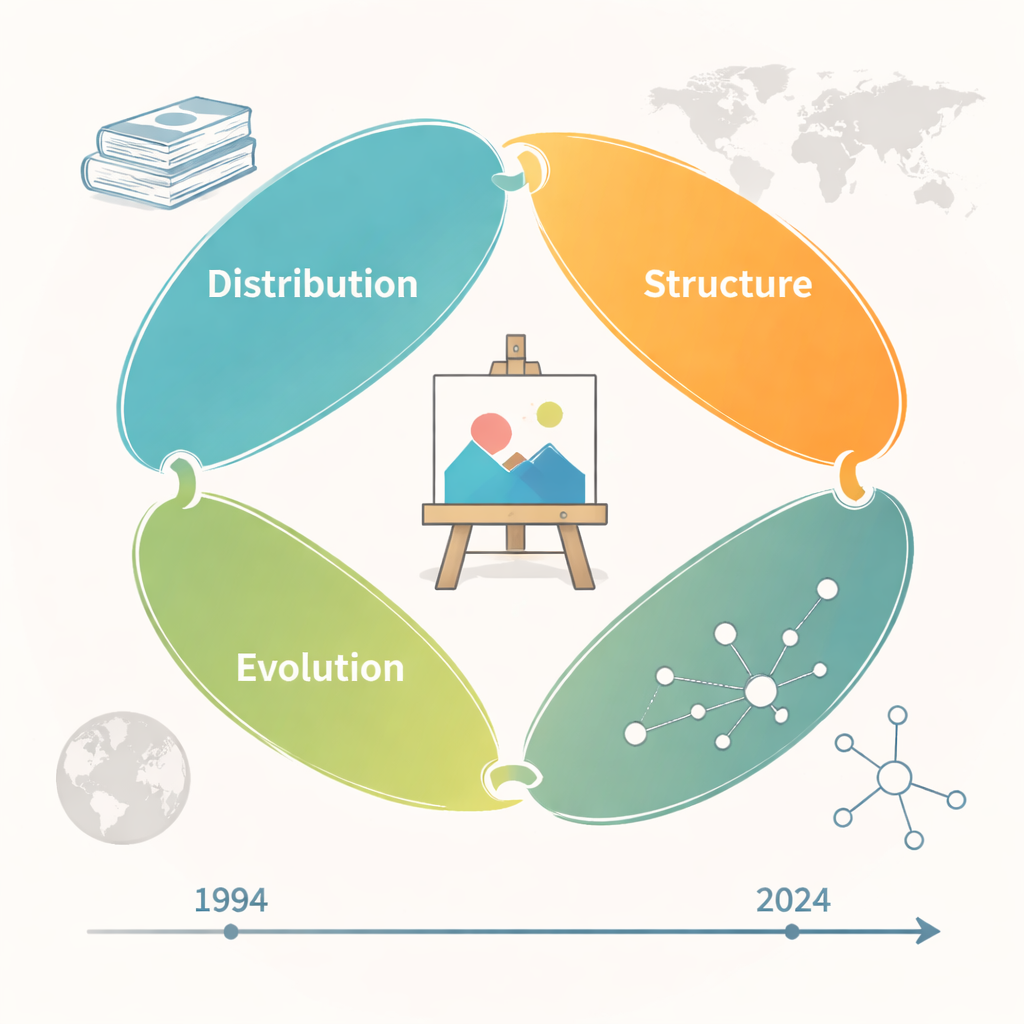
The study shows that painting research is both global and unevenly spread. The United States, Italy, and England produce the largest share of papers, with Spain and China emerging as important contributors. Much of the work is anchored in major universities, national research councils, and world-famous museums such as the National Gallery of Art and leading Italian institutions. At the same time, regions such as Africa, South and Southeast Asia, and Latin America remain underrepresented, highlighting gaps in who gets to shape the global story of painting. The most active authors are often chemists and conservation scientists who team up with art historians, reflecting a shift from lone scholars working in archives to multi-expert teams sharing microscopes, scanners, and digital tools.
From Pigments and Panels to Networks and Timelines
Looking across thousands of keywords, the authors show how the focus of painting research has deepened. Early work centered on identifying pigments and binders: What red is this? Which oil or glue holds the color to the surface? Techniques like Raman spectroscopy, X-ray fluorescence, and gas chromatography allowed researchers to characterize microscopic samples and build reference libraries for quick comparison. Over time, questions became more ambitious. Scientists began to study how colors fade, how varnishes yellow, and how humidity, pollution, and microbes slowly alter a painting. Other teams used these tools to trace where materials came from, revealing trade routes, workshop practices, and even forgeries. Digital imaging and 3D modeling have added yet another layer, allowing experts to map damage, simulate treatments, and analyze entire collections in ways that were unimaginable a generation ago.
How Ideas and Methods Evolve Over Time
By following citation patterns—who cites whom—the study uncovers how certain key works have shaped the field. Influential papers do not just introduce new gadgets; they provide shared methods and data that others can build on, such as widely used pigment handbooks or large sets of reference spectra. The analysis reveals three intertwined “paths” of development. One traces the refinement of scientific tools from the lab bench to in situ use directly on fragile artworks. Another follows the rise of digital methods, from basic imaging to artificial intelligence that can automatically detect cracks and losses. A third path moves from broad questions like where painting panels came from toward fine-grained studies of organic materials, dyes, and even the microbes that live on surfaces. Together, these strands show painting being treated less as a static object and more as a living system that changes over centuries.
Bringing Art and Science Together
In plain terms, the article concludes that modern painting research is no longer just about style and symbolism, nor solely about chemistry and physics. It is about weaving these perspectives together. The authors’ PDU framework—short for Perspective–Dimension–Unit—offers a structured way to track how topics, collaborations, and methods fit into a larger picture, and it could be applied to other areas of the humanities. At the same time, the study warns that technical work can drift away from deeper cultural questions, and that Western institutions still dominate the conversation. For general readers, the message is clear: every conservation story or technical study you hear about a famous painting is part of a much bigger, evolving network of knowledge, one that increasingly depends on collaboration across borders, disciplines, and ways of seeing.
Citation: Lan, J., Yan, C. Bibliometric analysis of knowledge structures and evolution in global painting art from 1994 to 2024. npj Herit. Sci. 14, 54 (2026). https://doi.org/10.1038/s40494-026-02324-x
Keywords: painting research, art conservation, heritage science, digital art history, bibliometrics