Clear Sky Science · en
Minimum intervention level decision for historical buildings: historical buildings along the central axis of Beijing, China
Why Old Buildings Still Matter Today
In the heart of Beijing runs a north–south line of temples, palaces, gates, and public squares known as the central axis. These buildings are not just tourist sights; they are living witnesses to centuries of Chinese history, now facing the pressures of mass tourism, modern safety standards, and new uses. This study asks a deceptively simple question with global relevance: how can we change historic buildings just enough to keep them safe and useful, but not so much that we damage the very history we want to preserve?
Finding the Sweet Spot of Gentle Change
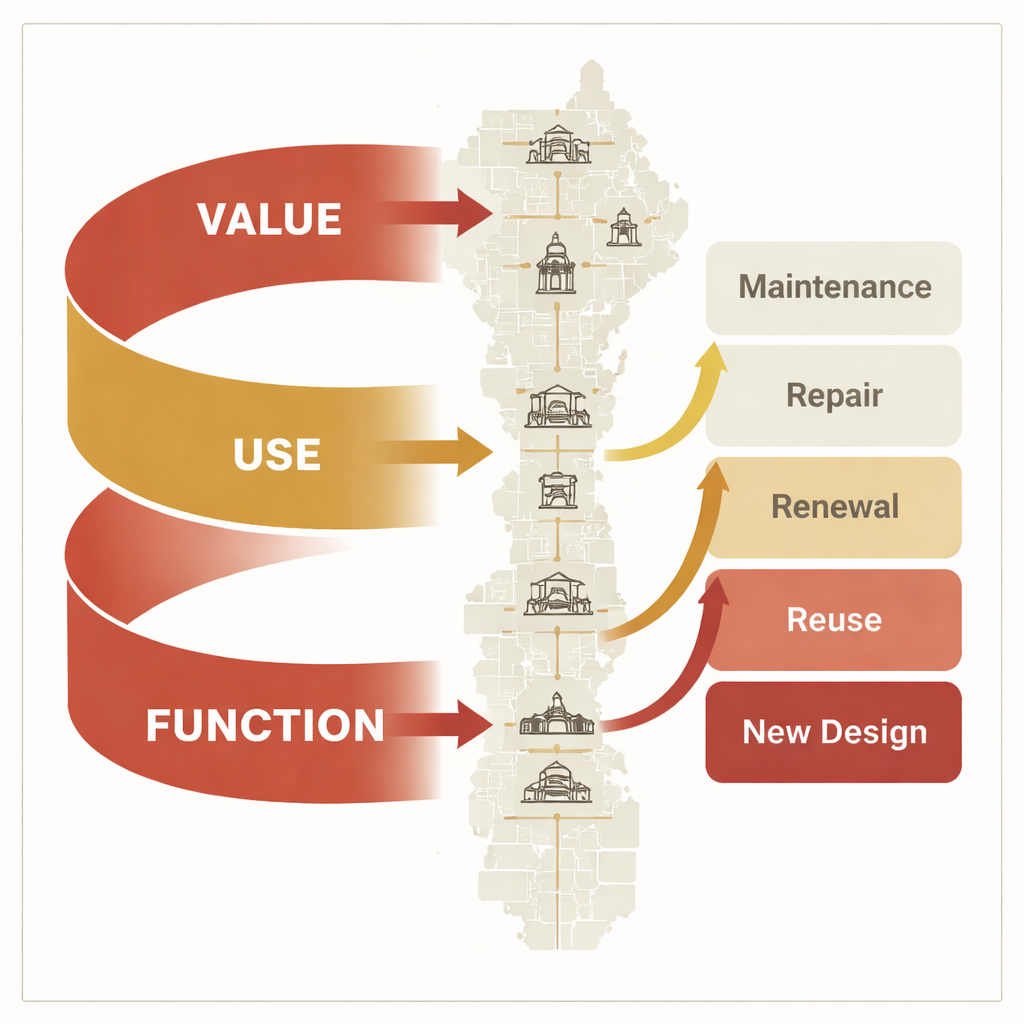
Conservation experts have long agreed on the principle of “minimum intervention”: touch historic fabric as little as possible. In practice, however, each building is different. Some are nearly intact, others are heavily altered or partly rebuilt; some must host millions of visitors, others serve as quiet neighborhood landmarks. The author tackles this dilemma by turning a broad slogan into a step-by-step decision system. The study first reviews nearly three decades of international research on how to repair, adapt, and reuse heritage buildings, extracting common ideas about protection laws, building condition, cultural meaning, and everyday use. From this, it distills five clear levels of intervention, ranging from simple maintenance to complete redesign on the original site, and builds an evaluation framework that weighs historical value, physical condition, and functional needs together.
From Expert Judgement to Calculated Choices
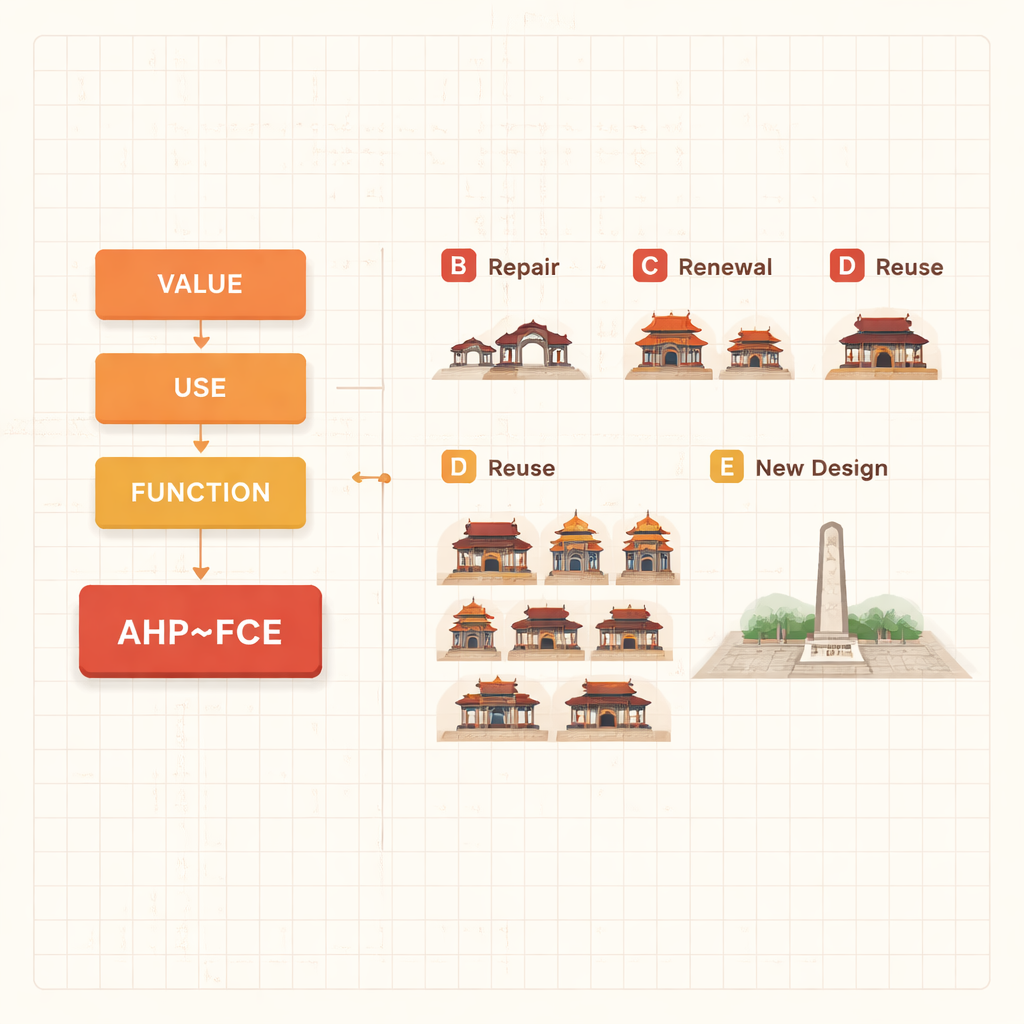
To make these choices more than just personal opinion, the study combines two mathematical tools often used in complex planning: the Analytic Hierarchy Process (AHP) and Fuzzy Comprehensive Evaluation (FCE). AHP helps break a big decision into smaller questions—such as how important legal protection is compared with a building’s artistic qualities or its flexibility for new uses—and then turns expert pairwise comparisons into numerical weights. FCE takes the inevitably fuzzy language of experts (ratings like “good” or “average”) about each building’s condition, space, and facilities, and converts them into scores that can be systematically compared. Together, these methods allow cultural significance, visual appearance, structural integrity, and user comfort to be considered in one coherent score for each site.
Testing the System on Beijing’s Central Axis
The author then tests this framework on 14 emblematic sites along Beijing’s newly inscribed World Heritage central axis, including the Forbidden City, the Temple of Heaven, ceremonial bridges, and major gates and squares. Each site is evaluated under 29 detailed factors grouped into three big questions: What is its heritage value? How visible, intact, and spatially clear is it? And how well do its spaces and facilities support current use, from exhibitions to barrier-free access? Twenty experts in planning, architecture, history, and tourism scored the sites, and the AHP–FCE calculations translated their judgements into overall “minimum intervention level” recommendations. The buildings fell into four of the five levels: modest repair, more substantial renewal, adaptive reuse, and new design, in a striking 2:1:10:1 ratio.
Different Buildings, Different Touch
The results highlight how similar-looking monuments may demand very different treatments. Two historic bridges along the axis call for careful repair: damaged stonework and surfaces should be fixed, and lighting and safety subtly improved, while preserving their original forms. Tiananmen Square and its surrounding complex fall into a “renewal” category, where some functions and public spaces can be updated—adding visitor services, accessibility features, and discreet technology—without changing the square’s iconic layout. Most sites, including the Forbidden City and Temple of Heaven, are best managed through “reuse”: their exteriors remain essentially unchanged, while interiors receive reversible updates such as flexible exhibition layouts, modern fire protection, and improved circulation. Only Yongding Gate, heavily altered in the past, justifies the “new design” level, allowing reconstruction guided by historical records combined with hidden modern structures and systems.
What This Means for the Future of Heritage
For non-specialists, the core message is that there is no one-size-fits-all rule for old buildings—but there can be a consistent way to decide how far to go. By turning expert knowledge into a transparent scoring system, this study shows that the current treatment of the central axis largely respects the promise of minimum intervention while still letting these places evolve. The approach can be adapted to other cities and building types, helping communities protect authenticity, welcome modern life, and make clear, defensible choices about how gently—or boldly—to touch the past.
Citation: Zhang, Y. Minimum intervention level decision for historical buildings: historical buildings along the central axis of Beijing, China. npj Herit. Sci. 14, 50 (2026). https://doi.org/10.1038/s40494-026-02323-y
Keywords: historic buildings, Beijing central axis, heritage conservation, adaptive reuse, minimum intervention