Clear Sky Science · en
Integrated reflectance hyperspectral imaging and macro-XRF for a full-surface non-invasive analysis of Raphael’s masterpiece “Baglioni Deposition”
Looking Beneath a Renaissance Masterpiece
Visitors standing before Raphael’s dramatic "Baglioni Deposition" see a finished Renaissance masterpiece. Yet beneath the visible paint lies a hidden world of trial sketches, corrections, and delicate color effects that shaped the final image. This study shows how museum scientists can now explore that unseen world without taking a single sample, using advanced imaging tools that "X‑ray" the work in color and chemical detail across every centimeter of the panel.
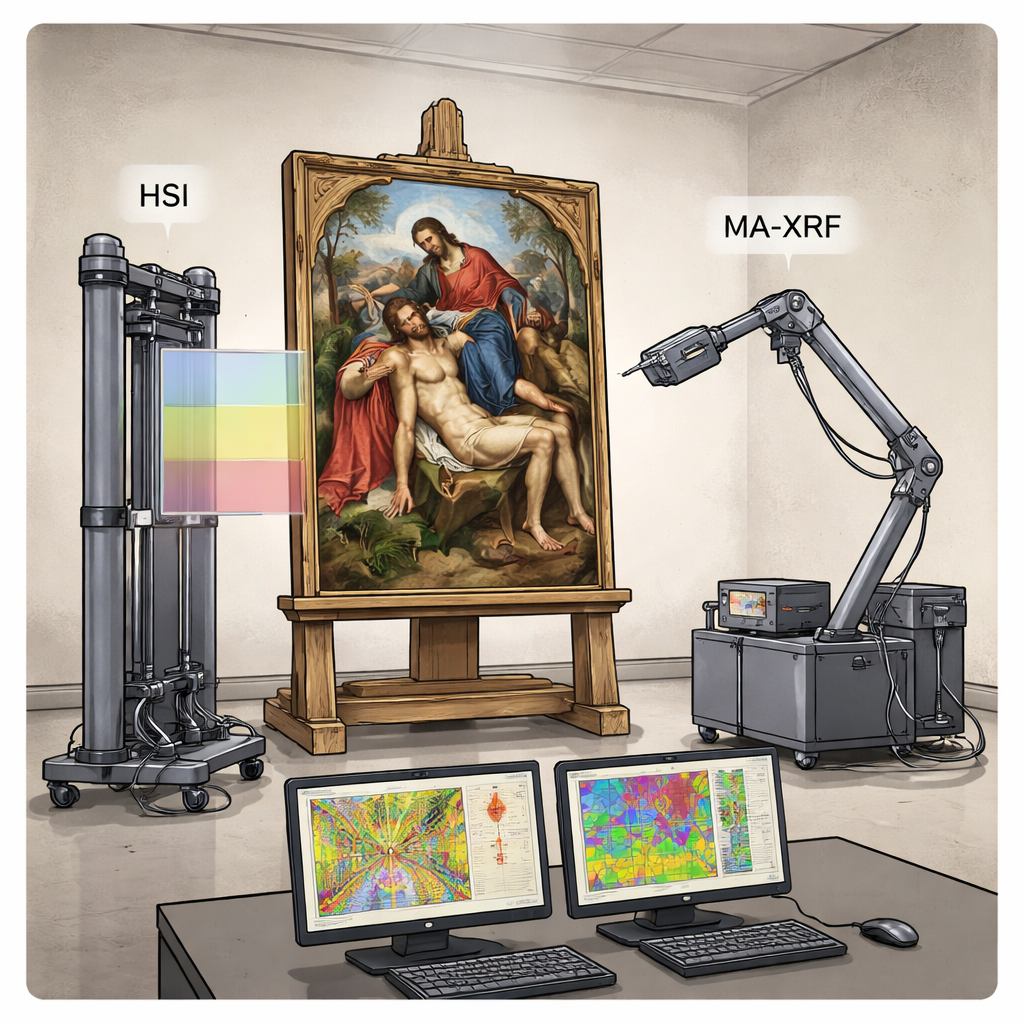
High-Tech Cameras for Old Paintings
Over the last decade, major museums have adopted new “chemical imaging” methods that can scan entire paintings instead of probing only a few tiny spots. In this project, carried out at Rome’s Borghese Gallery for the 500th anniversary of Raphael’s death, researchers used two such tools together on the "Baglioni Deposition": reflectance hyperspectral imaging and macro X-ray fluorescence. Hyperspectral imaging records hundreds of colors beyond what the human eye can see, from violet to short-wave infrared, for every pixel of the painting. Macro X-ray fluorescence, in turn, maps where chemical elements like lead, copper, mercury, and potassium are found in the paint layers. Both systems were mounted on precision scanners that swept across the panel in the gallery, building gigantic three-dimensional data blocks in which each point on the surface has its own spectrum and elemental “fingerprint.”
Finding Hidden Drawings and Earlier Ideas
Because different drawing materials and pigments reflect and absorb light in their own way, the hyperspectral data can be processed to reveal features invisible to ordinary photography. Using mathematical tools known as principal component analysis and minimum noise fraction, the team produced enhanced grayscale and false-color images that exaggerate subtle differences in the paint layers. These views confirmed earlier hints that Raphael had once painted an extra female figure in the center of the scene and then removed her. They also exposed a crisper, more detailed version of the distant landscape, with distinct trees and a different mountain profile, suggesting that Raphael softened and simplified this background at a later stage to achieve a more atmospheric effect. Fine, hatched underdrawing lines around some faces and draperies emerged only in these processed images, showing that the design evolved over several stages with different tools and inks rather than in a single, straightforward sketch.
Reading the Painting’s Chemistry Pixel by Pixel
The macro X-ray fluorescence scans added a complementary layer of information: the distribution of key elements across the entire work. Maps of barium and strontium highlighted variations in the gypsum-based ground and old fillings in cracks between the wood planks, even suggesting that parts of the preparation layer were reworked at some point. Lead maps showed the pervasive presence of lead white and clarified subtle changes in contours, much like a very clean X-ray radiograph. Copper maps traced blue and green pigments through the sky, landscape, and draperies, while silicon and potassium pointed to the use of lapis lazuli and glassy additives. Mercury and iron maps teased apart red, yellow, and brown pigments, and manganese highlighted later restorations rather than original paint. Together, these chemical images built a detailed map of Raphael’s materials and how he distributed them to shape light, color, and depth.
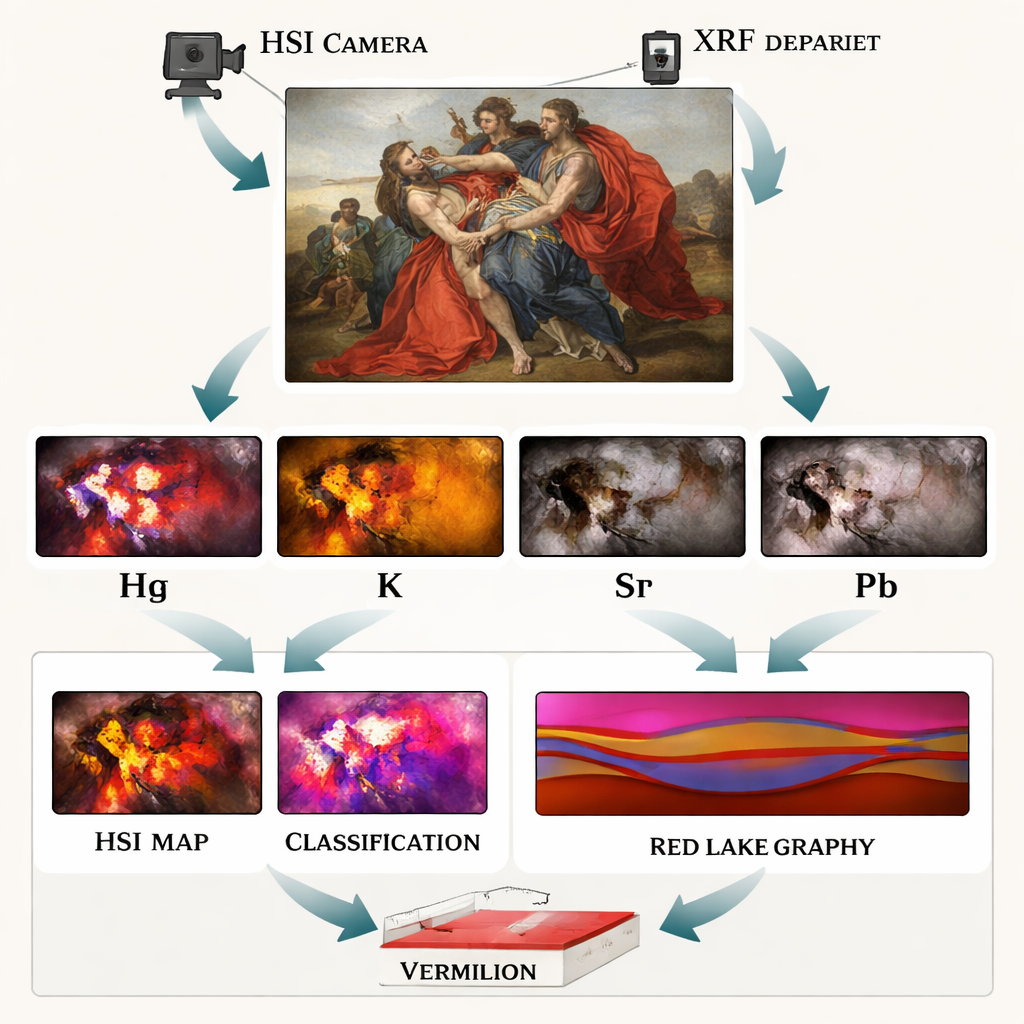
Decoding Raphael’s Reds
One of the most striking results came from focusing on the red passages that structure the composition, especially the figure of Grifonetto in vivid scarlet. By combining hyperspectral classification of red areas with the mercury and potassium maps, the researchers could distinguish between a dense red mineral pigment, vermilion, and transparent organic “red lakes” made from dyes. The data showed that Raphael relied almost entirely on just these two reds. Vermilion provided strong, opaque color in selected regions, while red lakes were applied in thin or thick layers, sometimes glazed over vermilion, to create a range of tones and glowing effects. This careful layering varied from drapery to drapery, revealing a deliberate strategy for controlling warmth, depth, and emphasis, rather than a simple, uniform recipe for red.
Why This Matters for Art and Conservation
For non-specialists, the message of this study is that a painting like the "Baglioni Deposition" is not a frozen image but a complex physical object with a long making and conservation history. By fusing hyperspectral imaging and macro X-ray fluorescence, scientists can now explore both the surface and the hidden layers of such works in extraordinary detail without removing paint or cutting samples. This approach has already clarified how Raphael planned and revised his composition, which materials he chose, and how he built up luminous colors with a handful of pigments. As researchers continue to mine these enormous datasets, they will refine our understanding of Raphael’s technique and provide conservators with precise guidance for preserving one of the Renaissance’s most important altarpieces for future generations.
Citation: Cucci, C., Picollo, M., Stefani, L. et al. Integrated reflectance hyperspectral imaging and macro-XRF for a full-surface non-invasive analysis of Raphael’s masterpiece “Baglioni Deposition”. npj Herit. Sci. 14, 134 (2026). https://doi.org/10.1038/s40494-026-02322-z
Keywords: Raphael, hyperspectral imaging, macro XRF, art conservation, Renaissance painting