Clear Sky Science · en
Provenance study of Tang-dynasty black-glazed porcelains unearthed at the Yingou site
Tracing the Journey of Ancient Black Porcelain
Anyone who has admired a piece of Chinese porcelain has glimpsed a conversation across centuries between craft workers and the earth itself. This study focuses on a special kind of Tang-dynasty black-glazed porcelain and asks a deceptively simple question: where was it made? By combining chemical tests and microscopic imaging, the researchers show how modern science can uncover the origins of ancient objects and clarify the story of one of China’s great ceramic traditions.
An Archaeological Puzzle in Northern China
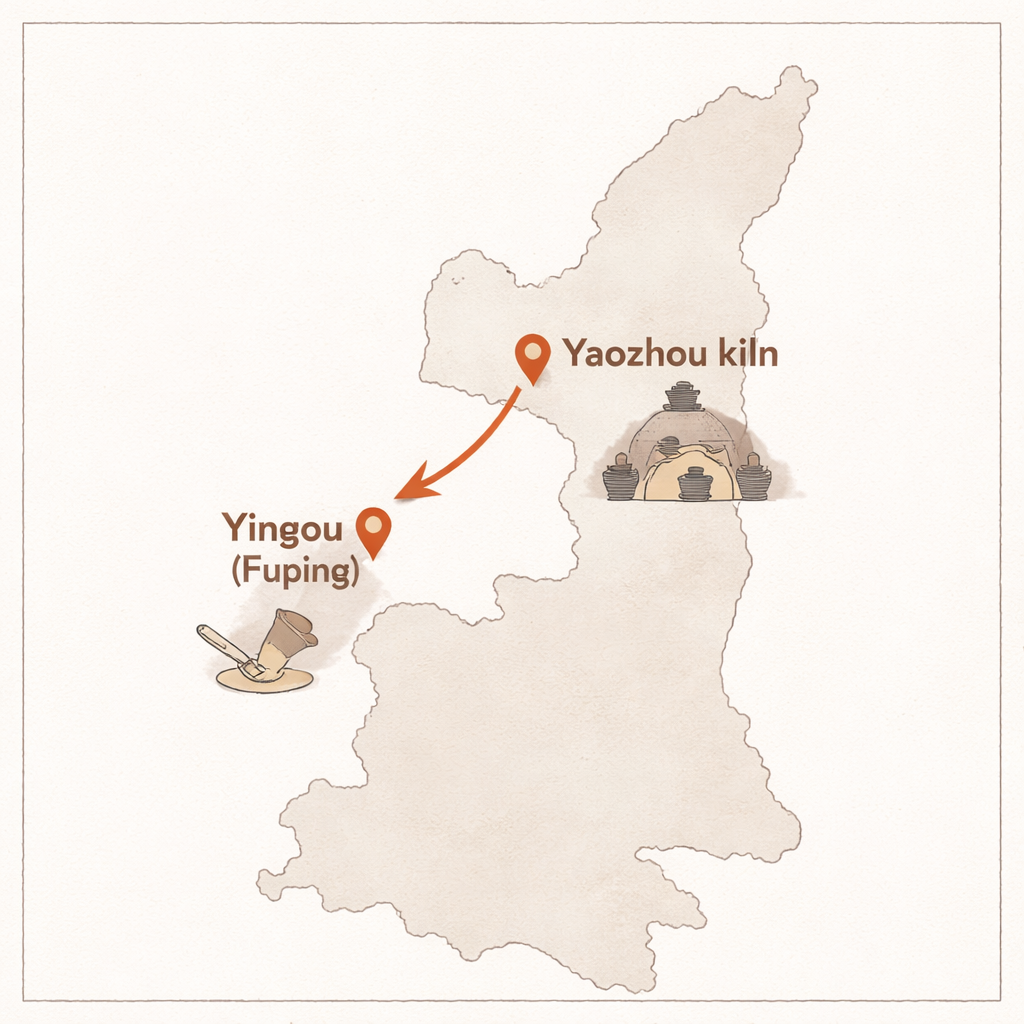
The Yingou site in Shaanxi Province is a large archaeological complex that includes kiln-like structures and many ceramic fragments from the Tang and Song periods. Among these finds are finely made black-glazed porcelains: thin, smooth, glossy, and sparsely decorated, matching the style of northern wares of the time. Because Yingou lies close to the famous Yaozhou kilns, scholars have long debated whether these black wares were produced locally at Yingou or imported from Yaozhou. Earlier work on other types of ceramics from the region hinted at strong links between the two areas but did not resolve the question for black porcelain, which is especially sensitive to local raw materials.
Reading the Chemistry of Clay and Glaze
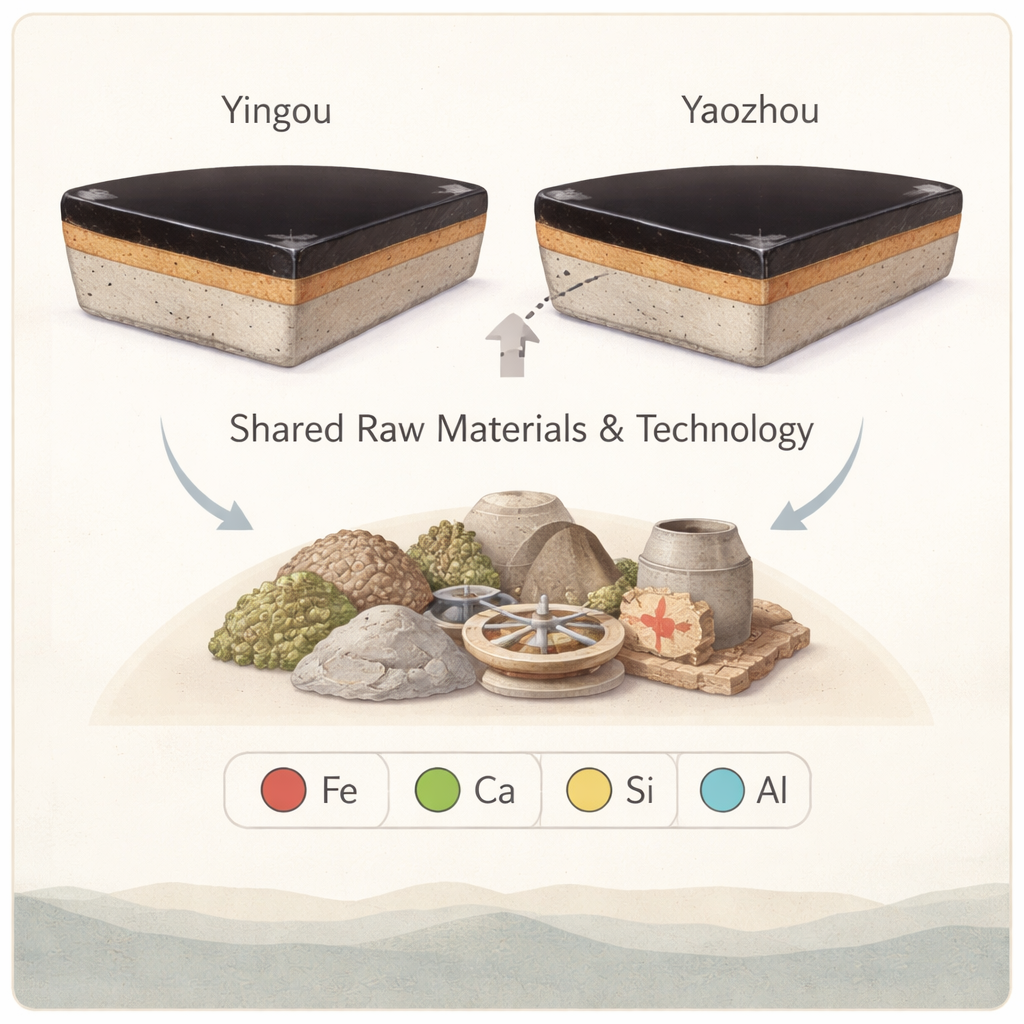
To tackle this puzzle, the team compared 15 black-glazed sherds from Yingou with eight authenticated Tang-dynasty black wares from Yaozhou. They measured the main chemical ingredients in the ceramic bodies and glazes using X-ray fluorescence and mass spectrometry, and then used statistical tools to see how the samples grouped. Both Yingou and Yaozhou bodies showed the same “high alumina, low silica” recipe typical of northern porcelain clays, and their iron and titanium contents fell in nearly identical ranges, explaining the similar gray body colors beneath the black glaze. When the researchers plotted the data, the two groups overlapped so strongly that no clear boundary appeared, suggesting they drew on very similar clay resources and followed closely related body recipes.
Invisible Signatures in Trace Elements and Rare Earths
The scientists then turned to more subtle chemical clues. They measured trace elements and rare earth elements, which behave like geological fingerprints that tend to survive firing and burial. Overall, Yingou and Yaozhou pieces shared closely matching patterns, with the same general shape of rare-earth curves and overlapping ranges for most trace elements. Yaozhou samples showed only slight enrichment in a few elements linked to accessory minerals, differences that fit naturally within the variability of a shared geological basin rather than pointing to completely separate sources. These results reinforce the idea that potters at both sites tapped into comparable clay deposits and raw-material systems, even if they did not always dig from precisely the same pit.
Peering Inside the Potsherds
Chemistry alone is not the whole story, so the team examined thin cross-sections of the sherds under microscopes and probed their internal structure using X-ray diffraction and Raman spectroscopy. Both Yingou and Yaozhou samples contained the same main minerals in their bodies—mullite, quartz, and cristobalite—signatures of high-temperature, well-controlled firing. Under magnification, each revealed a glossy black glaze with bubbles, a relatively coarse body, and a sharp boundary between them. Element maps showed similar bands rich in calcium where glaze and body meet. Raman measurements at this interface detected calcium aluminosilicate crystals such as anorthite, formed when lime from the glaze diffused into the clay during firing. These microscopic features point to a mature, shared firing technology rather than separate traditions.
What the Findings Mean for the Story of These Wares
Putting all of the evidence together, the study concludes that Yingou’s Tang-dynasty black-glazed porcelains are technologically and chemically consistent with those from the Yaozhou kiln system. In plain terms, the pieces from both places look as if they were made using the same kinds of clays, glazes, and firing know-how, likely grounded in a common geological resource base and a closely connected craft tradition. The data are not detailed enough to prove that every Yingou sherd was fired in a specific Yaozhou workshop, but they strongly support the idea that Yingou black porcelain belongs to the same broader production world. For non-specialists, this work shows how modern laboratory tools can help trace the life history of museum objects and deepen our understanding of how regional technologies and trade shaped everyday things more than a thousand years ago.
Citation: Ma, C., Luo, H., Wang, F. et al. Provenance study of Tang-dynasty black-glazed porcelains unearthed at the Yingou site. npj Herit. Sci. 14, 48 (2026). https://doi.org/10.1038/s40494-026-02321-0
Keywords: Tang dynasty porcelain, black-glazed ceramics, Yingou site, Yaozhou kiln, ceramic provenance