Clear Sky Science · en
Dynamic response prediction and safety assessment of suspended ancient wooden structures under tourist-induced pedestrian loads
Why old cliffside walkways still feel safe
High above the ground, some ancient temples in China are linked by wooden walkways that seem to float against sheer rock faces. These narrow paths now host modern tourist crowds, raising a simple but worrying question: can centuries‑old timber and stone safely handle today’s surges of visitors, especially when people walk in step and make the structure vibrate? This study looks closely at a famous suspended wooden boardwalk at Mount Heng to understand how it moves under crowd loads, and how many people it can safely and comfortably carry.
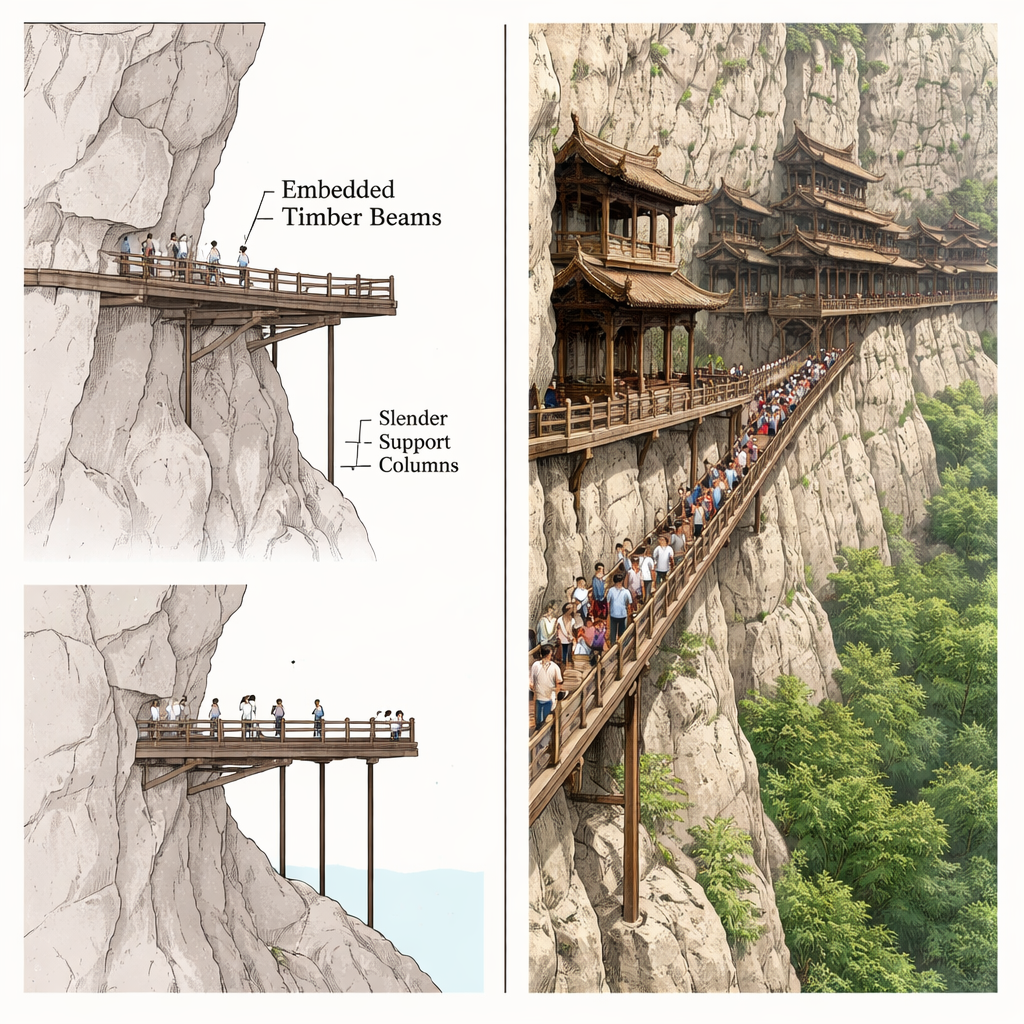
Cliff temples and their hanging walkways
The researchers focus on a “hanging” temple whose wooden galleries are anchored directly into the cliff. Each main beam is wedged into a hole in the rock at one end and cantilevers outward to support a deck and railings. Slender wooden columns stand under the outer edge but, in normal conditions, carry little weight. The passages are so narrow that people must walk in a single direction, and any bottleneck can quickly pack visitors together. This combination of flexible timber, semi‑rigid joints, and confined walkways makes the structure especially sensitive to the rhythmic forces of walking crowds.
Rebuilding the hidden structure in the computer
Because this is a protected heritage building, the team cannot simply overload it or cut it open. Instead, they scan the entire temple complex with a handheld 3D laser device to capture a detailed “point cloud” of every visible surface. From this, they digitally separate beams, columns, deck boards and railings, and then reconstruct missing parts—such as hidden mortise‑and‑tenon joints—based on traditional carpentry rules. All this information is fed into a building‑information model and then into a finite‑element program, which lets them calculate how the walkway bends and stresses under different patterns of pedestrian loading.
Testing how crowds really make it move
To see how the boardwalk behaves in practice, the authors study both slow, steady loading and fast, changing forces. For static tests, they simulate four crowd densities from sparse (1 person per square meter) to extreme (6 per square meter). Even at the highest density, stresses and deflections stay below code limits, but the columns prove surprisingly important: while they do not carry much direct beam stress, they cut mid‑span bending by nearly 18%, acting as a hidden safety reserve that keeps deformations under control. This challenges the idea that such columns are merely decorative and shows they quietly improve robustness when the deck is busy.
From random footsteps to crowd–structure feedback
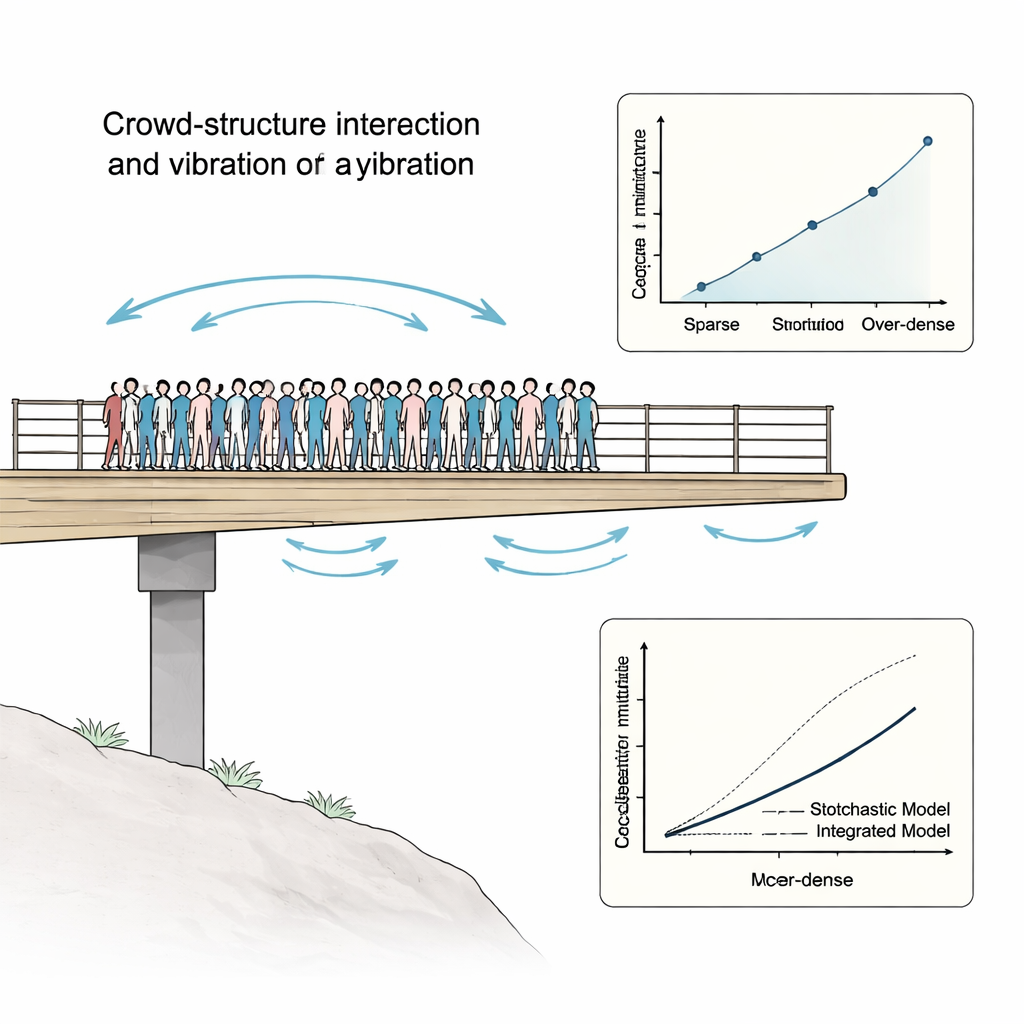
Walking people do not behave like simple repeating machines. Their step frequency, stride, and weight vary, and when space is tight they start to influence one another—and even react to the motion of the structure itself. The researchers therefore go beyond standard design rules that just add up many independent walkers. They build a stochastic crowd–structure interaction model that includes three key ingredients: step‑frequency synchronization among nearby people, spatial coherence of their footfalls along the deck, and weak feedback from the vibrating structure back to their gait. Using measured ranges of walking speed and step frequency, they run Monte Carlo simulations to see how vertical acceleration and displacement evolve as crowd density rises, and validate their predictions with on‑site vibration measurements under real tourist flows.
Comfort thresholds and safety warnings for visitors
The results show that as the boardwalk fills, vibration energy builds steadily, and responses cluster more strongly around the structure’s first natural frequency near 3.25 Hz. At low densities, classic random‑load models tend to over‑predict motion because they ignore human–structure feedback; the new integrated model matches field data much better. At high densities, both models converge as synchronized group behavior dominates. Using European comfort criteria, the authors find that vibrations feel “excellent” at about 1 person per square meter and remain “good” at 2. Around 3, accelerations approach the comfort limit, and by 4, visitors would clearly notice shaking and comfort would drop. A fitted prediction curve suggests that, beyond this density, peak deck deflections approach or exceed recommended comfort‑based limits, even if they are still structurally safe.
What this means for protecting cliff temples
For non‑experts, the takeaway is that these ancient cliffside walkways are not on the verge of collapse—but they are sensitive to how many people use them at once and how those people move. The study shows that modest‑looking columns offer an important safety buffer, and that refined computer models can turn noisy crowd behavior into clear guidelines. By linking crowd density to vibration and comfort thresholds, the authors provide practical tools for setting visitor caps, designing one‑way routes, and planning smart monitoring and early‑warning systems that keep both the heritage structures and their modern visitors safe.
Citation: Zhang, R., Hou, M., Liu, X. et al. Dynamic response prediction and safety assessment of suspended ancient wooden structures under tourist-induced pedestrian loads. npj Herit. Sci. 14, 53 (2026). https://doi.org/10.1038/s40494-026-02319-8
Keywords: heritage structures, crowd loading, timber walkways, vibration comfort, structural safety