Clear Sky Science · en
Determination of interfacial heat transfer coefficient between bronze and loess-based molds in Bronze Age China
Ancient metal secrets in the soil
For more than three thousand years, China’s Bronze Age craftsmen cast remarkably thin, intricate ritual vessels on a massive scale. This study asks a deceptively simple question with big implications: how did the humble local soil they shaped into molds control the flow of heat when glowing bronze met cool clay? By measuring this heat exchange for the first time, the authors open a new window onto how geography, materials, and physics together shaped one of the world’s great early technologies.
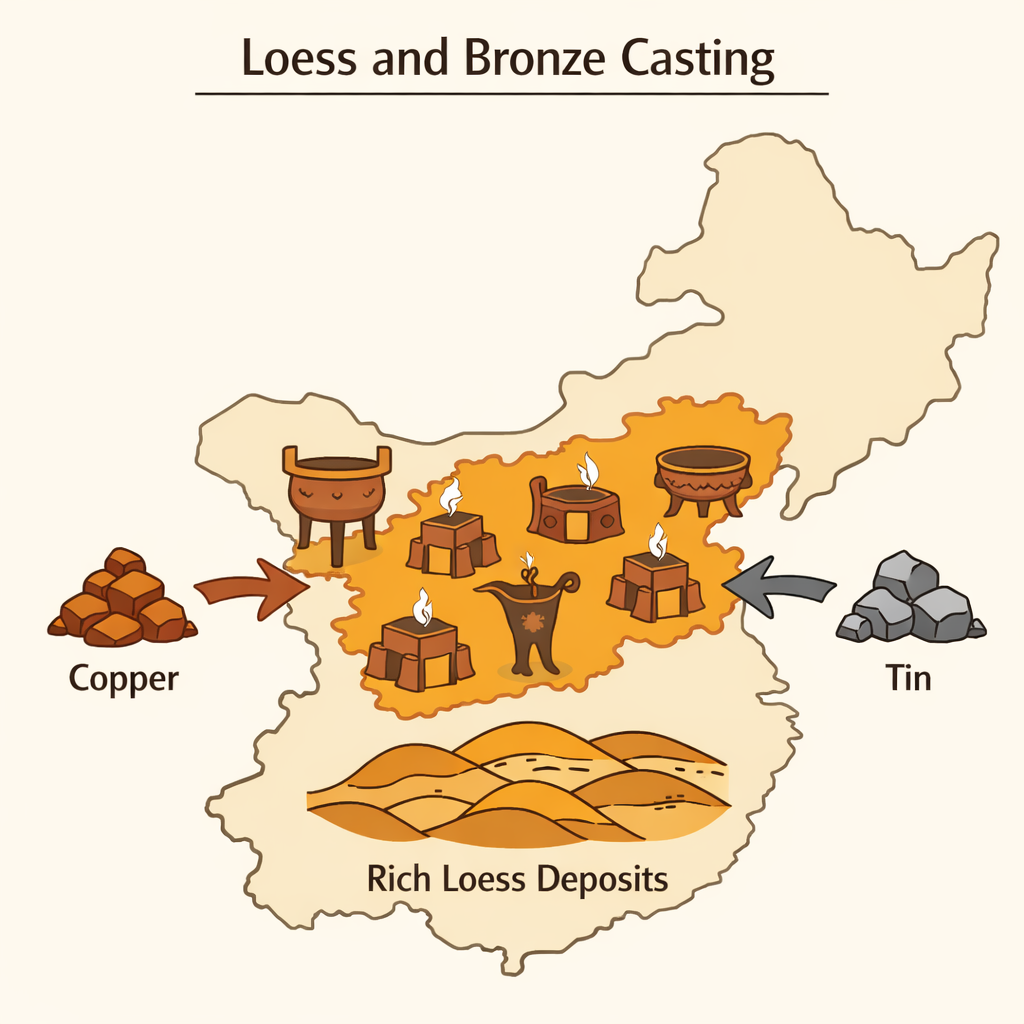
Why bronze workshops followed the yellow earth
Many Shang and Zhou dynasty foundries were not built next to copper mines, but instead clustered across the Loess Plateau, a vast blanket of fine, yellow wind-blown soil. Archaeologists had long noticed that these centers of bronze production overlapped regions rich in loess, a material that, when mixed and fired, made excellent clay molds. Earlier research measured properties such as density, grain size, and strength of excavated molds, but stopped short of explaining how these molds actually behaved during casting. The key missing piece was how efficiently heat crossed the boundary between molten bronze and the mold surface, a quantity engineers call the interfacial heat transfer coefficient.
Recreating a Bronze Age pour in the lab
To capture this hidden heat flow, the team studied clay molds and soil from the Western Zhou foundry at Zhouyuan in Shaanxi Province. They measured how well these ancient-inspired materials stored and conducted heat, then reproduced a simple flat bronze casting using local loess prepared with traditional techniques. The bronze alloy matched typical ancient recipes—mostly copper with about ten percent tin—and was poured at around 1100 degrees Celsius into a brick-like mold made of two thick clay plates. Thermocouples, thin temperature probes, were carefully embedded at known distances inside the mold and in the molten metal to track how temperatures changed second by second as the casting cooled and solidified.
Turning temperature curves into invisible heat flow
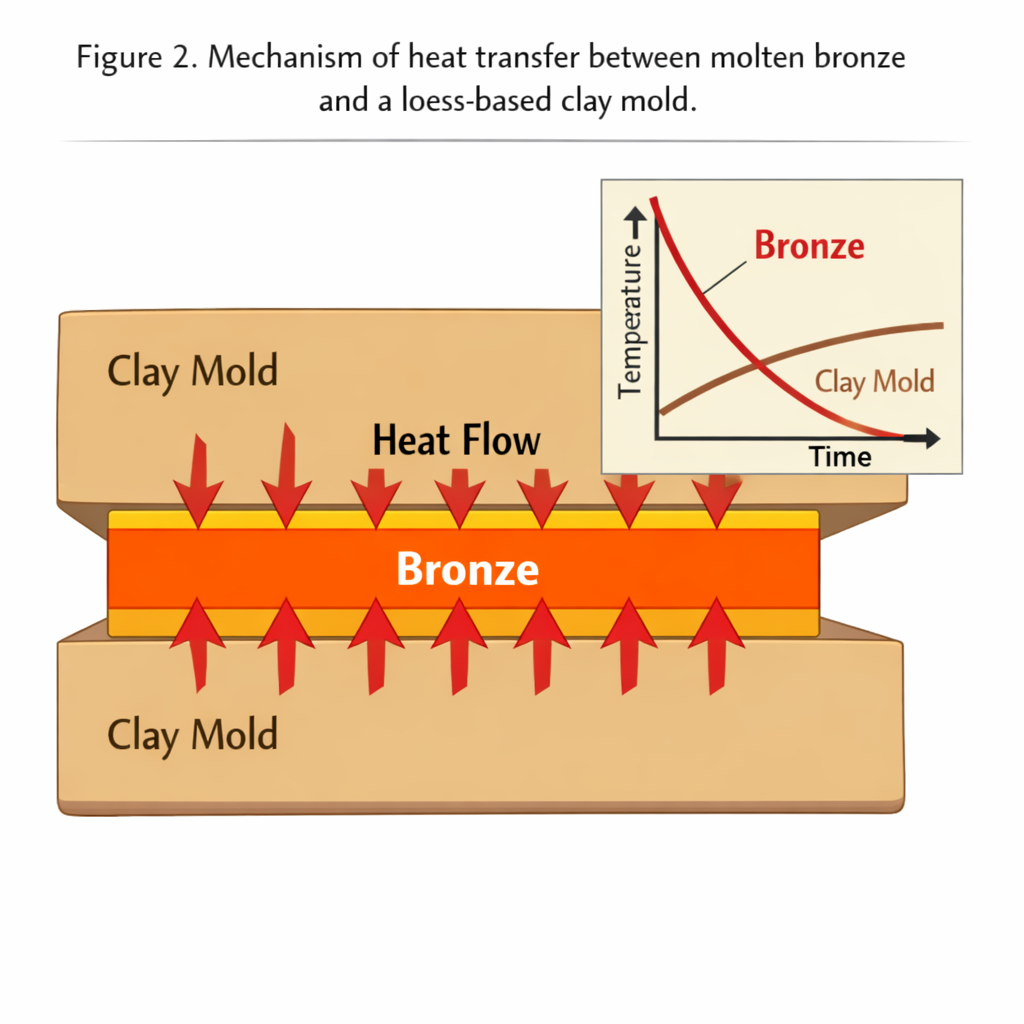
Directly measuring conditions exactly at the narrow contact strip between metal and mold is nearly impossible without destroying the experiment. Instead, the researchers used an indirect strategy borrowed from modern foundry engineering. They fed the recorded temperature histories into a computer model that simulated one-dimensional heat flow through the mold. Using an approach known as an inverse calculation, the program repeatedly adjusted the unknown heat flux at the interface until the simulated temperatures inside the mold matched the real measurements. From this reconstructed heat flux and the known temperature difference between bronze and mold, the team could finally compute how strongly heat was crossing the interface throughout the casting process.
What the loess molds were really doing
The results reveal that heat transfer at the interface was not a single fixed value but changed dramatically over time. Immediately after pouring, the hot liquid bronze dumped heat into the much cooler clay at a very high rate, corresponding to a relatively large interfacial heat transfer coefficient. As the metal cooled and began to solidify, it shrank away slightly from the mold walls, opening tiny gaps filled with air. Because air is a poor conductor, the effective heat transfer dropped quickly and then leveled off at a lower, nearly steady value once the casting was fully solid. Throughout the process, the mold itself warmed only modestly: its high capacity to absorb heat and low thermal conductivity acted like a built-in brake, slowing the flow of heat and smoothing temperature changes that might otherwise crack the mold.
What this means for history and technology
By putting precise numbers on how ancient loess-based molds drew heat from molten bronze, this work transforms vague descriptions of “good casting soil” into testable physical data. These values can now be plugged into casting simulations to explore how mold recipes, vessel thickness, or pouring temperature affected whether a complex object filled properly or cooled without flaws. Because high-quality ritual bronzes from different Chinese regions share similar alloys and relied on comparable loess resources, the findings may help explain why Bronze Age capitals clustered where they did and how artisans tuned their methods across time and space. In short, the study shows that the quiet physics at the bronze–clay boundary helped shape both the beauty of ancient vessels and the broader patterns of Chinese history.
Citation: Yang, H., Fang, M., Eckfeld, T. et al. Determination of interfacial heat transfer coefficient between bronze and loess-based molds in Bronze Age China. npj Herit. Sci. 14, 49 (2026). https://doi.org/10.1038/s40494-026-02318-9
Keywords: ancient bronze casting, loess clay molds, heat transfer, archaeometallurgy, Chinese Bronze Age